What does margin mean in Forex?
Margin in Forex trading is the minimum capital a trader must deposit to open and maintain a leveraged currency position. It represents a portion of account equity that the broker sets aside as a good-faith deposit while the trade remains active, serving as collateral against potential losses rather than a fee or transaction cost.
How does margin work in Forex?
Margin in Forex works by requiring you to deposit a fraction of a position’s total value while the broker provides the remaining exposure through leverage.
Brokers monitor equity against used margin and calculate margin level as (equity ÷ used margin) × 100. The broker issues a margin call or closes positions if equity falls too low.
Example of margin in Forex trading
Assume you open a EUR/USD position worth USD 100,000 (1 standard lot) with a 2% margin requirement.
Margin required = USD 100,000 × 2% = USD 2,000
If your account balance is USD 5,000, the broker reserves USD 2,000 as used margin. The remaining USD 3,000 stays as free margin and absorbs unrealized losses or supports additional positions.
This allows traders to control larger currency positions with limited capital, managed through margin and equity monitoring.
How do I calculate margins for a Forex trade?
You calculate margin for a Forex trade by multiplying the total position value by the broker’s margin requirement percentage. There are 3 steps to calculate margin.
Determine the position size
Identify the margin requirement
Apply the formula
1. Determine the position size
Identify the total notional value of the trade. For example, 1 standard lot in EUR/USD equals 100,000 units of the base currency.
2. Identify the margin requirement
Brokers express margin as a percentage, such as 1%, 2%, or 3.33%.
3. Apply the formula
Margin required = Position value × Margin requirement
Most trading platforms automatically calculate required margin when opening a trade, display it in the margin calculator, and update it in real time until closing the position.
How does leverage affect margin in Forex?
Leverage affects margin in Forex by determining how much capital a trader must deposit to open a position. Higher leverage reduces the margin required, while lower leverage increases the margin required for the same trade size.
Brokers calculate margin requirements using the inverse of leverage:
Margin requirement = 1 ÷ Leverage
For example:
A USD 100,000 position requires USD 2,000 in margin at 50:1 leverage, and USD 1,000 at 100:1 leverage.
Higher leverage allows traders to control larger Forex positions with less capital, but it also increases market exposure because losses affect account equity more quickly.
What are margin levels in Forex?
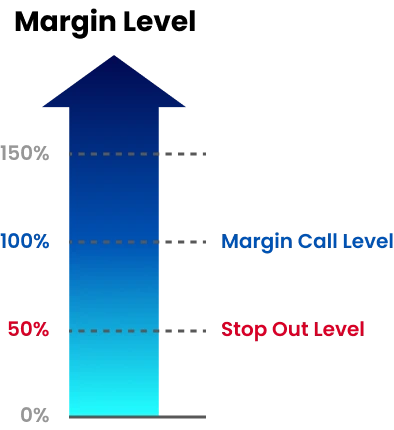
Margin levels in Forex are a risk metric that measures the relationship between a trader's account equity and the used margin committed to open positions. Brokers express margin level as a percentage, calculated as:
Margin level = (Equity ÷ Used margin) × 100
A higher margin level means the account holds more equity relative to used margin, which preserves free margin and reduces the risk of a margin call. A lower margin level indicates declining equity and may trigger a margin call or forced position closure.
What are used margins?
Used margin in Forex is the portion of a trader’s account equity currently committed to maintain open positions. These funds cannot be used to open new positions until those trades are closed.
Assume you have a USD 5,000 account and open a USD 100,000 EUR/USD position with a 2% margin requirement. The broker reserves USD 2,000 as used margin for the duration of that trade.
What are free margins?
Free margin in Forex is the account equity not reserved for open positions. It is available to open new trades or absorb losses from existing positions. Free margin is calculated as:
Free Margin = Equity − Used Margin
In the example above, your free margin is USD 3,000 (USD 5,000 − USD 2,000). This amount absorbs any unrealized losses on the open position and supports any additional trades you want to open.
What is a margin call?
A margin call in Forex is a broker notification that a trader’s account equity has fallen too low relative to the margin required for open positions.
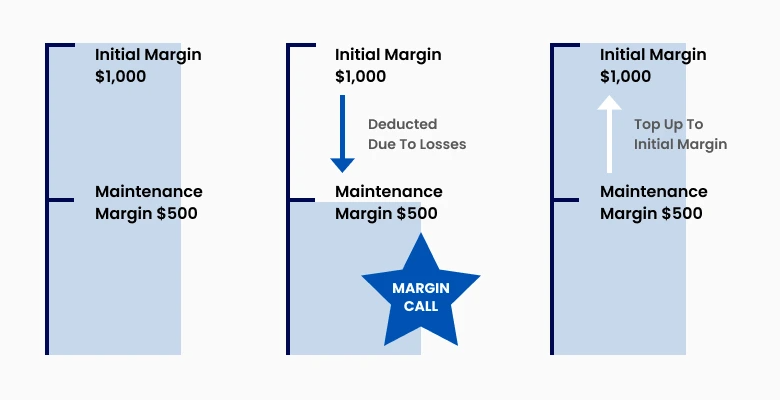
If the EUR/USD trade moves against you and losses reduce your equity from USD 5,000 to USD 2,000, your margin level falls to 100% and free margin reaches zero. The broker issues a margin call at this point.
On a margin call, the trader must deposit additional funds or close positions to restore the required margin level. The broker automatically closes open trades to prevent further losses if the trader does not act.
What are Forex margin requirements?
Forex margin requirements are the minimum amount of capital a trader must deposit to open and maintain a leveraged currency position. Brokers set margin requirements as a percentage of the total trade value.
For example, a 2% margin requirement means a trader must deposit USD 2,000 to control a USD 100,000 Forex position. For major currency pairs such as EUR/USD, USD/CAD, and USD/JPY, margin requirements typically range from 2% to 5% of the notional position value.
Margin requirements vary depending on the broker, regulatory limits, and the leverage offered for specific currency pairs. The FCA limits leverage on CFDs to between 2:1 and 30:1 depending on asset volatility, and requires brokers to close positions when trading capital falls to 50% of the margin needed to maintain them.
What are the benefits of margin in Forex?
The 4 benefits of margin in Forex include:
Access to larger market positions
Efficient use of trading capital
Greater market participation
Ability to diversify across positions
1. Access to larger market positions
Margin allows traders to control positions larger than their account balance by using leverage. This allows greater position control without committing the full trade value upfront.
2. Efficient use of trading capital
Margin requires only a small percentage of the total position value. Traders can allocate remaining funds to additional trades, risk management, or reserve capital to absorb losses.
3. Greater market participation
Margin lowers the capital barrier to enter the Forex market. Traders can access major currency pairs and execute meaningful trade sizes without depositing the full notional value of the position. A 2024 study of US margin Forex traders found that 38% cited low capital entry as a primary reason for starting Forex trading.
4. Ability to diversify across positions
Margin allows traders to spread available capital across multiple currency pairs simultaneously. This reduces dependence on a single trade and distributes market exposure across different positions.
What are the risks of margin in Forex?
The 4 risks of margin in Forex include:
Amplified losses
Margin calls
Forced position liquidation
Rapid capital depletion
1. Amplified losses
Margin magnifies losses in the same way it magnifies gains. A small adverse price movement can generate losses that are large relative to the margin used.
2. Margin calls
Losses can reduce account equity and trigger a margin call when the margin level falls below the broker’s required threshold. Traders may need to deposit additional funds or close positions to restore the margin level.
3. Forced position liquidation
The broker may automatically close open positions if equity continues to decline after a margin call, preventing the account balance from going negative. At a 50% stop-out level, the broker begins closing open positions starting with those incurring the largest losses once the margin level reaches that threshold.
4. Rapid capital depletion
Leveraged exposure increases the speed at which losses accumulate. High volatility or large position sizes can quickly reduce account equity and deplete trading capital. ESMA reports that 74% to 89% of retail accounts lose money trading leveraged CFDs, including Forex products. NFA and ESMA data show that only 25% to 30% of retail trading accounts are profitable in any given quarter, and the percentage of traders earning a full-time income from trading is estimated at 1% to 3%.
How do I manage risks with margin in Forex?
There are 5 ways to manage risks when trading Forex with margin because leverage increases exposure to market losses.
Practice using demo Forex accounts
Set stop-loss orders
Use take-profit orders
Monitor margin levels
Avoid over-leveraging
1. Practice using demo Forex accounts
Use demo accounts to test trading strategies without risking real capital. This helps traders understand how leverage and price movements affect account equity.
2. Set stop-loss orders
Stop-loss orders automatically close a position at a predefined loss level, limiting downside risk.
3. Use take-profit orders
Take-profit orders automatically close a position once a target price is reached. This locks in gains and reduces the need to monitor positions continuously.
4. Monitor margin levels
Track margin levels regularly to maintain sufficient equity relative to used margin and avoid margin calls.
5. Avoid over-leveraging
Limit leverage by using smaller position sizes relative to account capital. Lower leverage slows the rate at which losses reduce account equity. Most professional traders use leverage of up to 5:1 or none at all, and risk no more than 2% of account capital per trade.
A clear margin strategy defines position sizing, leverage limits, stop-loss placement, and acceptable margin levels before entering a trade. Risk management guidelines recommend risking 1–2% of account equity per trade, keeping total margin usage below 30–40% of account equity, and maintaining margin levels above 200% to preserve a buffer during volatility.