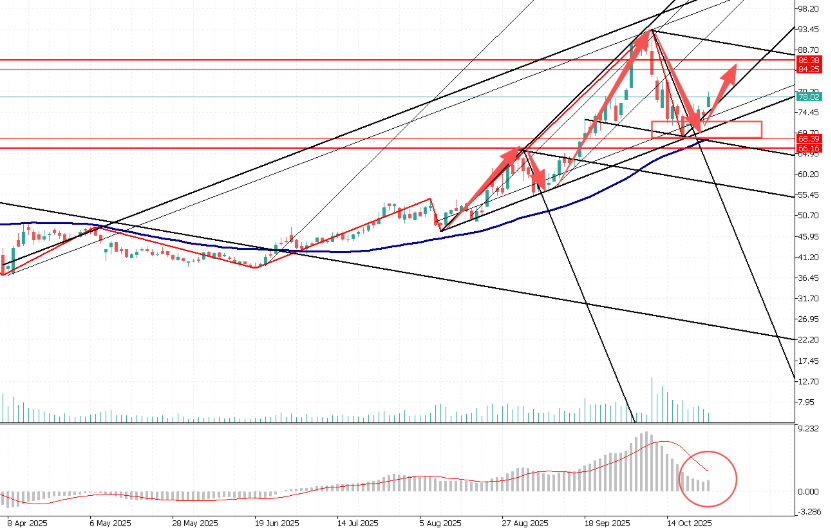
AI Chip Shortage Widens; SMIC Surges as Its Domestic-Substitution Edge Emerges
Amid the rapid reshaping of the global semiconductor landscape, Semiconductor Manufacturing International Corporation (SMIC) is at a critical juncture. The latest analyses in October note that the Chinese government is vigorously promoting “chip self-sufficiency and control,” creating policy dividends and market opportunities for domestic foundries. In this context, SMIC—the largest wafer foundry in mainland China—plays a dual role as both a market competitor and a pillar of national strategy.
Market and Demand
With demand rising in parallel for artificial intelligence (AI) applications, 5G/6G communications, automotive electronics, and smart manufacturing, China’s domestic need for chips—especially GPUs, AI accelerators, and power devices—is growing rapidly. The Chinese foundry ecosystem in which SMIC operates is expected to expand over the next two years thanks to this demand. In addition, export restrictions on semiconductor equipment and technology imposed on China by the United States and its allies have, paradoxically, pushed domestic customers to favor local supply chains, thereby enhancing SMIC’s pricing power and shipment potential in the home market.
Technological Breakthroughs and Process Capabilities
In advanced process nodes, SMIC still trails the world’s leading foundries (such as TSMC and Samsung), but it has demonstrated a degree of innovation under “constrained technology conditions.” SMIC is using deep ultraviolet (DUV) lithography and multi-patterning to advance R&D at the 7 nm and sub-7 nm nodes. For example, there have been reports that it has trial-produced “5 nm-class” chips, although costs and yields have yet to fully match global leaders. In addition, SMIC is testing an immersion DUV lithography tool developed by a domestic company in an effort to reduce reliance on imported equipment. While mass production with this equipment is still some years away, the technical direction is drawing close market attention.
Competitiveness and Profitability
SMIC’s competitive strengths lie mainly in its deep cultivation of the Chinese market, close relationships with domestic customers, strong policy support, and a utilization rate that has remained high in recent years. Previous reports indicate its revenue grew about 23.4% year-on-year in the first half of 2025. That said, gross margin and net profit remain under pressure: heavy capital expenditures, equipment outlays, process migrations, and yield challenges all weigh on profitability. On the competitive front, although China aims to build a homegrown foundry ecosystem, global foundry giants and packaging/materials/equipment suppliers remain in the lead. SMIC continues to face strong competitive pressure in advanced nodes, equipment availability, and yield management.
Outlook
SMIC’s development path can be viewed from several angles. First, as AI applications scale and AI chip shipments increase, capacity at SMIC’s mature and advanced nodes should benefit. Second, under the national strategy of semiconductor self-reliance, ongoing policy and funding support will provide a favorable backdrop for SMIC’s expansion. Third, in terms of capacity build-out, its 7 nm and below capacity is expected to increase significantly over the next few years. Caution is warranted, however: if yields fail to improve quickly, if equipment constraints do not meaningfully ease, or if global electronics demand weakens, the pace of profit recovery could slow. Furthermore, international geopolitical risks and uncertainties around trade sanctions remain potential swing factors.
Conclusion
SMIC is in a phase of “structural opportunity + transformation challenge.” It enjoys advantages in the domestic market, policy support, and solid demand, but still needs breakthroughs in process technology, yield improvement, and profitability. For investors and industry observers, key watch points include: the actual capacity inflection, yield progress at 7 nm and below, the magnitude of gross-margin improvement, and whether constraints in equipment and talent are easing. If these indicators improve in tandem, SMIC is poised to become a standard-bearer in China’s semiconductor rise; otherwise, it risks falling into a “high investment, low return” trap.