

Australian Dollar wins the data and still cannot rally
- AUD/USD finished another soft session, holding just above its 200-day average despite a strong domestic jobs report.
- A large May employment beat and a lower unemployment rate keep the RBA's August meeting live, but US data is setting the tone on the pair.
- Chinese factory surveys, RBA minutes, and US payrolls next week are the catalysts most likely to decide the next break.
The Australian Dollar spent Thursday doing the one thing it was not supposed to do after a strong labour report, which is nothing. May employment rose by 40.3K against expectations near 25K, a swing of more than 80K from the prior month's contraction, and the unemployment rate slipped to 4.4% from 4.5%. That is a clean hawkish print for the Reserve Bank of Australia (RBA), the kind of data that keeps a live August meeting on the table and should reward the currency. Instead the Aussie sat pinned to its 200-day Exponential Moving Average (EMA) near 0.6900, unable to turn a positive yield gap into more than a brief, fading bounce.

The US side is doing the work
The explanation sits across the Pacific. US data on Thursday was firm where it counted: the third estimate of first-quarter Gross Domestic Product (GDP) was revised up to 2.1% from 1.6%, initial jobless claims fell to 215K against a 225K consensus, and personal income and spending both rose 0.7%. Core Personal Consumption Expenditures (PCE), the inflation gauge the Federal Reserve (Fed) watches most closely, held at 3.4% YoY while the headline rate ticked up to 4.1%. None of that argues for the cuts the market has already abandoned for 2026, and it keeps the October hike the Fed's dot plot now flags very much alive.
The awkward part is that none of this should be happening to the higher-yielder. At 4.35% the RBA's cash rate sits well above the Fed's 3.50% to 3.75% band, so the Aussie carries a clear rate advantage over the US Dollar. Yet yield is not what is trading here. The Aussie is a China and risk proxy first, and with Chinese activity soft and the US Dollar broadly bid, a jobs beat and a positive rate gap are not enough to overpower the bigger flow. The market wanted a reason to buy the Aussie, got one, and sold the bounce anyway.
Sitting on the line that matters
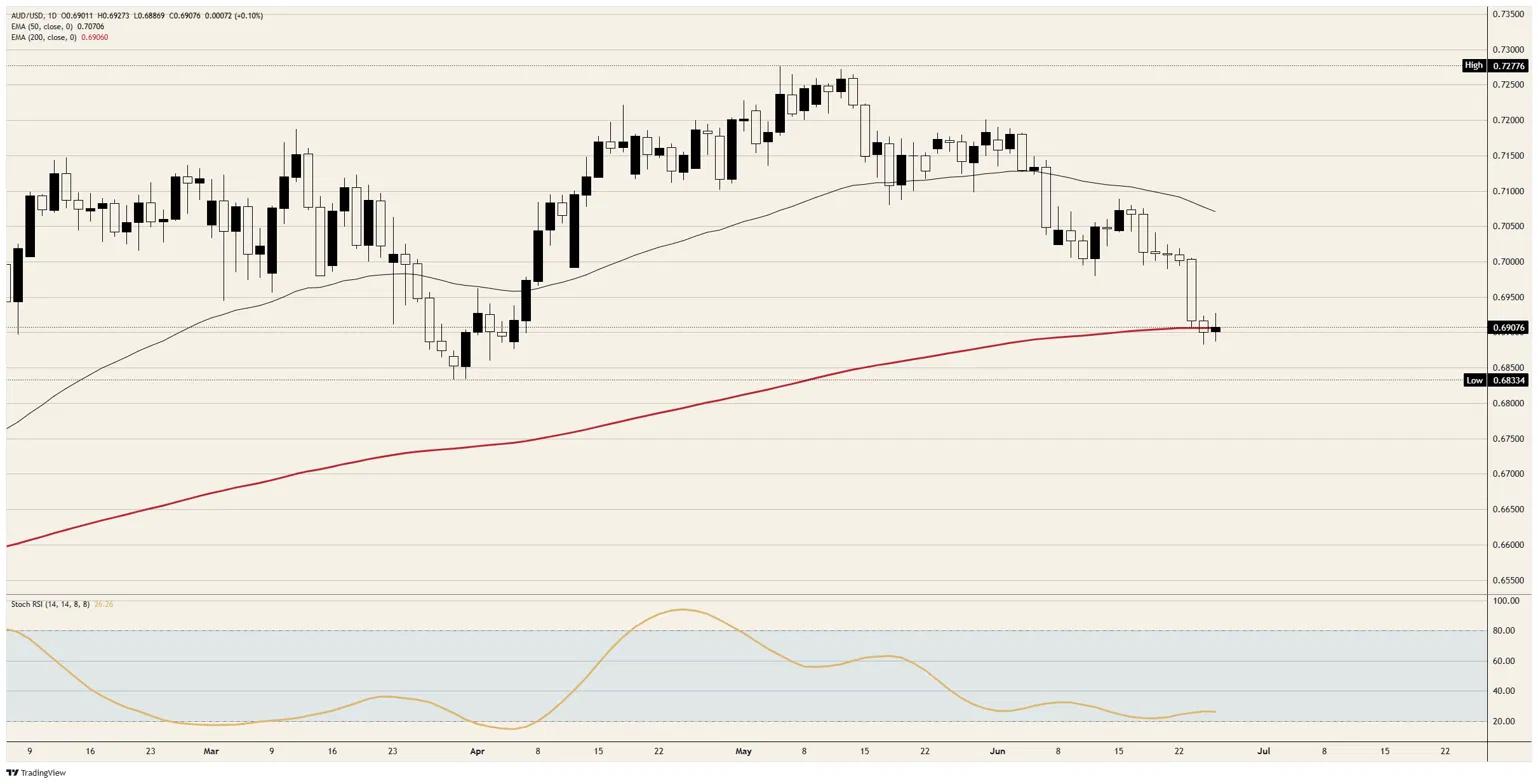
Price action has compressed the whole debate into a single level. The 200-day EMA near 0.6900 is the floor the Aussie has leaned on through this slide from the June highs around 0.7150, and Thursday's close sat almost exactly on it. The daily Stochastic Relative Strength Index (Stoch RSI) near 26 shows momentum stretched to the downside without being exhausted, consistent with a grind lower rather than a snap-back. On the topside, Thursday's high near 0.6950 is the first hurdle, then the 0.7000 handle, with the 50-day EMA near 0.7050 capping the broader range.
The week ahead is stacked
The calendar gives this pair no quiet run into month-end. An RBA Governor address on Sunday and the RBA minutes on Tuesday will be read for how seriously the board is weighing an August hike after a print this strong. The bigger swing factor, though, is Chinese: the official factory and services gauges on Tuesday and the private RatingDog manufacturing read on Wednesday will tell the commodity bid more than anything out of Canberra. From the US, Nonfarm Payrolls (NFP) on Thursday, pulled forward around the Independence Day holiday, is the marquee event, with the Institute for Supply Management (ISM) manufacturing survey on Wednesday as the warm-up.
Levels to watch
Resistance: The first cap is Thursday's high near 0.6950, then the 0.7000 handle and the 50-day EMA close to 0.7050. A daily close back above 0.6950 would suggest the slide is pausing rather than resting.
Support: The 200-day EMA near 0.6900 is the whole game. A clean daily close below it opens the April lows around 0.6850, with 0.6800 the next defined level beneath.
Bias: Bearish while the pair trades below 0.6950 and leans on the 200-day line. The strong jobs print and positive yield gap argue for a floor, not a rally, and with the US Dollar bid and Chinese data soft the path of least resistance points lower. Only a daily close above 0.7000 flips the near-term read.
AUD/USD daily chart
Australian Dollar FAQs
One of the most significant factors for the Australian Dollar (AUD) is the level of interest rates set by the Reserve Bank of Australia (RBA). Because Australia is a resource-rich country another key driver is the price of its biggest export, Iron Ore. The health of the Chinese economy, its largest trading partner, is a factor, as well as inflation in Australia, its growth rate and Trade Balance. Market sentiment – whether investors are taking on more risky assets (risk-on) or seeking safe-havens (risk-off) – is also a factor, with risk-on positive for AUD.
The Reserve Bank of Australia (RBA) influences the Australian Dollar (AUD) by setting the level of interest rates that Australian banks can lend to each other. This influences the level of interest rates in the economy as a whole. The main goal of the RBA is to maintain a stable inflation rate of 2-3% by adjusting interest rates up or down. Relatively high interest rates compared to other major central banks support the AUD, and the opposite for relatively low. The RBA can also use quantitative easing and tightening to influence credit conditions, with the former AUD-negative and the latter AUD-positive.
China is Australia’s largest trading partner so the health of the Chinese economy is a major influence on the value of the Australian Dollar (AUD). When the Chinese economy is doing well it purchases more raw materials, goods and services from Australia, lifting demand for the AUD, and pushing up its value. The opposite is the case when the Chinese economy is not growing as fast as expected. Positive or negative surprises in Chinese growth data, therefore, often have a direct impact on the Australian Dollar and its pairs.
Iron Ore is Australia’s largest export, accounting for $118 billion a year according to data from 2021, with China as its primary destination. The price of Iron Ore, therefore, can be a driver of the Australian Dollar. Generally, if the price of Iron Ore rises, AUD also goes up, as aggregate demand for the currency increases. The opposite is the case if the price of Iron Ore falls. Higher Iron Ore prices also tend to result in a greater likelihood of a positive Trade Balance for Australia, which is also positive of the AUD.
The Trade Balance, which is the difference between what a country earns from its exports versus what it pays for its imports, is another factor that can influence the value of the Australian Dollar. If Australia produces highly sought after exports, then its currency will gain in value purely from the surplus demand created from foreign buyers seeking to purchase its exports versus what it spends to purchase imports. Therefore, a positive net Trade Balance strengthens the AUD, with the opposite effect if the Trade Balance is negative.













