

Gold hits four-week low as firmer US Dollar, Oil-driven inflation weigh
- Gold drops to a four-week low as stalled US-Iran talks keep the US Dollar supported amid lingering uncertainty.
- Hormuz supply disruption keeps Oil prices elevated, fueling inflation risks and reinforcing a “higher-for-longer” rate outlook.
- Technically, XAU/USD remains capped below the 100-day and 50-day SMAs, with momentum indicators signaling growing bearish pressure.
Gold (XAU/USD) slips to a near one-month low, pressured by a firmer US Dollar (USD) and mounting Oil-driven inflation concerns, as investors await clearer signals on stalled diplomatic efforts between the United States (US) and Iran to end the war. At the time of writing, XAU/USD is trading around $4,571, down roughly 2.37% on the day.

This Tuesday marks two months since the US and Israel launched attacks on Iran. While a ceasefire appears to be holding, there has been no meaningful progress toward a second round of peace talks. The United States is reviewing Iran’s latest proposal. Still, early signals suggest that US President Donald Trump and his national security team remain skeptical of Tehran’s offer, which leaves nuclear negotiations for a later stage.
With no near-term resolution in sight, risk sentiment remains fragile, keeping the US Dollar supported. A stronger Greenback reduces demand for bullion as it becomes more expensive in other currencies. The US Dollar Index (DXY), which tracks the Greenback’s value against a basket of six major currencies, is trading around 98.74, erasing the previous day’s losses and up 0.25% on the day.
At the same time, Oil prices continue to rise as supply through the Strait of Hormuz remains largely disrupted due to a dual blockade, fueling inflation risks. This, in turn, adds further pressure on the non-yielding metal, as markets expect central banks, particularly the Federal Reserve (Fed), to keep borrowing costs higher for longer and may even consider raising rates if inflation pressures persist.
Higher interest rates increase the opportunity cost of holding Gold, as the metal does not offer any yield. Traders now look ahead to the upcoming Fed monetary policy decision due on Wednesday, where a hold is fully priced in, according to the CME FedWatch tool. The focus will be on forward guidance, which is likely to determine the next directional move in Gold, as a hawkish stance is expected to keep prices under pressure.
Looking ahead, investors will continue to monitor US-Iran developments while keeping an eye on US economic data, including the ADP Employment Change 4-week average and the Conference Board’s Consumer Confidence Index for April.
Technical analysis: XAU/USD trades below key SMAs as downside momentum builds
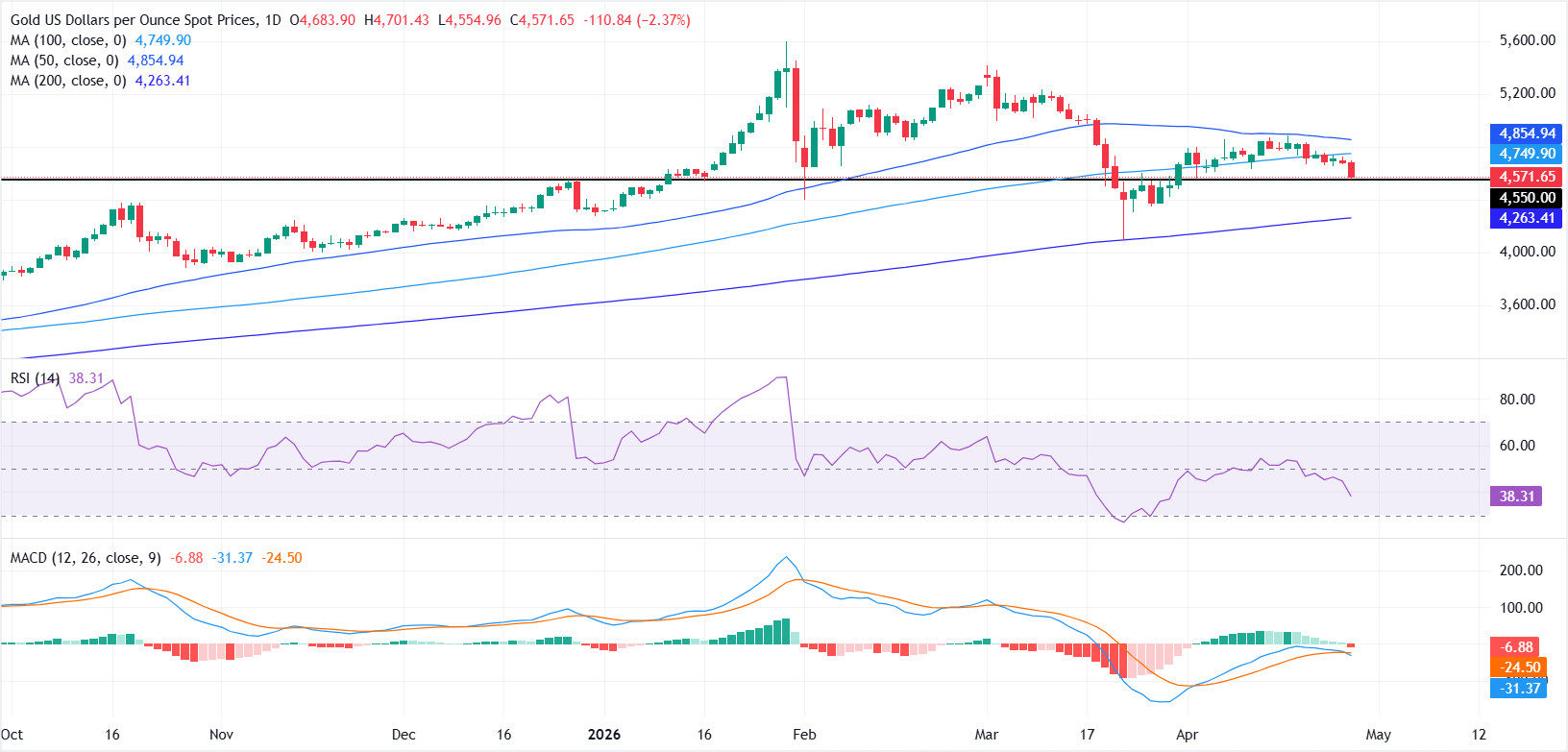
On the daily chart, XAU/USD remains capped below the 100-day Simple Moving Average (SMA) and the 50-day SMA, keeping the near-term bias bearish. The Relative Strength Index (RSI) around 39 holds below the midline, while a negative Moving Average Convergence Divergence (MACD) reading points to building downside momentum, suggesting sellers remain in control.
On the topside, initial resistance is seen at the 100-day SMA around $4,749, with a subsequent barrier at the 50-day SMA near $4,854, and bulls would need a daily close above this cluster to reassert a stronger uptrend. On the downside, immediate support comes from the nearby horizontal level at $4,550, while a deeper slide would expose the 200-day SMA around $4,263, where longer-term buyers could attempt to defend the broader bullish structure.
(The technical analysis of this story was written with the help of an AI tool.)
Inflation FAQs
Inflation measures the rise in the price of a representative basket of goods and services. Headline inflation is usually expressed as a percentage change on a month-on-month (MoM) and year-on-year (YoY) basis. Core inflation excludes more volatile elements such as food and fuel which can fluctuate because of geopolitical and seasonal factors. Core inflation is the figure economists focus on and is the level targeted by central banks, which are mandated to keep inflation at a manageable level, usually around 2%.
The Consumer Price Index (CPI) measures the change in prices of a basket of goods and services over a period of time. It is usually expressed as a percentage change on a month-on-month (MoM) and year-on-year (YoY) basis. Core CPI is the figure targeted by central banks as it excludes volatile food and fuel inputs. When Core CPI rises above 2% it usually results in higher interest rates and vice versa when it falls below 2%. Since higher interest rates are positive for a currency, higher inflation usually results in a stronger currency. The opposite is true when inflation falls.
Although it may seem counter-intuitive, high inflation in a country pushes up the value of its currency and vice versa for lower inflation. This is because the central bank will normally raise interest rates to combat the higher inflation, which attract more global capital inflows from investors looking for a lucrative place to park their money.
Formerly, Gold was the asset investors turned to in times of high inflation because it preserved its value, and whilst investors will often still buy Gold for its safe-haven properties in times of extreme market turmoil, this is not the case most of the time. This is because when inflation is high, central banks will put up interest rates to combat it. Higher interest rates are negative for Gold because they increase the opportunity-cost of holding Gold vis-a-vis an interest-bearing asset or placing the money in a cash deposit account. On the flipside, lower inflation tends to be positive for Gold as it brings interest rates down, making the bright metal a more viable investment alternative.














