

Indian Rupee remains weak amid concerns over India’s forex reserves
- The Indian Rupee trades near its lifetime low against the US Dollar due to multiple headwinds.
- Firm oil price outlook and growing concerns over India’s forex reserves are hurting the Indian Rupee.
- Improving US-China trade relations and pared dovish Fed bets are supporting the US Dollar.
The Indian Rupee (INR) trades close to its all-time low against the US Dollar (USD) in the opening trade on Friday. The USD/INR pair rises to near 95.95 as the Indian Rupee faces intense selling pressure due to growing concerns over India’s foreign exchange reserves, following the centre’s decision to hike import duty on Gold and Silver.

Indian government raises import tariffs on Gold and Silver
On early Wednesday, the Indian government announced import tariffs on Gold and Silver to 15% from 6%. The move was aimed at discouraging the general public from purchasing precious metals to ease pressure on the nation’s foreign exchange (forex) reserves. This weekend, Indian Prime Minister (PM) Narendra Modi urged citizens to postpone their non-essential gold purchases for a year.
According to a report from the Economic Times (ET), the precious metal accounts for over 9% of the country's total imports. India's imports in 2025-26 was USD 775 billion.
However, it appears that the decision has sentimentally impacted investors, raising concerns over the sufficient availability of forex reserves by the Indian government to pay for imported items.
Centre hikes energy prices by 3%
Earlier in the day, the Indian government announced an increase in prices of petrol and diesel by Rs. 3 per litre, in an attempt to partly offset the impact of a significant increase in crude oil prices. So far this year, the WTI Oil price has increased almost 70% to $98, and is expected to remain elevated as the Strait of Hormuz, a critical passage to almost 20% of global energy supply, remains closed amid conflicts between Iran and the United States (US).
Higher oil prices have hit the Indian Rupee badly in the past few months. Currencies from economies, such as India, which rely heavily on oil imports to meet their energy needs, tend to underperform in a high oil price environment.
FIIs increased investment in Indian stock market by little on Thursday
Foreign Institutional investors (FIIs) turned out to be net buyers in the Indian stock market on Thursday after remaining net sellers in the previous seven trading days. However, the investment deployed was Rs. 187.46 crore, significantly lower than the seven-day average selling of Rs. 4,144.01 crore.
A marginal improvement in sentiment of foreign investors toward the Indian equity market appears to be the expectations that the Indian government and the Reserve Bank of India (RBI) are considering various measures to improve the inflow of foreign capital flows. According to a report from the Indian Express, the Centre and the Reserve Bank of India are now weighing a fresh set of measures to attract foreign capital inflows, including a possible cut in the withholding tax on government bonds, which is 20% at present.
Multiple tailwinds strengthening US Dollar is also supporting USD/INR
The US Dollar outperforms its major currency peers, with the US Dollar Index (DXY) revisiting over two-week high of 99.10, is also strengthening the USD/INR pair. The Greenback trades firmly, following signs of improving trade relations between the US and China after the President Donald Trump-Leader Xi Jinping meeting.
In addition to improving US-China trade relations, firm expectations that the Federal Reserve (Fed) will hold interest rates steady at their current levels or raise them this year to curtail elevated price pressures are also offering strength to the US Dollar.
Technical Analysis: USD/INR remains close to its all-time high of 95.90
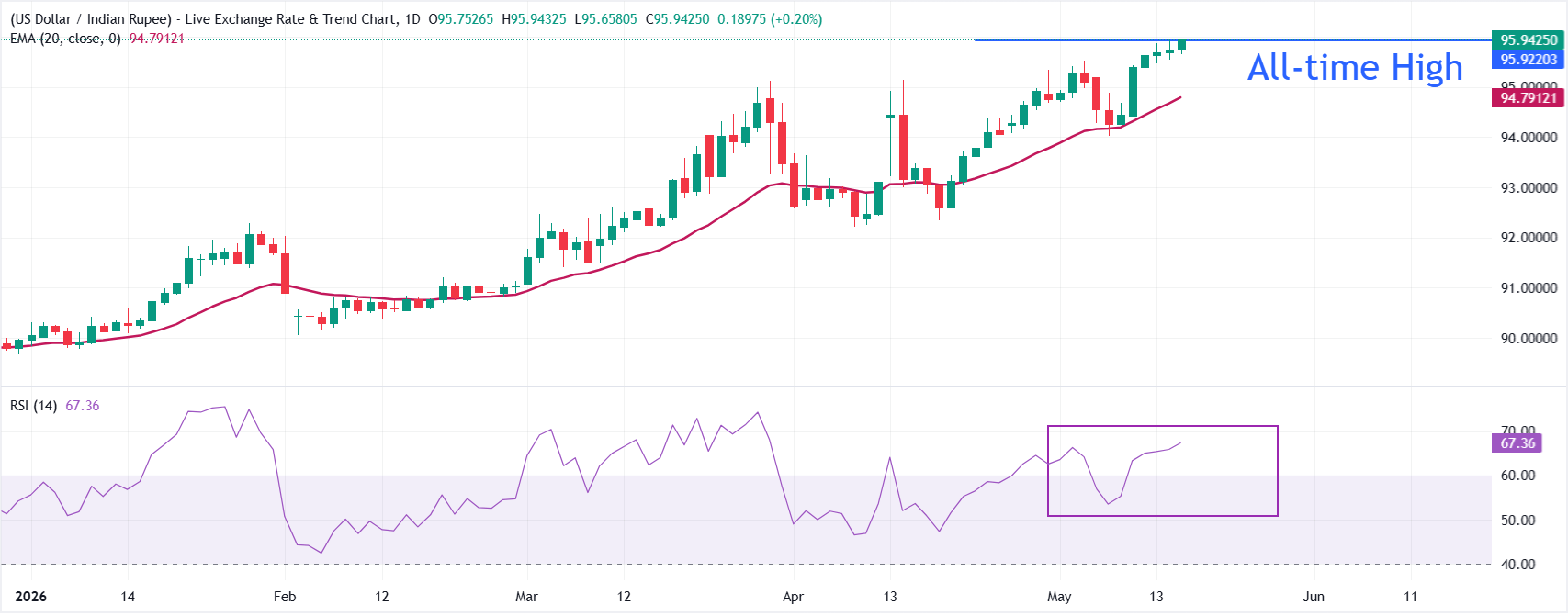
USD/INR demonstrates strength at around 95.95 as of writing. The pair extends its advance above the 20-period Exponential Moving Average (EMA) at 94.7912, maintaining a clear bullish near-term bias.
The rising EMA underpins the uptrend structure, while the Relative Strength Index (14) at 67.36 leans toward overbought territory without yet signaling exhaustion, suggesting buyers still retain control for now.
On the downside, immediate support is located at the 20-period EMA at 94.79, with a break below this dynamic floor likely signaling a corrective phase after the recent strong run-up. Looking up, the pair could extend its upside toward 97.00 if it manages to stabilize above 96.00.
(The technical analysis of this story was written with the help of an AI tool.)
Indian Rupee FAQs
The Indian Rupee (INR) is one of the most sensitive currencies to external factors. The price of Crude Oil (the country is highly dependent on imported Oil), the value of the US Dollar – most trade is conducted in USD – and the level of foreign investment, are all influential. Direct intervention by the Reserve Bank of India (RBI) in FX markets to keep the exchange rate stable, as well as the level of interest rates set by the RBI, are further major influencing factors on the Rupee.
The Reserve Bank of India (RBI) actively intervenes in forex markets to maintain a stable exchange rate, to help facilitate trade. In addition, the RBI tries to maintain the inflation rate at its 4% target by adjusting interest rates. Higher interest rates usually strengthen the Rupee. This is due to the role of the ‘carry trade’ in which investors borrow in countries with lower interest rates so as to place their money in countries’ offering relatively higher interest rates and profit from the difference.
Macroeconomic factors that influence the value of the Rupee include inflation, interest rates, the economic growth rate (GDP), the balance of trade, and inflows from foreign investment. A higher growth rate can lead to more overseas investment, pushing up demand for the Rupee. A less negative balance of trade will eventually lead to a stronger Rupee. Higher interest rates, especially real rates (interest rates less inflation) are also positive for the Rupee. A risk-on environment can lead to greater inflows of Foreign Direct and Indirect Investment (FDI and FII), which also benefit the Rupee.
Higher inflation, particularly, if it is comparatively higher than India’s peers, is generally negative for the currency as it reflects devaluation through oversupply. Inflation also increases the cost of exports, leading to more Rupees being sold to purchase foreign imports, which is Rupee-negative. At the same time, higher inflation usually leads to the Reserve Bank of India (RBI) raising interest rates and this can be positive for the Rupee, due to increased demand from international investors. The opposite effect is true of lower inflation.














