

Ripple Price Forecast: XRP risks deeper decline toward $1.00
- XRP clings to short-term support at $1.10, but persistent selling pressure leaves it vulnerable to a further 10% drop toward $1.00.
- Mild inflows into spot ETFs and marginal increases in the derivatives market fall short of lifting sentiment and the XRP price.
- XRP remains largely defined by a bearish technical structure, with major moving averages and momentum indicators edging lower.
Ripple (XRP) upholds a broader bearish outlook, trending down at $1.10 at the time of writing on Tuesday. The remittance token failed to sustain an early-week rebound on Monday, with the headwinds primarily attributed to geopolitical uncertainty amid mixed signals from the United States (US) and Iran following the first round of peace negotiations in Switzerland.

While US Vice President JD Vance said late Monday that Iran had allowed International Atomic Energy Agency (IAEA) inspectors back to the country, Iran denied the claim, saying that Tehran made "no new commitments.”
Iran’s top negotiator, Mohammad Bagher Ghalibaf, stated that the US agreed to release $12 billion in frozen Iranian funds.
On the other hand, US President Donald Trump told reporters that “if Iran doesn’t live up to their agreement, or if they’re not behaving, I will do what I have to do.”
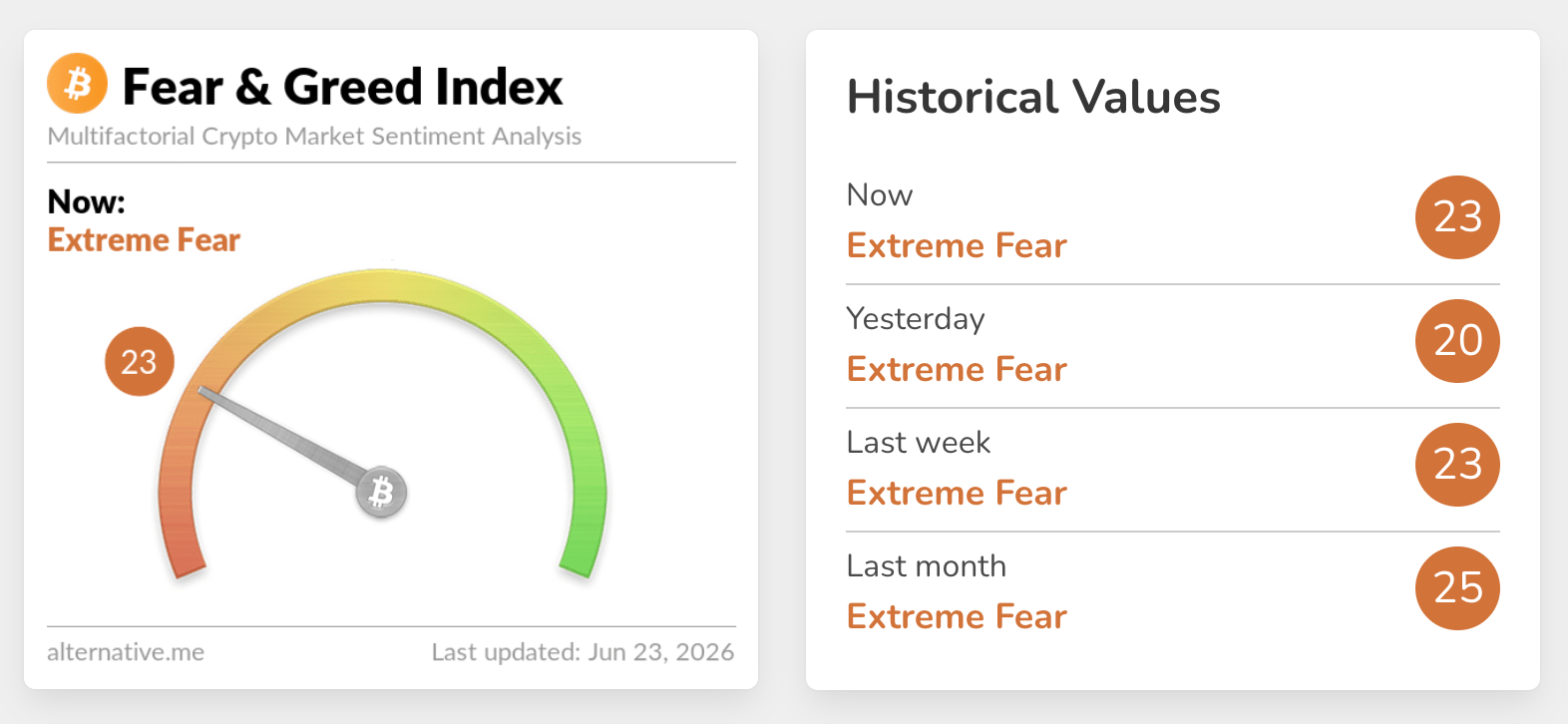
The crypto market remains pressured, with sentiment falling across the board, as reflected in the Fear & Greed Index, which logged Extreme Fear territory at 23 on Monday, up only marginally from 20 the previous day.
XRP weakness persists despite mild investment inflows
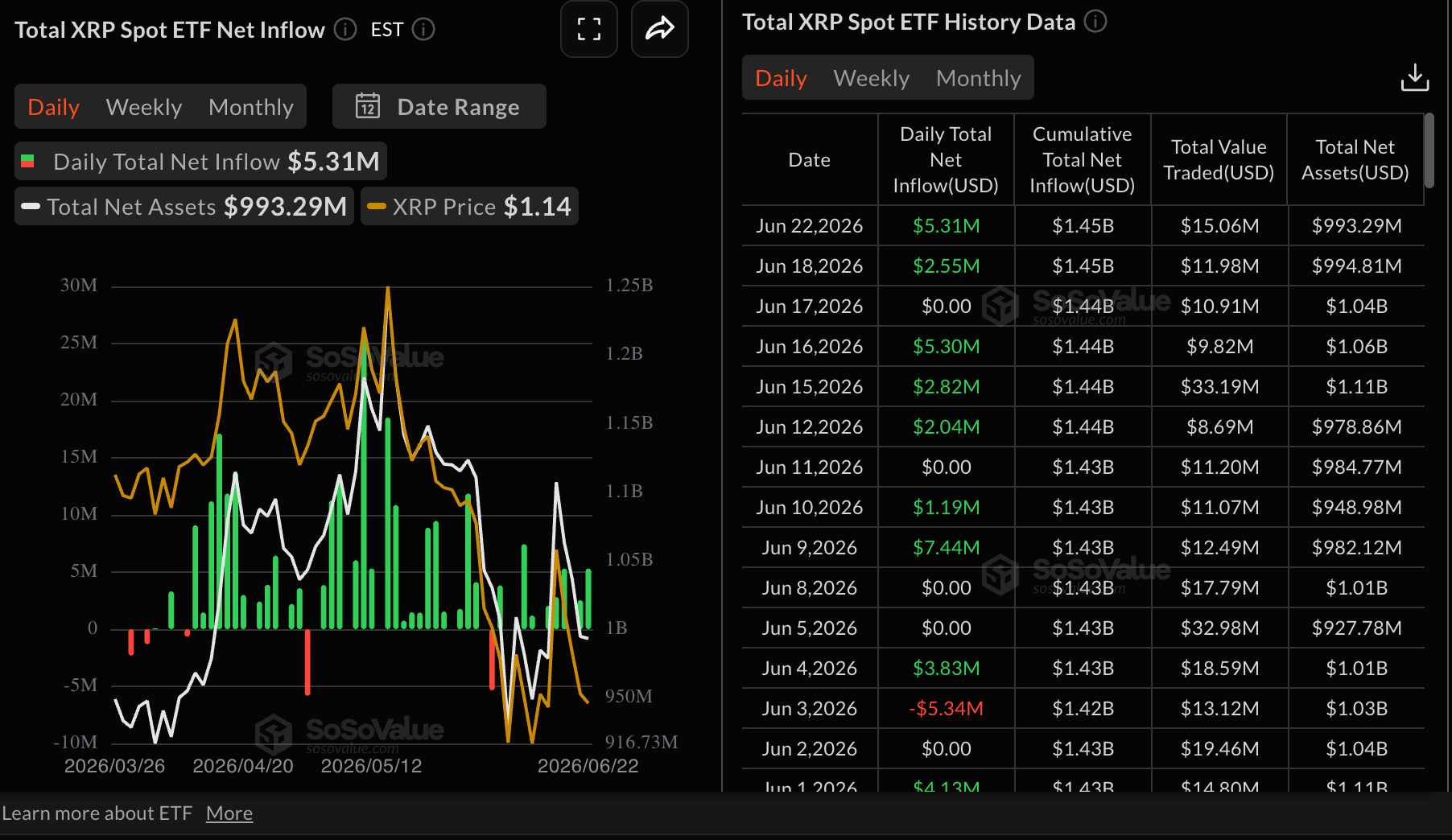
Institutions are turning to XRP amid intense heads in the broader crypto market. The appetite is reflected in inflows into spot Exchange-Traded Funds (ETFs), which increased to roughly $5 million on Monday, from nearly $3 million on Friday.
Cumulative inflows are steady at $1.45 billion, while assets under management average $993 million, according to SoSoValue. Sustained and increased demand for XRP ETFs is required to support an extended recovery. However, the overall sentiment in the crypto market remains on the back foot, suggesting that rallies could be sold, limiting growth.
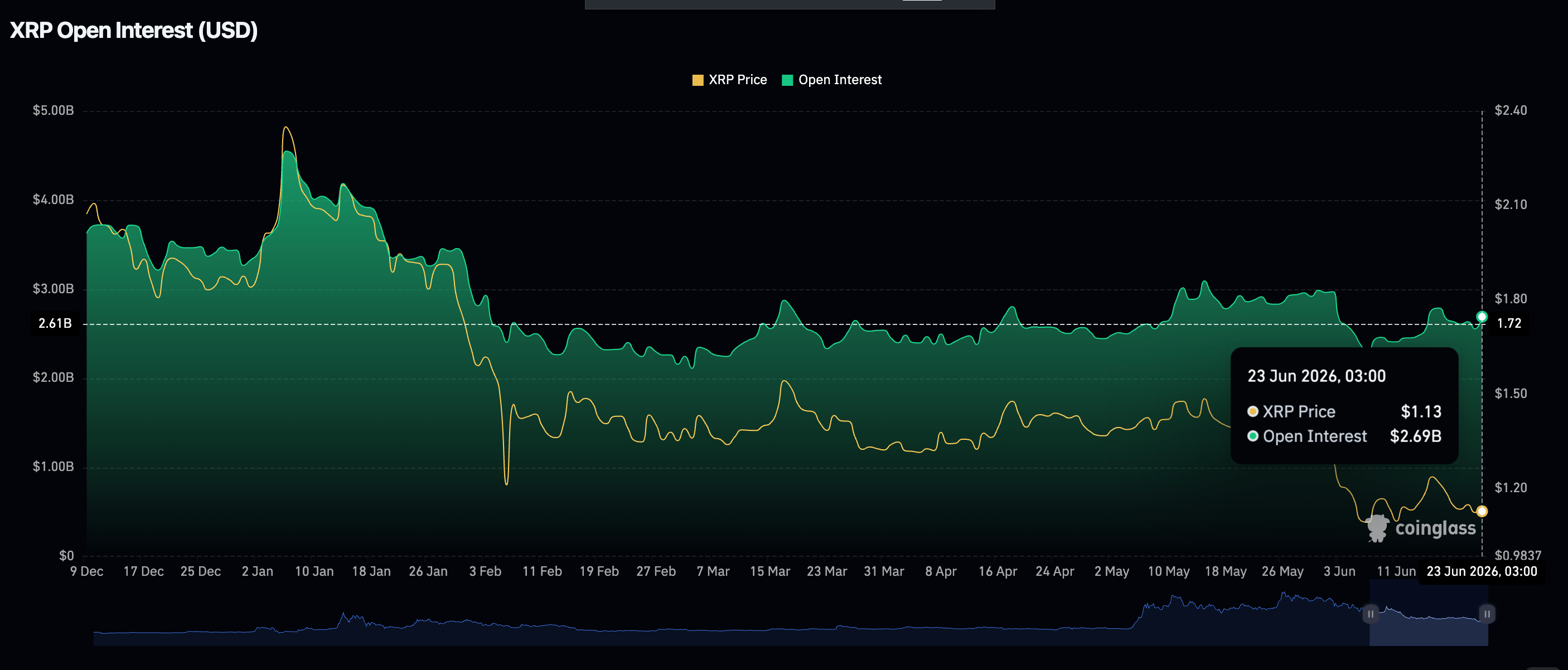
Retail participation in the derivatives edges higher with futures Open Interest (OI) climbing marginally to $2.69 billion on Monday, up from $2.55 billion the previous day. The return of the retail market suggests that investors are increasing risk exposure. Nevertheless, it continues to fall short, with supply overwhelming demand in the spot market.
Price analysis: XRP holds key support
XRP trades above $1.10, keeping a bearish near-term bias as price holds well below the 50-day, 100-day and 200-day Exponential Moving Averages (EMAs) at $1.25, $1.35 and $1.56 respectively.
The pair is also trading under the middle Bollinger Bands $1.15 on the daily chart, while the Relative Strength Index (RSI) at 37 leans toward weak bearish momentum. Meanwhile, a mildly positive Moving Average Convergence Divergence (MACD) histogram around zero only hints at tentative stabilization rather than a sustained recovery.
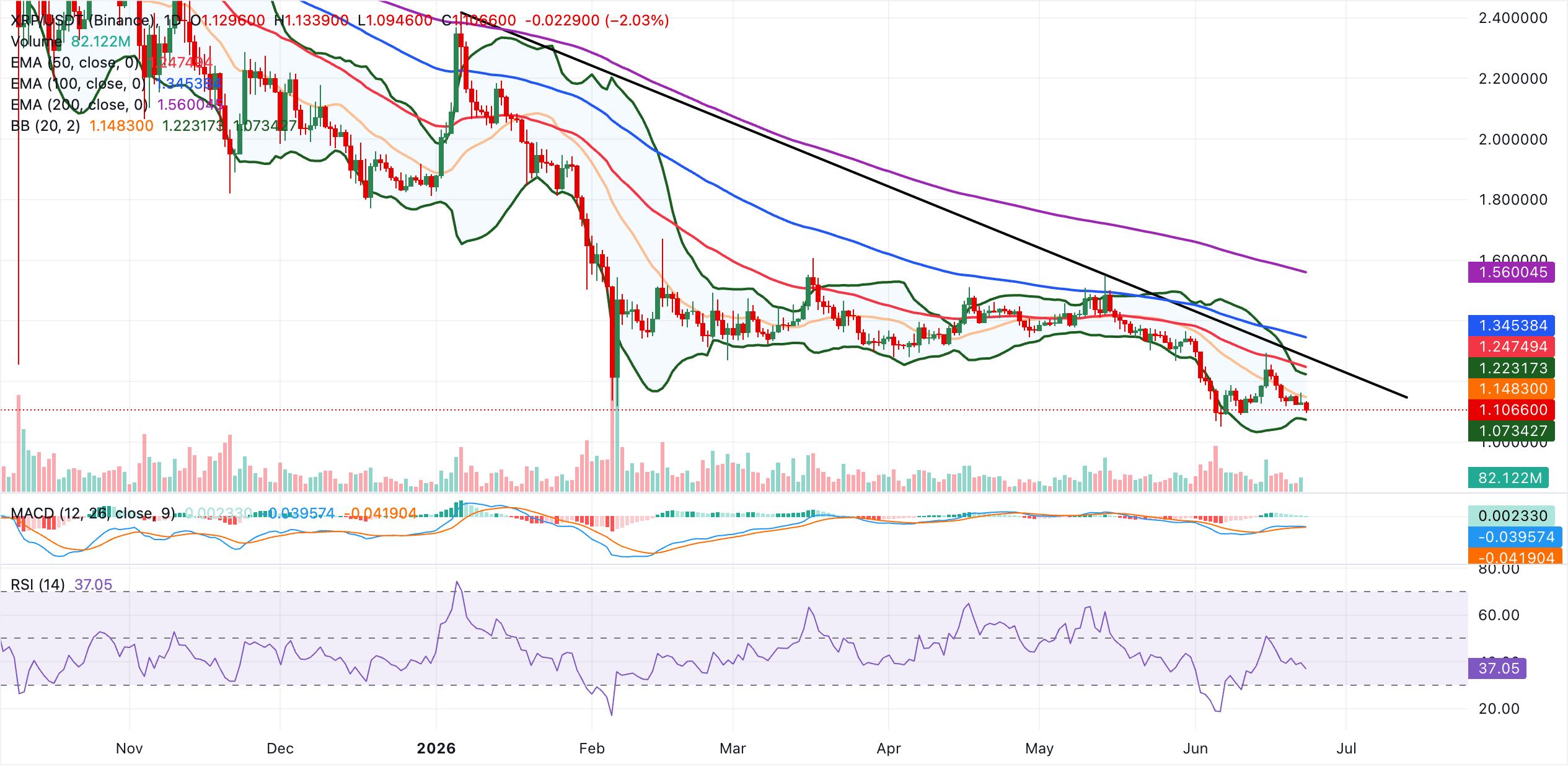
Initial resistance lies at the Bollinger Band midline near $1.15, followed by the upper band at $1.22. Above that, the 50-day EMA at $1.25 and the downward-sloping resistance trendline intersecting around $1.28 form a more substantial supply zone, ahead of the 100-day EMA at $1.35 and the 200-day EMA at $1.56. On the downside, the lower Bollinger band at $1.07 offers the first notable support, and a clear break beneath this floor would expose the pair to further downside pressure toward the recent $1.05 support and the psychological demand area at $1.00.
(The technical analysis of this story was written with the help of an AI tool.)
Crypto ETF FAQs
An Exchange-Traded Fund (ETF) is an investment vehicle or an index that tracks the price of an underlying asset. ETFs can not only track a single asset, but a group of assets and sectors. For example, a Bitcoin ETF tracks Bitcoin’s price. ETF is a tool used by investors to gain exposure to a certain asset.
Yes. The first Bitcoin futures ETF in the US was approved by the US Securities & Exchange Commission in October 2021. A total of seven Bitcoin futures ETFs have been approved, with more than 20 still waiting for the regulator’s permission. The SEC says that the cryptocurrency industry is new and subject to manipulation, which is why it has been delaying crypto-related futures ETFs for the last few years.
Yes. The SEC approved in January 2024 the listing and trading of several Bitcoin spot Exchange-Traded Funds, opening the door to institutional capital and mainstream investors to trade the main crypto currency. The decision was hailed by the industry as a game changer.
The main advantage of crypto ETFs is the possibility of gaining exposure to a cryptocurrency without ownership, reducing the risk and cost of holding the asset. Other pros are a lower learning curve and higher security for investors since ETFs take charge of securing the underlying asset holdings. As for the main drawbacks, the main one is that as an investor you can’t have direct ownership of the asset, or, as they say in crypto, “not your keys, not your coins.” Other disadvantages are higher costs associated with holding crypto since ETFs charge fees for active management. Finally, even though investing in ETFs reduces the risk of holding an asset, price swings in the underlying cryptocurrency are likely to be reflected in the investment vehicle too.














