

Ripple Price Forecast: XRP ticks up as buyers re-engage
- XRP logs subtle gains, trading above $1.12 on Thursday as traders increase exposure.
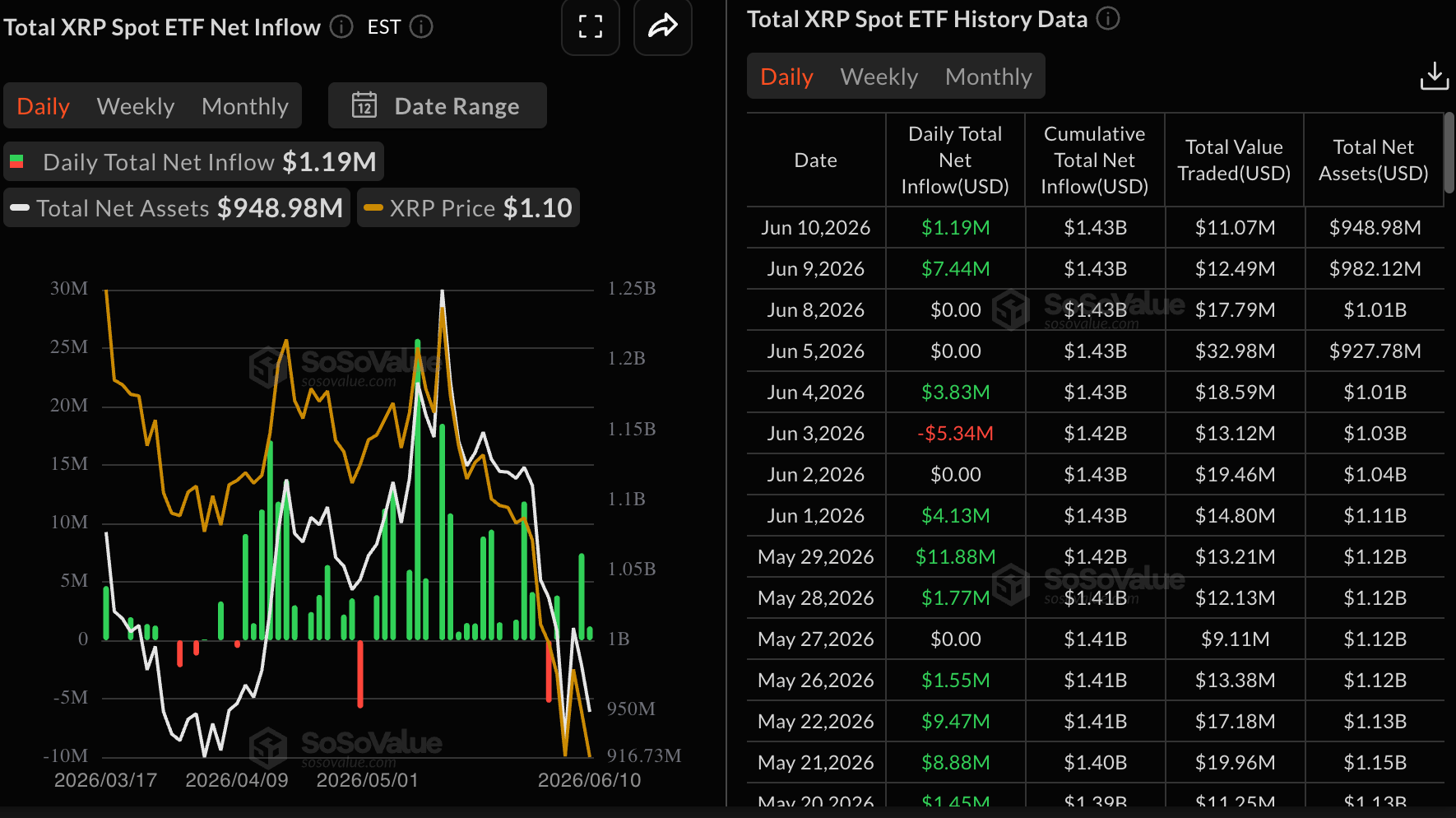
- XRP saw mild capital inflows on Wednesday via ETFs, in line with broader upside momentum.
- XRP’s technical indicators show early signs of recovery as the RSI climbs out of oversold conditions
Ripple (XRP) trends higher at the time of writing on Thursday, trading above $1.12. The cross-border remittance token seeks to erase a persistent downtrend that has weighed on the price since mid-May, as investors navigated geopolitical tensions in the Middle East.

An imminent peace agreement remains elusive as the United States (US) and Iran continue to exchange fire. US President Donald Trump has insisted that Iran is taking too long to sign the peace deal. Following the statement, the US military launched multiple attacks on Iran, describing them as “self-defense.”
Iran’s Islamic Revolutionary Guards Corps (IRGC) launched strikes against US military installations in Kuwait, Bahrain, and Jordan.
XRP ETFs extend inflow streak
Institutional investors are cautiously increasing their exposure to digital assets, as evidenced by nearly $1.2 million in inflows into spot Exchange-Traded Funds (ETFs) on Wednesday. This follows approximately $7.44 million in inflows on Tuesday, indicating persistent demand for related crypto investment products.
Cumulative inflows now average $1.43 billion, with assets under management totaling $949 million, according to SoSoValue data.
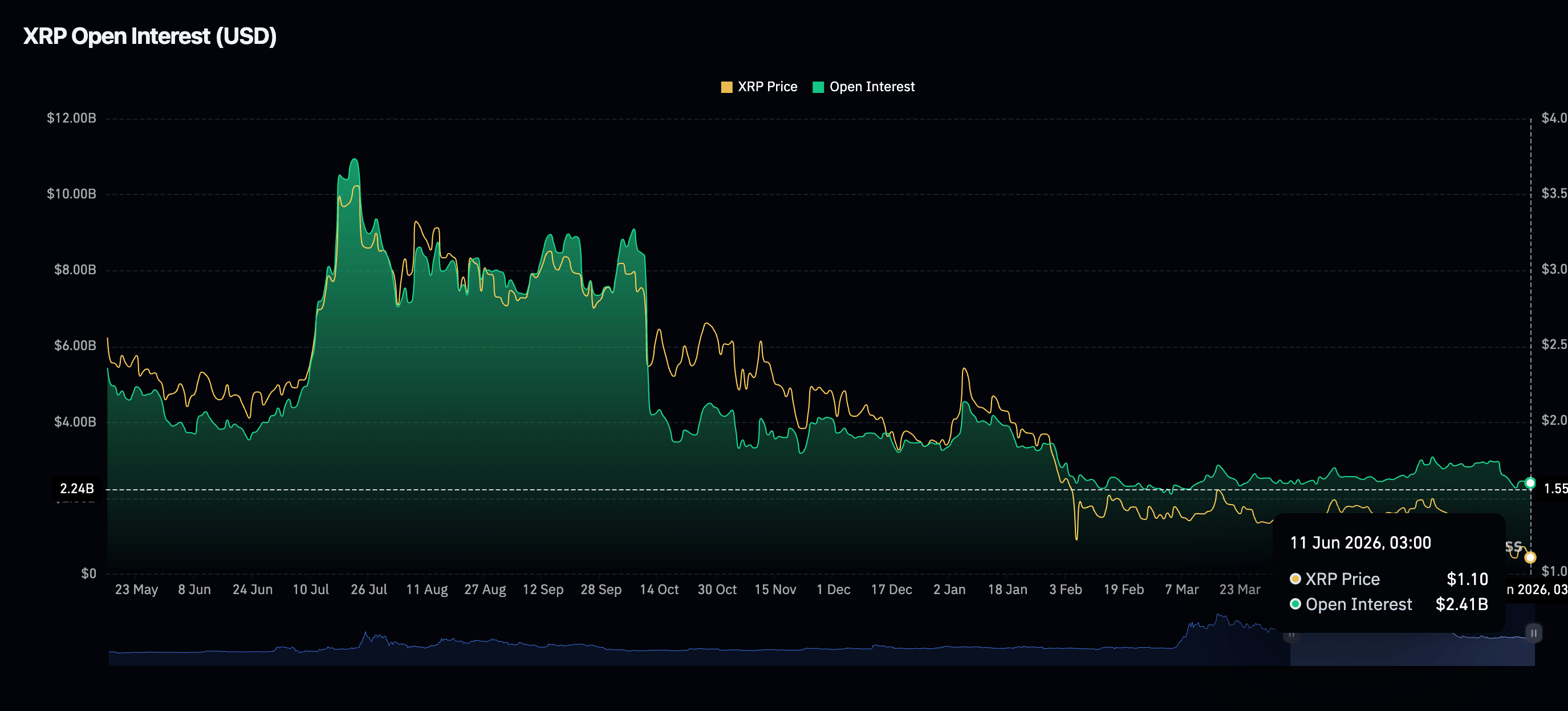
Conversely, retail demand remains on the back foot, with futures Open Interest (OI) steadying at $2.41 billion on Thursday. The OI averaged $2.44 billion on Sunday and was slightly above $3 billion on May 15.
A persistent sell-off in the derivatives market signals diminishing investor confidence in XRP’s ability to sustain its upward trajectory, with market participants reluctant to open new positions.
Price analysis: XRP rebounds as key suppprt holds
XRP trades at $1.12, while holding firmly below the 50-day, 100-day and the 200-day Exponential Moving Averages (EMAs) at $1.30, $1.40 and $1.61, respectively, keeping the broader tone bearish. The latest SuperTrend reading at $1.26 also sits well above spot, reinforcing the view that current price action remains capped, while the Relative Strength Index (RSI ) near 33 on the daily chart hints at weak but not extreme selling pressure as the Moving Average Convergence Divergence (MACD) histogram stays in negative territory.
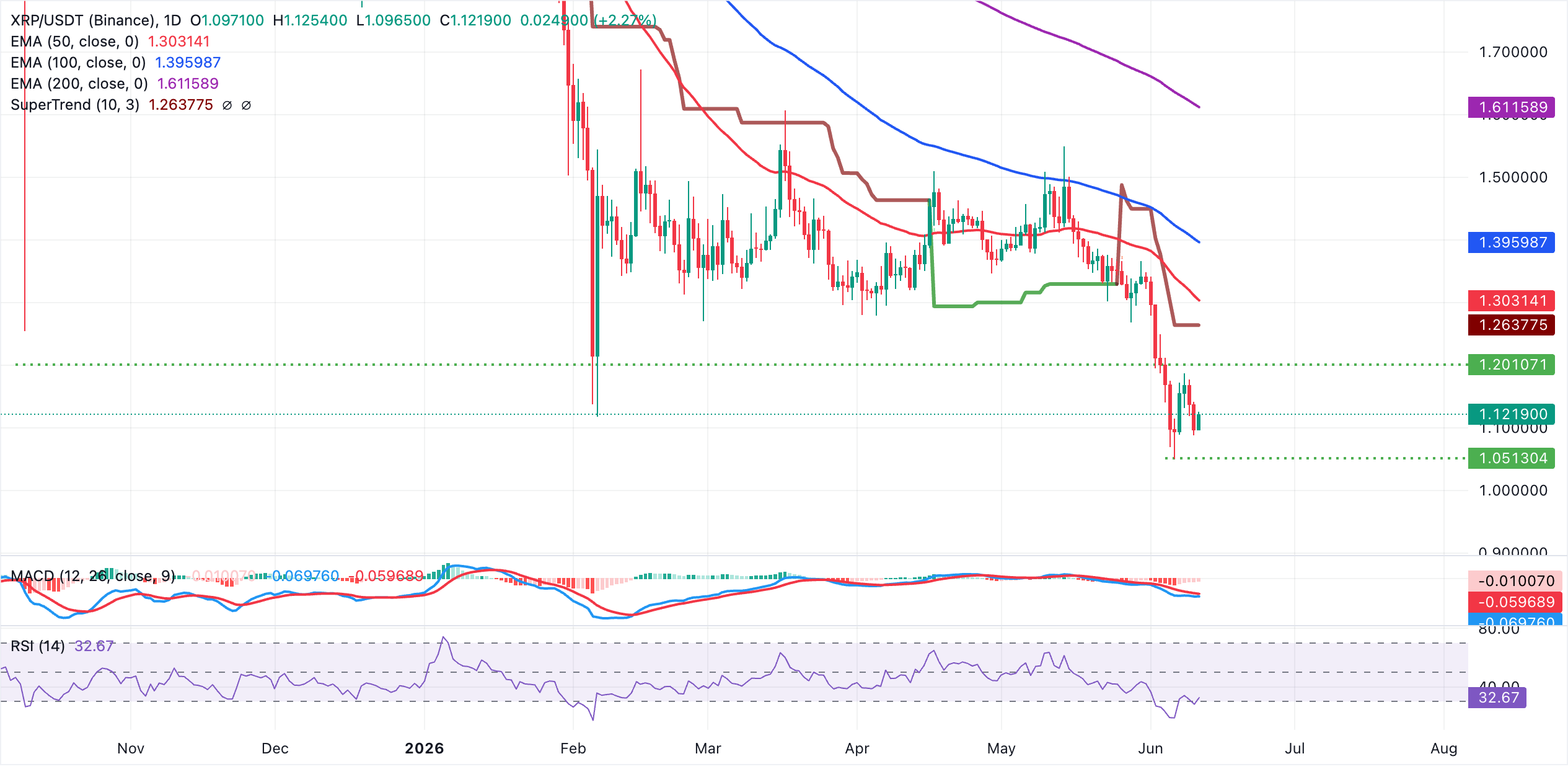
On the topside, initial resistance emerges at the SuperTrend barrier around $1.26, followed by the 50-day EMA at $1.30. A stronger recovery would face subsequent hurdles at the 100-day EMA near $1.40 and the more distant 200-day EMA around $1.61. If rebounds get sold and XRP resumes its decline, bulls will eye support at psychological levels, including $1.05 and $1.00, respectively.
(The technical analysis of this story was written with the help of an AI tool.)
Crypto ETF FAQs
An Exchange-Traded Fund (ETF) is an investment vehicle or an index that tracks the price of an underlying asset. ETFs can not only track a single asset, but a group of assets and sectors. For example, a Bitcoin ETF tracks Bitcoin’s price. ETF is a tool used by investors to gain exposure to a certain asset.
Yes. The first Bitcoin futures ETF in the US was approved by the US Securities & Exchange Commission in October 2021. A total of seven Bitcoin futures ETFs have been approved, with more than 20 still waiting for the regulator’s permission. The SEC says that the cryptocurrency industry is new and subject to manipulation, which is why it has been delaying crypto-related futures ETFs for the last few years.
Yes. The SEC approved in January 2024 the listing and trading of several Bitcoin spot Exchange-Traded Funds, opening the door to institutional capital and mainstream investors to trade the main crypto currency. The decision was hailed by the industry as a game changer.
The main advantage of crypto ETFs is the possibility of gaining exposure to a cryptocurrency without ownership, reducing the risk and cost of holding the asset. Other pros are a lower learning curve and higher security for investors since ETFs take charge of securing the underlying asset holdings. As for the main drawbacks, the main one is that as an investor you can’t have direct ownership of the asset, or, as they say in crypto, “not your keys, not your coins.” Other disadvantages are higher costs associated with holding crypto since ETFs charge fees for active management. Finally, even though investing in ETFs reduces the risk of holding an asset, price swings in the underlying cryptocurrency are likely to be reflected in the investment vehicle too.














