

USD/INR tumbles at open as Middle East war de-escalates
- The Indian Rupee recovers strongly against the US Dollar as both the US and Iran signal readiness to end the war.
- Iran wants guarantees of no repetitive aggression from the US in return for peace.
- FIIs continue to dump their stake in the Indian stock market.
The Indian Rupee (INR) opens higher against the US Dollar (USD) on Wednesday after a holiday due to the Shri Mahavir Jayanti the previous day. The USD/INR pair slumps to near 93.65 from the all-time high of 95.22 posted on Monday, as a significant de-escalation in the Middle East war, following comments from both the United States (US) and Iran signaling their willingness to end the war, has improved the appeal of risk-sensitive assets.

US and Iran show readiness to end Middle East war
On Tuesday, Iran’s President Masoud Pezeshkian told European Union (EU) Council President António Costa that his country is ready to end the war with the US, but it needs certain guarantees especially no repetition of aggression, Iranian state news agency reported.
These comments from Iran came after US President Donald Trump announced that Washington is willing to end the war with Iran despite the Strait of Hormuz remaining closed, a channel to almost 20% of global oil supply. Trump added that forcing the waterway back open would mean extending the military mission beyond his timeline of four to six weeks, Wall Street Journal (WSJ) reported.
Meaningful signs of US-Iran war de-escalation have diminished demand for safe-haven assets, such as the US Dollar. As of writing, the US Dollar Index (DXY), which tracks the Greenback’s value against six major currencies, trades subduedly near Tuesday’s low around 99.85. The USD Index fell almost 0.8% on Tuesday after posting a fresh 10-month high at around 100.65.
FIIs continue to pare stake in Indian stock market
Currencies from economies like India, which are in their developing stage, rely heavily on foreign investments for a strong financial system. The consistent outflow of foreign funds from the Indian stock market has battered the Indian Rupee significantly in the past months.
In March, Foreign Institutional Investors (FIIs) offloaded their stake worth Rs. 1,22,539.89 crore from the Indian stock market due to the war in the Middle East, assuming that higher oil prices in the wake of the war would be a drag on Nifty 50 Q4FY2025-26 earnings.
US data awaited
On Wednesday, investors will focus on the US ADP Employment Change and the ISM Manufacturing PMI data for March, and Retail Sales data for February, which will be published in the North American session. Economists expect US private sector to have created 40K fresh jobs, lower than 63K in February.
The ISM is expected to report that the Manufacturing PMI will tick higher to 52.5 from the previous reading of 52.4. US Retail Sales are estimated to have grown 0.5% after declining 0.2% in January.
Technical Analysis: USD/INR retraces from all-time highs of 95.22
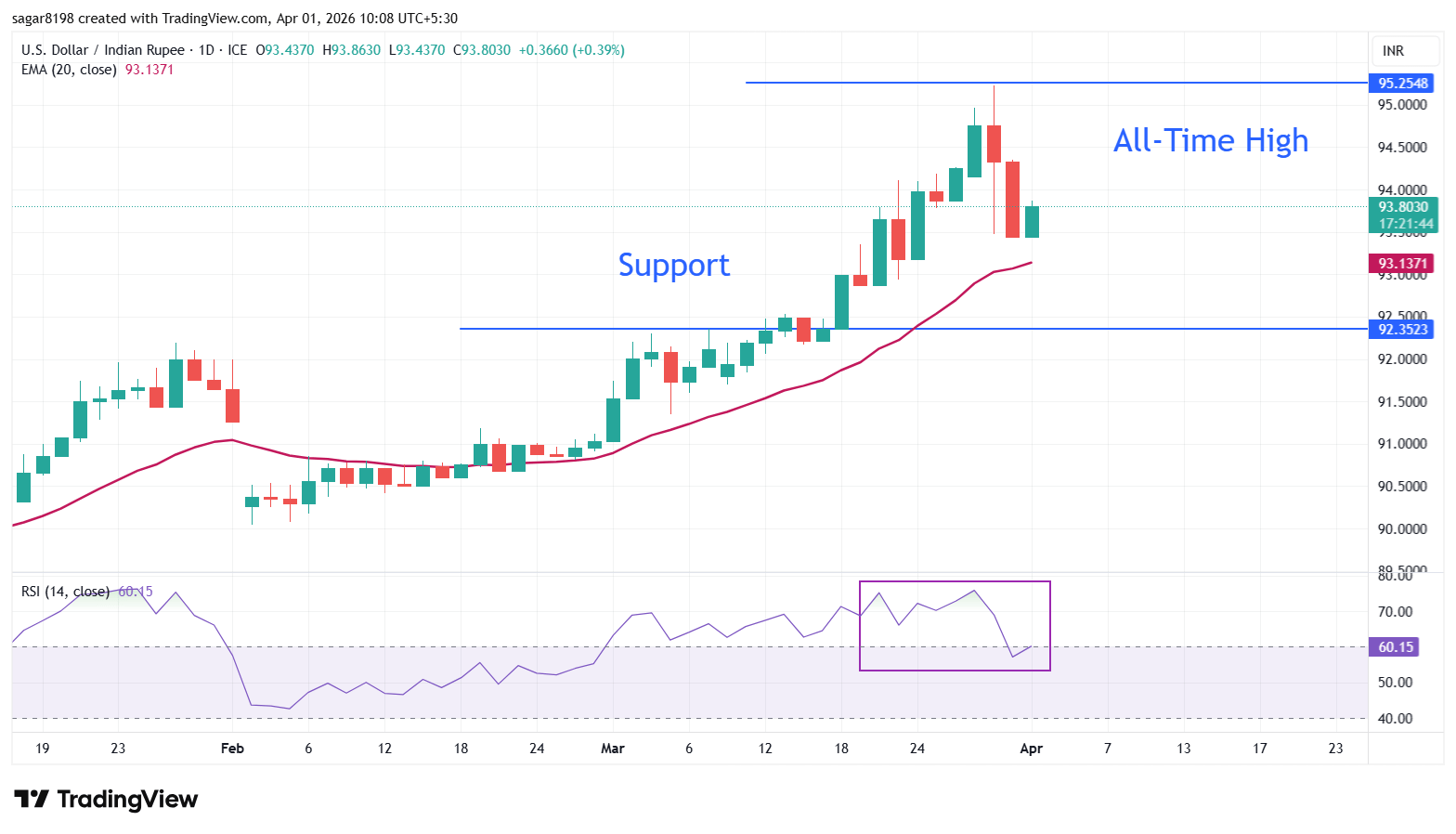
USD/INR corrects sharply from the all-time high of 95.22 to near 93.65 in the opening session on Wednesday. However, the continuation of higher highs and higher lows from the 90s area suggests that the bullish trend is bullish. The ascending 20-day Exponential Moving Average (EMA) near 93.13 confirms a strong bullish tone.
The 14-day Relative Strength Index (RSI) falls below 60.00 after remaining inside the 60.00-80.00 zone for a longer period, indicating the suspension of the bullish momentum with the upside bias remaining intact.
Initial support emerges at 20-day EMA, which is around 93.13, followed by previous peak levels in the 92.00-92.35 range. A downside break below the range would dent the overall bullish structure and open the way towards the March 5 low of 91.35. On the upside, the all-time high of 95.22 will be the major barrier for the spot price. A decisive break above the same would boost the odds of an extension of the advance toward 96.00.
Indian Rupee FAQs
The Indian Rupee (INR) is one of the most sensitive currencies to external factors. The price of Crude Oil (the country is highly dependent on imported Oil), the value of the US Dollar – most trade is conducted in USD – and the level of foreign investment, are all influential. Direct intervention by the Reserve Bank of India (RBI) in FX markets to keep the exchange rate stable, as well as the level of interest rates set by the RBI, are further major influencing factors on the Rupee.
The Reserve Bank of India (RBI) actively intervenes in forex markets to maintain a stable exchange rate, to help facilitate trade. In addition, the RBI tries to maintain the inflation rate at its 4% target by adjusting interest rates. Higher interest rates usually strengthen the Rupee. This is due to the role of the ‘carry trade’ in which investors borrow in countries with lower interest rates so as to place their money in countries’ offering relatively higher interest rates and profit from the difference.
Macroeconomic factors that influence the value of the Rupee include inflation, interest rates, the economic growth rate (GDP), the balance of trade, and inflows from foreign investment. A higher growth rate can lead to more overseas investment, pushing up demand for the Rupee. A less negative balance of trade will eventually lead to a stronger Rupee. Higher interest rates, especially real rates (interest rates less inflation) are also positive for the Rupee. A risk-on environment can lead to greater inflows of Foreign Direct and Indirect Investment (FDI and FII), which also benefit the Rupee.
Higher inflation, particularly, if it is comparatively higher than India’s peers, is generally negative for the currency as it reflects devaluation through oversupply. Inflation also increases the cost of exports, leading to more Rupees being sold to purchase foreign imports, which is Rupee-negative. At the same time, higher inflation usually leads to the Reserve Bank of India (RBI) raising interest rates and this can be positive for the Rupee, due to increased demand from international investors. The opposite effect is true of lower inflation.














