

Trade The World
Australian Dollar declines as US Dollar advances ahead of CPI data
Oleh Akhtar Faruqui
Tarikh Diterbitkan: 13 Jan 2026 | Tarikh Diubah: 13 Jan 2026


POPULAR ARTICLES

The Australian Dollar declines against the US Dollar on Tuesday following the release of Australia’s Westpac Consumer Confidence, which fell 1.7% month-over-month (MoM) in January to a three-month low of 92.9, extending December’s sharp 9.0% drop amid shifting rate expectations.
- Australian Dollar could gain amid cautious sentiment surrounding the RBA outlook.
- Westpac Consumer Confidence fell 1.7% MoM in January to a three-month low of 92.9, extending December’s 9.0% drop.
- The US Dollar receives support as traders adopt caution ahead of December's inflation data.
The Australian Dollar declines against the US Dollar on Tuesday following the release of Australia’s Westpac Consumer Confidence, which fell 1.7% month-over-month (MoM) in January to a three-month low of 92.9, extending December’s sharp 9.0% drop amid shifting rate expectations.
Reserve Bank of Australia (RBA) Governor Michele Bullock is expected to comment on concerns over the Fed’s independence after federal prosecutors threatened to indict Chair Jerome Powell over his congressional testimony on a building renovation, a move Powell has described as an attempt to undermine the central bank’s independence.
ANZ Job Advertisements declined 0.5% in December, following an upwardly revised 1.5% drop in the prior month. Meanwhile, household spending increased 1.0% month-on-month in November 2025, easing from a revised 1.4% rise in October, as consumers remained cautious amid elevated interest rates and persistent inflation.
Australia’s mixed November Consumer Price Index (CPI) left the Reserve Bank of Australia’s (RBA) policy outlook uncertain. However, RBA Deputy Governor Andrew Hauser said that the November inflation data was largely as expected. Hauser added that interest rate cuts are unlikely anytime soon. Focus now shifts to the quarterly CPI report due later this month for clearer guidance on the RBA’s next policy move.
US Dollar gains ahead of inflation data
- The US Dollar Index (DXY), which measures the value of the US Dollar against six major currencies, is holding ground and trading around 98.90 at the time of writing. Traders await the Consumer Price Index (CPI) data for December due on Tuesday, which could offer clues on the Federal Reserve’s (Fed) policy path.
- The Greenback faced challenges amid expectations of a dovish Federal Reserve (Fed). December’s slower-than-expected US jobs growth suggests the US central bank could hold interest rates steady later this month.
- Markets are pricing in two Federal Reserve rate cuts this year, starting in June, though an upside inflation surprise could curb easing prospects. The CME Group's FedWatch tool indicates that the Fed funds futures price indicates a 95% probability that the US central bank will keep rates unchanged at its January 27–28 meeting.
- US Nonfarm Payrolls (NFP) rose by 50,000 in December, falling short of November's 56,000 (revised from 64,000) and came in weaker than the market expectations of 60,000. However, the Unemployment Rate ticked lower to 4.4% in December from 4.6% in November, while the Average Hourly Earnings climbed to 3.8% YoY in December from 3.6% in the previous reading.
- Federal Reserve Bank of New York President John Williams said late Monday that US monetary policy is “well positioned” to steer inflation back to its target without damaging employment. He indicated there is no immediate need to resume interest-rate cuts as the central bank edges closer to a neutral policy stance.
- Richmond Fed President Tom Barkin said the decline in the unemployment rate was welcome and described job growth as modest but stable. Barkin added that it is difficult to find firms outside healthcare or AI that are hiring and said it remains unclear whether the labor market will tilt toward more hiring or more firing.
Australian Dollar remains above 0.6700, nine-day EMA
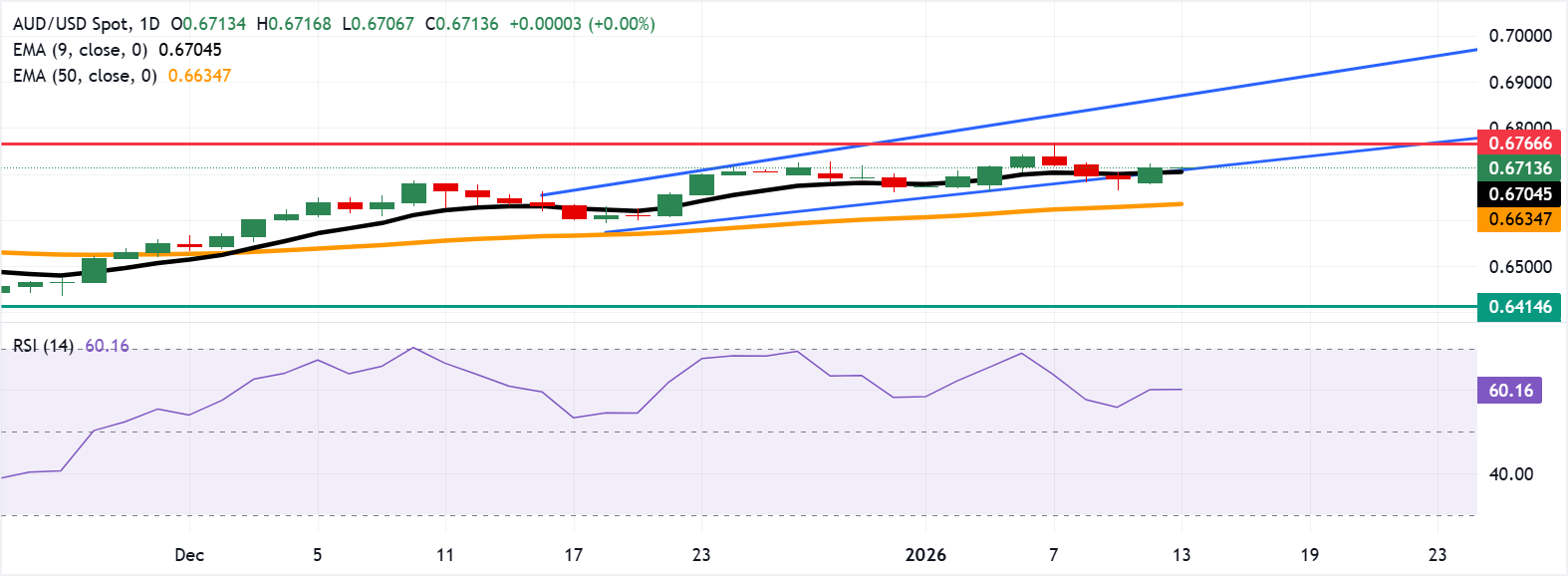
AUD/USD is trading around 0.6710 on Tuesday. Daily chart analysis shows the pair rebounded toward an ascending channel, signaling a renewed bullish bias. The 14-day Relative Strength Index (RSI) at 60.55 remains above the midpoint, supporting upside momentum.
The AUD/USD pair could target 0.6766, its highest level since October 2024. Further gains could see the pair test the upper boundary of the ascending channel near 0.6860.
The immediate support lies at the nine-day Exponential Moving Average (EMA) of 0.6705, followed by the 50-day EMA at 0.6634. Further losses would open the downside toward 0.6414, the lowest since June 2025.
Australian Dollar Price Today
The table below shows the percentage change of Australian Dollar (AUD) against listed major currencies today. Australian Dollar was the weakest against the New Zealand Dollar.
| USD | EUR | GBP | JPY | CAD | AUD | NZD | CHF | |
|---|---|---|---|---|---|---|---|---|
| USD | 0.08% | -0.03% | 0.49% | -0.02% | 0.11% | -0.12% | 0.02% | |
| EUR | -0.08% | -0.11% | 0.41% | -0.10% | 0.03% | -0.20% | -0.06% | |
| GBP | 0.03% | 0.11% | 0.51% | 0.01% | 0.14% | -0.08% | 0.05% | |
| JPY | -0.49% | -0.41% | -0.51% | -0.49% | -0.37% | -0.60% | -0.45% | |
| CAD | 0.02% | 0.10% | -0.01% | 0.49% | 0.13% | -0.10% | 0.04% | |
| AUD | -0.11% | -0.03% | -0.14% | 0.37% | -0.13% | -0.22% | -0.08% | |
| NZD | 0.12% | 0.20% | 0.08% | 0.60% | 0.10% | 0.22% | 0.14% | |
| CHF | -0.02% | 0.06% | -0.05% | 0.45% | -0.04% | 0.08% | -0.14% |
The heat map shows percentage changes of major currencies against each other. The base currency is picked from the left column, while the quote currency is picked from the top row. For example, if you pick the Australian Dollar from the left column and move along the horizontal line to the US Dollar, the percentage change displayed in the box will represent AUD (base)/USD (quote).
Australian Dollar FAQs
One of the most significant factors for the Australian Dollar (AUD) is the level of interest rates set by the Reserve Bank of Australia (RBA). Because Australia is a resource-rich country another key driver is the price of its biggest export, Iron Ore. The health of the Chinese economy, its largest trading partner, is a factor, as well as inflation in Australia, its growth rate and Trade Balance. Market sentiment – whether investors are taking on more risky assets (risk-on) or seeking safe-havens (risk-off) – is also a factor, with risk-on positive for AUD.
The Reserve Bank of Australia (RBA) influences the Australian Dollar (AUD) by setting the level of interest rates that Australian banks can lend to each other. This influences the level of interest rates in the economy as a whole. The main goal of the RBA is to maintain a stable inflation rate of 2-3% by adjusting interest rates up or down. Relatively high interest rates compared to other major central banks support the AUD, and the opposite for relatively low. The RBA can also use quantitative easing and tightening to influence credit conditions, with the former AUD-negative and the latter AUD-positive.
China is Australia’s largest trading partner so the health of the Chinese economy is a major influence on the value of the Australian Dollar (AUD). When the Chinese economy is doing well it purchases more raw materials, goods and services from Australia, lifting demand for the AUD, and pushing up its value. The opposite is the case when the Chinese economy is not growing as fast as expected. Positive or negative surprises in Chinese growth data, therefore, often have a direct impact on the Australian Dollar and its pairs.
Iron Ore is Australia’s largest export, accounting for $118 billion a year according to data from 2021, with China as its primary destination. The price of Iron Ore, therefore, can be a driver of the Australian Dollar. Generally, if the price of Iron Ore rises, AUD also goes up, as aggregate demand for the currency increases. The opposite is the case if the price of Iron Ore falls. Higher Iron Ore prices also tend to result in a greater likelihood of a positive Trade Balance for Australia, which is also positive of the AUD.
The Trade Balance, which is the difference between what a country earns from its exports versus what it pays for its imports, is another factor that can influence the value of the Australian Dollar. If Australia produces highly sought after exports, then its currency will gain in value purely from the surplus demand created from foreign buyers seeking to purchase its exports versus what it spends to purchase imports. Therefore, a positive net Trade Balance strengthens the AUD, with the opposite effect if the Trade Balance is negative.

FXStreet
Lebih sejuta pengguna bergantung pada FXStreet untuk data pasaran masa nyata, alat carta, pandangan pakar dan berita Forex. Kalendar ekonomi yang komprehensif dan webinar pendidikan mereka membantu pedagang kekal bermaklumat dan membuat keputusan yang dikira. FXStreet disokong oleh pasukan kira-kira 60 profesional di ibu pejabat Barcelona dan pelbagai wilayah global.
Read More








