

Silver Price Forecast: XAG/USD corrects to near $86.50 as Iran stops killing protesters
Oleh Sagar Dua
Tarikh Diterbitkan: 15 Jan 2026 | Tarikh Diubah: 15 Jan 2026


ARTIKEL POPULAR
Silver price corrects almost 6% to near $86.50 during the Asian trading session on Thursday.
- Silver price retraces sharply from its all-time high of $93.51 as Iran tensions ease.
- Iran assured US President Trump that it will stop killings of protesters.
- The Fed is unlikely to cut interest rates in the policy meeting later this month.
Silver price corrects almost 6% to near $86.50 during the Asian trading session on Thursday. The white metal retraced from its all-time high of $93.51 posted on Wednesday after United States (US) President Donald Trump said that Iran assured it will stop killings of protesters, and has no plans of large-scale civil executions, resulting in a decline in appeal of safe-haven demand.
Market sentiment remained risk-averse as US President Trump threatened military action against the government of Supreme Leader Ayatollah Ali Khamenei for executing protestors amid civil unrest in Iran. The assurance from Tehran that it will stop executions of civilians has downplayed the risks of US military action.
Meanwhile, expectations from the Federal Reserve (Fed) that it won’t reduce interest rates in the policy meeting later this month are also weighing on the Silver. The speculation for the Fed pausing its ongoing monetary easing campaign intensified after the release of the US Consumer Price Index (CPI) data on Tuesday, which showed that price pressure remained sticky.
Going forward, the major trigger for the Silver price will be the announcement of the new Fed Chairman by the White House. US President Trump said in December that he would announce the successor of Fed Chair Jerome Powell sometime in January. The comments from Trump in his latest interviews showed that White House Economic Adviser Kevin Hassett, former Fed Chair Kevin Warsh, and current Fed Governors Christopher Waller and Michelle Bowman are major contenders to replace Jerome Powell.
Silver technical analysis
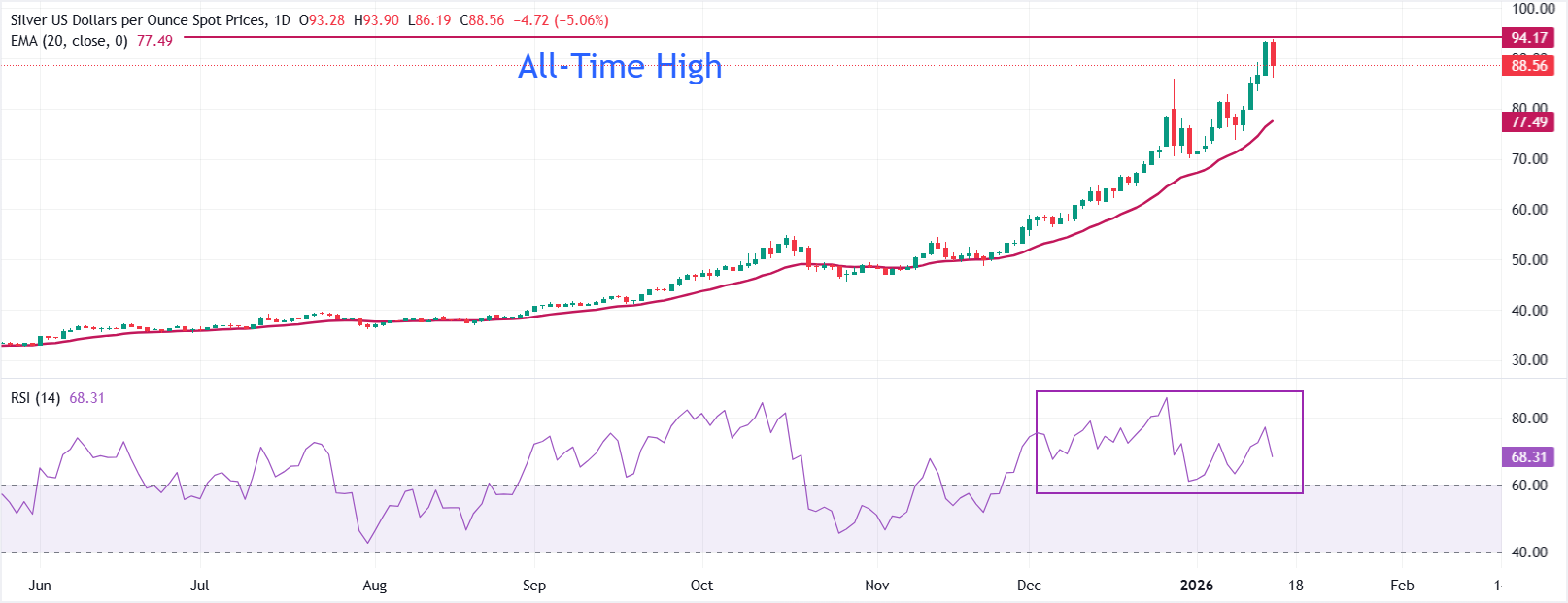
XAG/USD trades sharply lower to near $88.50 as of writing. The 20-day Exponential Moving Average rises and sits at $77.48, reinforcing an upward bias as THE price holds well above it. Its positive slope supports the trend and keeps pullbacks contained around the average.
The 14-day Relative Strength Index (RSI) at 68 (near overbought) reflects firm momentum after cooling from recent extremes, which could cap immediate upside if it stalls.
As long as the pair stays above the rising 20-EMA, bulls retain control, and an extension of the advance would remain the base case. A close below the 20-day EMA would shift the bias toward consolidation and open room for further downside toward the January 8 low of $73.85.
(The technical analysis of this story was written with the help of an AI tool.)
Silver FAQs
Silver is a precious metal highly traded among investors. It has been historically used as a store of value and a medium of exchange. Although less popular than Gold, traders may turn to Silver to diversify their investment portfolio, for its intrinsic value or as a potential hedge during high-inflation periods. Investors can buy physical Silver, in coins or in bars, or trade it through vehicles such as Exchange Traded Funds, which track its price on international markets.
Silver prices can move due to a wide range of factors. Geopolitical instability or fears of a deep recession can make Silver price escalate due to its safe-haven status, although to a lesser extent than Gold's. As a yieldless asset, Silver tends to rise with lower interest rates. Its moves also depend on how the US Dollar (USD) behaves as the asset is priced in dollars (XAG/USD). A strong Dollar tends to keep the price of Silver at bay, whereas a weaker Dollar is likely to propel prices up. Other factors such as investment demand, mining supply – Silver is much more abundant than Gold – and recycling rates can also affect prices.
Silver is widely used in industry, particularly in sectors such as electronics or solar energy, as it has one of the highest electric conductivity of all metals – more than Copper and Gold. A surge in demand can increase prices, while a decline tends to lower them. Dynamics in the US, Chinese and Indian economies can also contribute to price swings: for the US and particularly China, their big industrial sectors use Silver in various processes; in India, consumers’ demand for the precious metal for jewellery also plays a key role in setting prices.
Silver prices tend to follow Gold's moves. When Gold prices rise, Silver typically follows suit, as their status as safe-haven assets is similar. The Gold/Silver ratio, which shows the number of ounces of Silver needed to equal the value of one ounce of Gold, may help to determine the relative valuation between both metals. Some investors may consider a high ratio as an indicator that Silver is undervalued, or Gold is overvalued. On the contrary, a low ratio might suggest that Gold is undervalued relative to Silver.

Lebih sejuta pengguna bergantung pada FXStreet untuk data pasaran masa nyata, alat carta, pandangan pakar dan berita Forex. Kalendar ekonomi yang komprehensif dan webinar pendidikan mereka membantu pedagang kekal bermaklumat dan membuat keputusan yang dikira. FXStreet disokong oleh pasukan kira-kira 60 profesional di ibu pejabat Barcelona dan pelbagai wilayah global.
Baca Lagi








