[TMGM Financial Breakfast] Why Is Gold Falling? Long-Term Outlook for Gold Still Remains Promising
After the United States launched military strikes against Iran, crude oil prices surged sharply, completely erasing market expectations for a rapid easing of Middle East tensions and significantly intensifying inflation concerns. The military action directly impacted the security of the Strait of Hormuz — one of the world’s most critical energy transportation routes — increasing risks surrounding global energy supply.
US Secretary of State Marco Rubio stated on Tuesday that negotiations related to the US and Iran could still require several more days before meaningful results emerge, further intensifying market uncertainty. Higher oil prices are expected to further fuel inflation expectations, potentially forcing the Federal Reserve to maintain elevated interest rates for a longer period. Although gold has historically been viewed as an effective inflation hedge over the long term, as a non-yielding asset, its holding cost rises significantly in a high-interest-rate environment. This substantially weakens gold’s attractiveness and continues pressuring prices lower.

At the same time, a stronger US dollar and rebounding Treasury yields have also significantly increased the opportunity cost of holding gold. Geopolitical uncertainty has driven oil prices higher, worsening market inflation fears and reinforcing expectations that the Federal Reserve may continue tightening monetary policy. This creates a clear negative environment for non-yielding assets such as gold.
Investors are now closely monitoring two major developments simultaneously: the latest progress in US-Iran negotiations and the upcoming US April Personal Consumption Expenditures (PCE) inflation data scheduled for release on Thursday. The PCE report is expected to provide critical clues regarding the future path of monetary policy. According to the CME FedWatch tool, markets still assign meaningful probability to another Federal Reserve rate hike this year, with the probability of a 25-basis-point hike in December currently standing at approximately 41%.
A strong US dollar and persistently elevated Treasury yields remain the primary factors suppressing gold prices at present, while inflation expectations triggered by rising oil prices continue adding additional pressure. Higher yields increase the opportunity cost of holding non-yielding assets, while dollar strength makes gold more expensive for holders of other currencies.
UBS recently lowered its year-end gold price target by US$400 to US$5,500 per ounce. The main reasons behind the downgrade include persistently high Treasury yields, continued US dollar strength, and broader macroeconomic risks. However, UBS maintained a relatively constructive longer-term outlook within the same report. The bank noted that several structural trends continue supporting the strategic value of physical gold allocations, including extremely high global debt levels, persistent expansion of US fiscal deficits, and ongoing diversification of foreign exchange reserves by central banks globally. UBS also expects that if oil prices gradually retreat later this year, gold prices could once again receive meaningful support.
Market Analysis:
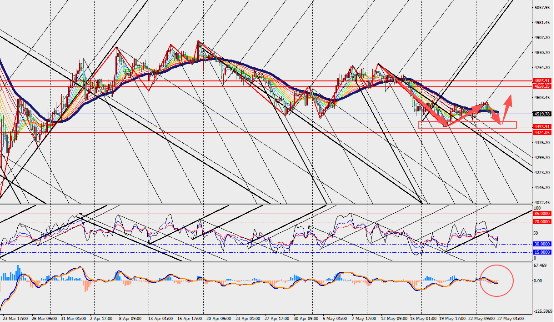
Gold rebounded after recent declines on the 4-hour chart timeframe, while both the MACD lines and histogram continue converging below the zero axis. In the short term, gold prices are likely to remain range-bound between US$4,500 and US$4,580. If geopolitical tensions surrounding the Strait of Hormuz continue intensifying, safe-haven demand could potentially drive another rebound in gold prices. Conversely, if US-Iran negotiations achieve meaningful progress or oil prices decline significantly, easing inflation pressures could create additional downside pressure for both gold and silver prices.