

Bitcoin long-term holders resume accumulation as ETF outflows keep institutional sentiment subdued — Glassnode
- Long-term Bitcoin holders have resumed accumulation, signaling renewed conviction amid market weakness and persistent selling pressure from US spot ETFs.
- Glassnode stated that accumulation is strengthening across multiple wallet cohorts, indicating growing investor conviction despite continued institutional caution.
- Nansen's Nicolai Sondergaard said macro uncertainty, not fading Bitcoin conviction, drove June's record ETF outflows as investors await clearer signals.
Long-term Bitcoin (BTC) investors have begun absorbing supply despite persistent negative flows from US spot BTC exchange-traded funds (ETFs), according to a report by Glassnode on Wednesday.

Long-term holders return to accumulation
The firm stated that long-term holders (LTHs) have shifted back into net accumulation after months of distribution, signaling renewed confidence as Bitcoin trades near $60,000.
While the pace of buying remains below the aggressive accumulation seen during previous bull markets, the firm described the shift as a notable change in investor behavior.
“Although it is too early to call this a full accumulation regime, the return of persistent long-term buying provides an encouraging signal that conviction is beginning to rebuild beneath the surface,” Glassnode wrote.
Historically, sustained transitions from net distribution to net accumulation have often emerged during periods of market weakness as longer-term investors absorb supply from shorter-term participants.
Glassnode added that the renewed buying is not limited to long-term holders. The Bitcoin Accumulation Trend Score revealed that accumulation has become increasingly broad-based across several wallet cohorts.
The report pointed to strong buying activity among investors holding less than one Bitcoin and entities controlling between 100 and 1,000 BTC.
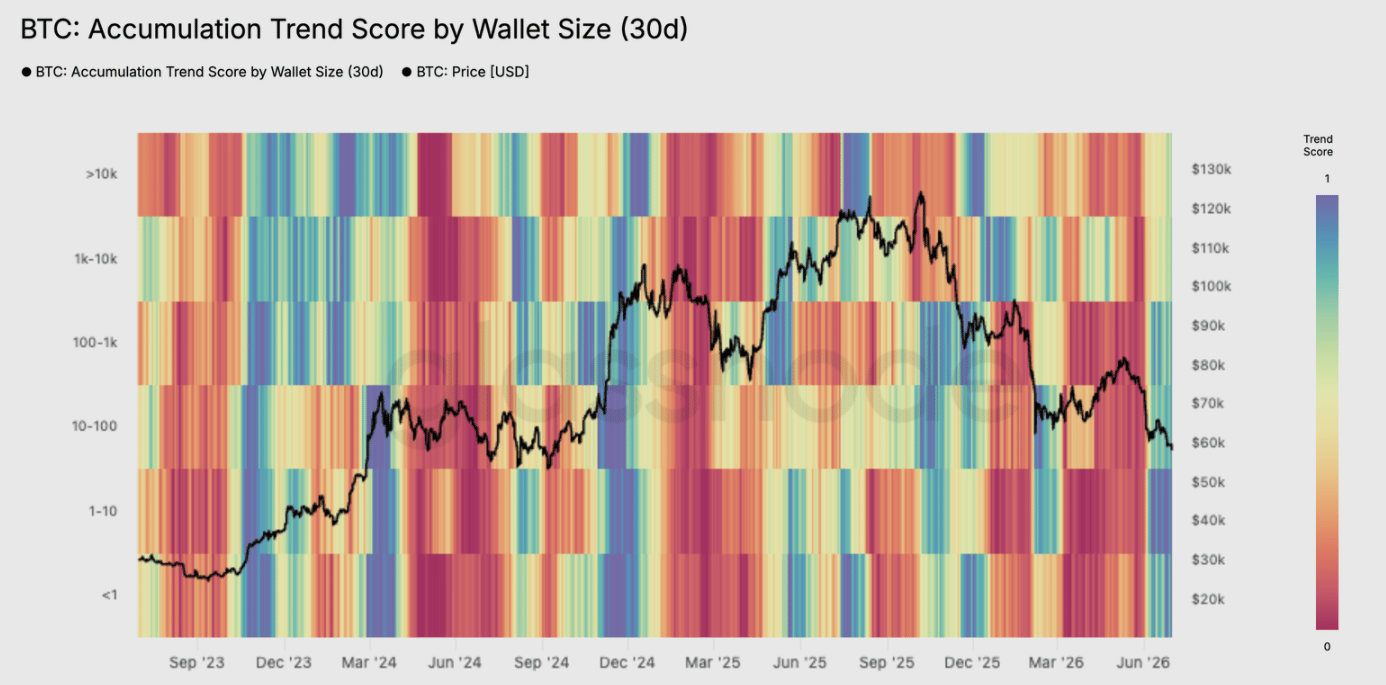
Glassnode stated that the synchronized improvement across multiple investor groups suggests confidence is gradually rebuilding after the recent correction. However, sustained buying will be needed to confirm a broader recovery.
Institutional demand remains under pressure amid persistent ETF outflows
On the institutional side, the seven-day moving average of US spot Bitcoin ETF flows has fallen deeper into negative territory despite a brief recovery in May, with persistent outflows accompanying Bitcoin's retreat toward $60,000.
"The persistence of redemptions suggests institutional investors remain in a defensive posture, reducing exposure rather than stepping in to absorb the recent weakness," the report stated.
The firm added that the divergence between patient on-chain investors and price-sensitive institutional participants reveals the market's current sentiment.
While long-term holders have begun absorbing supply, ETF investors have yet to show similar conviction, making stabilization in ETF flows contingent on any broader improvement in market confidence.
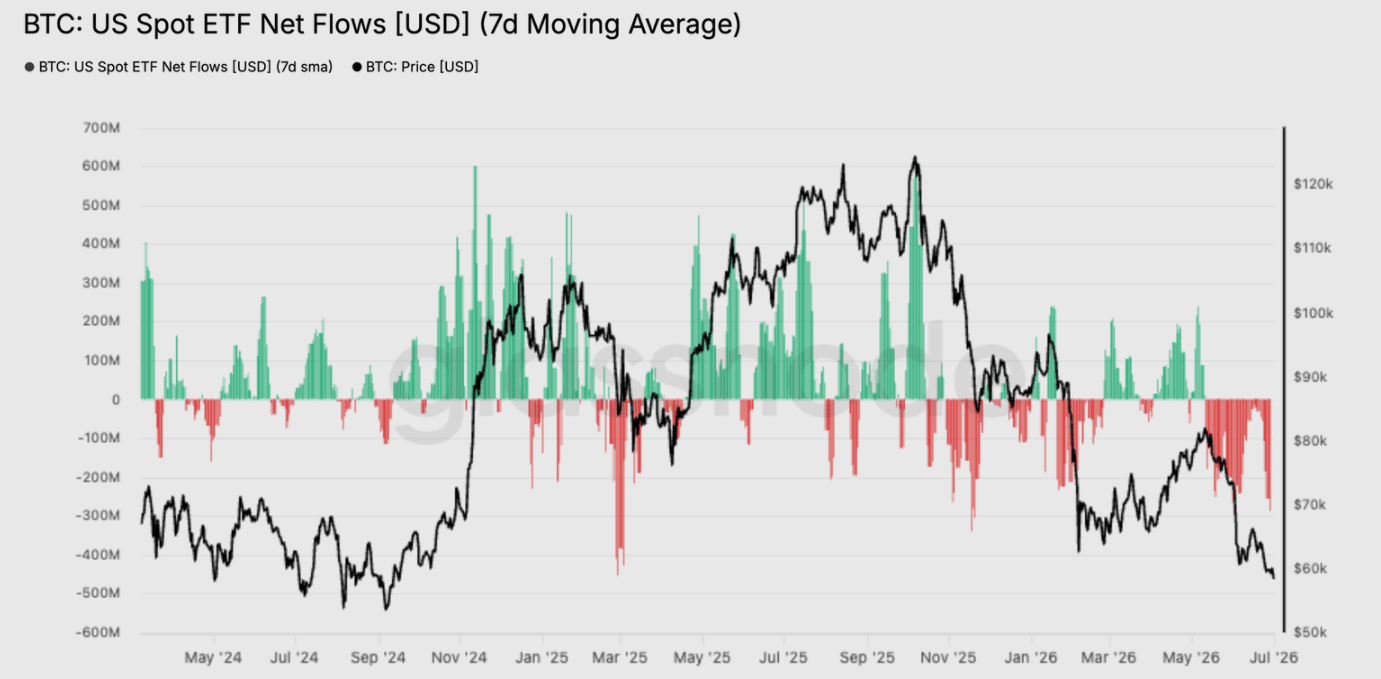
US spot Bitcoin ETFs recorded a record $4.5 billion in net outflows in June, marking their weakest month since launch. BlackRock's IBIT accounted for $3.55 billion of those redemptions over nine consecutive trading days.
Macro uncertainty remains major driver of institutional caution
Nansen Senior Research Analyst Nicolai Sondergaard attributed the sustained outflows to a combination of macroeconomic headwinds and competition for risk capital rather than a wholesale loss of confidence in Bitcoin.
"Two events compressed simultaneously to produce the streak: the SpaceX IPO in mid-June absorbed billions in discretionary risk capital, and the first FOMC meeting under Chair Warsh delivered a hawkish pivot that removed near-term rate cuts from the table," Sondergaard told FXStreet.
He noted that the shift in interest rate expectations has further weighed on institutional positioning. The 10-year US Treasury yield climbed to 4.49% and bond futures priced in more than an 85% probability of another rate hike before the end of the year.
Sondergaard also highlighted that exchanges have recorded net outflows of roughly 5,500 BTC over the past week, suggesting continued distribution.
Long-term holder supply has also climbed to a record high of around 14.7 million BTC, while Bitcoin's MVRV Z-score compressed toward levels that have historically coincided with major cycle bottoms.
"The onchain and derivatives layers are saying different things about the same market," Sondergaard said, adding that macroeconomic data will likely determine whether institutional investors begin returning in July.
Bitcoin is trading at $59,550, up 2.4% in the past 24 hours at the time of writing.














