

Bitcoin Price Forecast: BTC struggles amid renewed US-Iran peace uncertainty
- Bitcoin trades below $63,000 on Tuesday after failing to close above the key resistance zone the previous day.
- Mixed signals from Washington and Tehran on the progress of negotiations add to uncertainty and weigh on crypto’s recovery.
- Institutional selling continues with spot ETFs recording mild outflows on Monday, capping BTC upside potential.
Bitcoin (BTC) trades below $63,000 at the time of writing on Tuesday as conflicting signals from the US and Iran regarding the progress of peace negotiations continue to fuel geopolitical uncertainty. Meanwhile, persistent institutional selling, with spot Exchange Traded Funds (ETFs) recording outflows on Monday, caps the Crypto King’s upside despite ongoing diplomatic efforts.

BTC struggles as uncertainty over the US-Iran peace deal persists
Bitcoin price remains under pressure, trading below $63,000 on Tuesday, after Iran signaled it would not allow inspectors from the International Atomic Energy Agency (IAEA) to access its damaged nuclear facilities, raising fresh concerns.
Iranian Foreign Ministry spokesperson Esmaeil Baghaei also said there had been no meeting with the UN agency’s chief, Rafael Grossi, in Switzerland. His remarks contradicted comments from US Vice President JD Vance, who had suggested the talks included an agreement for IAEA inspections, according to Sky News.
“There was no protocol for such inspections”, Baghaei added.
Meanwhile, US President Donald Trump and Vice President JD Vance pointed to progress in the nuclear negotiations, but Iranian officials insisted that “no new commitments” had been made.
The conflicting statements have renewed uncertainty surrounding the US-Iran negotiations, dampening risk sentiment and keeping investors cautious despite ongoing diplomatic efforts between Washington and Tehran.
BTC traders are waiting for a cleaner catalyst
QCP Capital reported on Tuesday that the recent complications surrounding US-Iran peace talks in Switzerland earlier this week have done little to support crypto’s recovery.
“BTC will likely require a confluence of positive catalysts to break decisively out of its current range,” said QCP Capital’s analyst.
The analyst added that this week’s Personal Consumption Expenditures (PCE) inflation report, to be released on Thursday, will be a key catalyst for markets and could significantly influence interest rate expectations.
“Following recent hawkish rhetoric from policymakers, an upside surprise could reinforce expectations for further policy tightening, while a softer-than-expected reading would likely support crypto and other risk assets," added the report.
Adding to the potential volatility is a sizeable quarter-end rebalancing event. According to JPMorgan, institutional investors may sell as much as $165 billion of equities and purchase a similar amount of bonds by the end of Q2, the largest reallocation in at least four years. Such flows could create meaningful cross-asset volatility as quarter-end approaches.
Selling continues
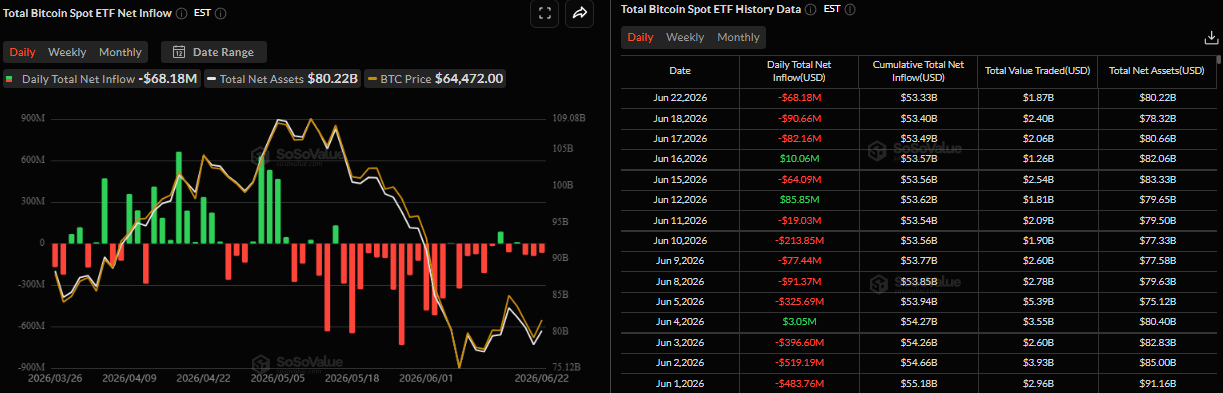
Institutional demand continues to weaken as the week begins. SoSoValue weekly data show that spot BTC ETFs recorded a mild $68.18 million outflow on Monday, following an $226.84 million outflow last week, marking the sixth consecutive week of withdrawals. While outflows were more muted compared to prior weeks, these continued withdrawals weigh on Bitcoin’s price outlook. If these outflows intensify over the coming days, BTC could see a deeper correction.
On the corporate side, Strategy announced on Monday that the firm has increased its USD Reserve by $300 million to $1.4 billion and plans to continue replenishing it to support the credit quality of its Digital Credit securities. Moreover, the firm also acquired 520 BTC during the same period, bringing the total holdings to 847,363 BTC. This highlights the company’s continued conviction in Bitcoin and aggressive accumulation despite the recent BTC price correction.
Bitcoin Price Forecast: BTC faces rejection from the $64,000 mark
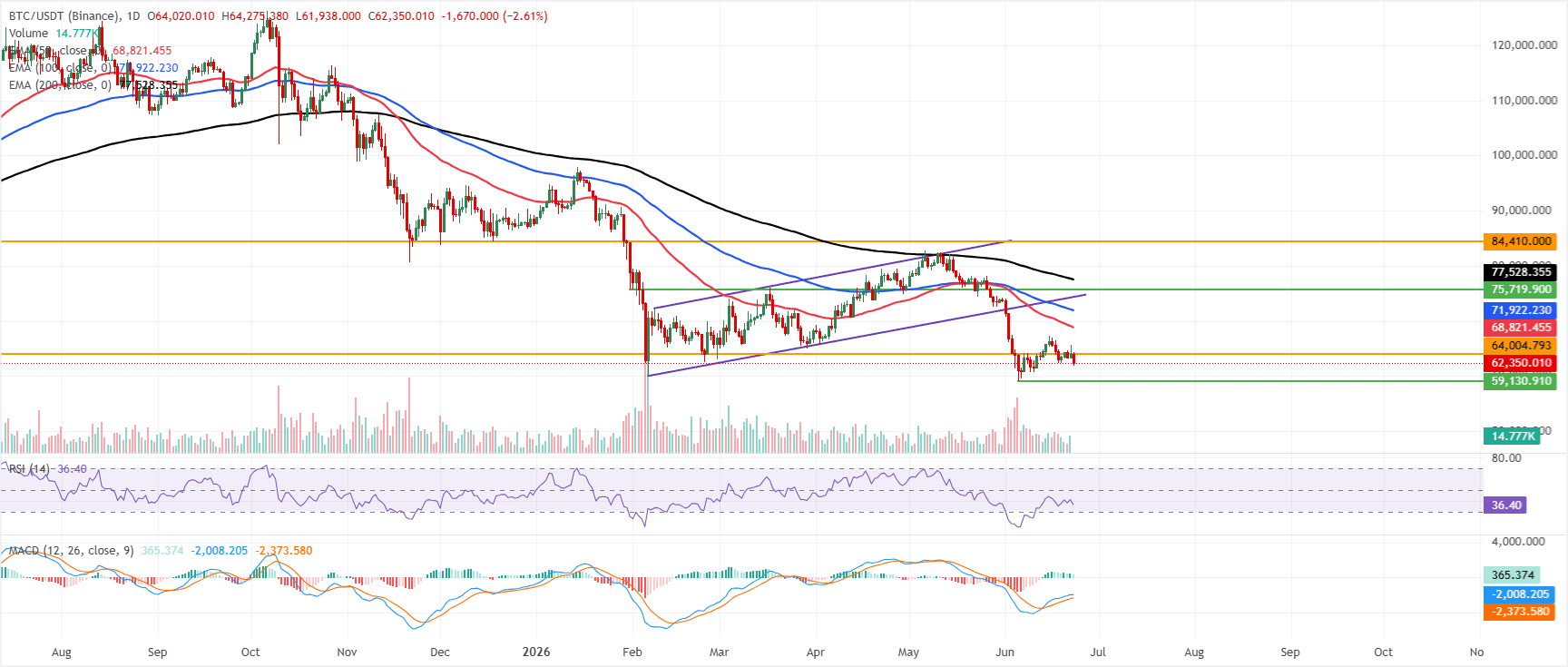
Bitcoin price trades at $62,350 on Tuesday, keeping a bearish near-term bias as it sits well beneath the key Exponential Moving Averages (EMAs). BTC faced rejection at the horizontal daily resistance level of $64,004 the previous day, suggesting the structure is fragile.
Momentum is mixed, with the Relative Strength Index (RSI) subdued near 36. Still, the Moving Average Convergence Divergence (MACD) histogram is holding in positive territory, suggesting selling pressure is losing intensity rather than accelerating.
On the topside, initial resistance is aligned with the horizontal level at $64,004, where a recovery would first be challenged before the 50-day EMA at $68,821 and the 100-day EMA at $71,922 come into play as more meaningful caps; beyond these, the 200-day EMA at $77,528 and the prior horizontal barrier near $84,410 define a broader medium-term ceiling.
On the downside, the immediate focus remains on whether BTC can hold the psychological level of $60,000, as a daily close decisively below this zone would expose the market to a deeper corrective phase.
(The technical analysis of this story was written with the help of an AI tool.)
Bitcoin, altcoins, stablecoins FAQs
Bitcoin is the largest cryptocurrency by market capitalization, a virtual currency designed to serve as money. This form of payment cannot be controlled by any one person, group, or entity, which eliminates the need for third-party participation during financial transactions.
Altcoins are any cryptocurrency apart from Bitcoin, but some also regard Ethereum as a non-altcoin because it is from these two cryptocurrencies that forking happens. If this is true, then Litecoin is the first altcoin, forked from the Bitcoin protocol and, therefore, an “improved” version of it.
Stablecoins are cryptocurrencies designed to have a stable price, with their value backed by a reserve of the asset it represents. To achieve this, the value of any one stablecoin is pegged to a commodity or financial instrument, such as the US Dollar (USD), with its supply regulated by an algorithm or demand. The main goal of stablecoins is to provide an on/off-ramp for investors willing to trade and invest in cryptocurrencies. Stablecoins also allow investors to store value since cryptocurrencies, in general, are subject to volatility.
Bitcoin dominance is the ratio of Bitcoin's market capitalization to the total market capitalization of all cryptocurrencies combined. It provides a clear picture of Bitcoin’s interest among investors. A high BTC dominance typically happens before and during a bull run, in which investors resort to investing in relatively stable and high market capitalization cryptocurrency like Bitcoin. A drop in BTC dominance usually means that investors are moving their capital and/or profits to altcoins in a quest for higher returns, which usually triggers an explosion of altcoin rallies.














