

Bitcoin Weekly Forecast: Quarter-end rebalancing might fuel BTC next bullish move
- Bitcoin recovers to $61,800 on Friday after falling to a 21-month low of $57,800.
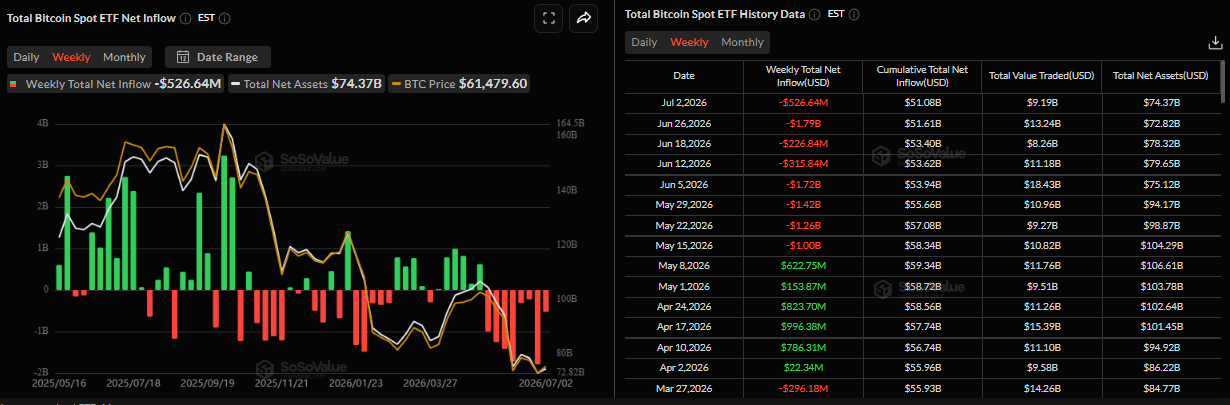
- US-listed spot ETFs recorded outflows of $526.64 million through Thursday, pointing to the eighth consecutive week of withdrawals.
- Analysts highlight that the quarter-end portfolio rebalancing could provide short-term support for Bitcoin.
Bitcoin (BTC) is up over 3% so far this week, trading above $61,800 at the time of writing on Friday after slipping to a 21-month low earlier this week. Institutional selling continued, with spot Exchange Traded Funds (ETFs) recording net outflows of over $520 million through Thursday, pointing to the eighth consecutive week of withdrawals. Meanwhile, analysts suggest that the quarter-end portfolio rebalancing could provide short-term support for Crypto King.

Institutional sell-off continues
Institutional demand continued to weaken so far this week. SoSoValue data show that spot BTC ETFs recorded an outflow of $526.64 million through Thursday. Unless Friday’s inflows are very significant, BTC is about to mark the eighth week of steady withdrawals. This signals that institutional demand continues to weaken and fails to provide a cushion against falling prices, with the largest cryptocurrency by market capitalization sliding to a 21-month low of $57,800 this week.
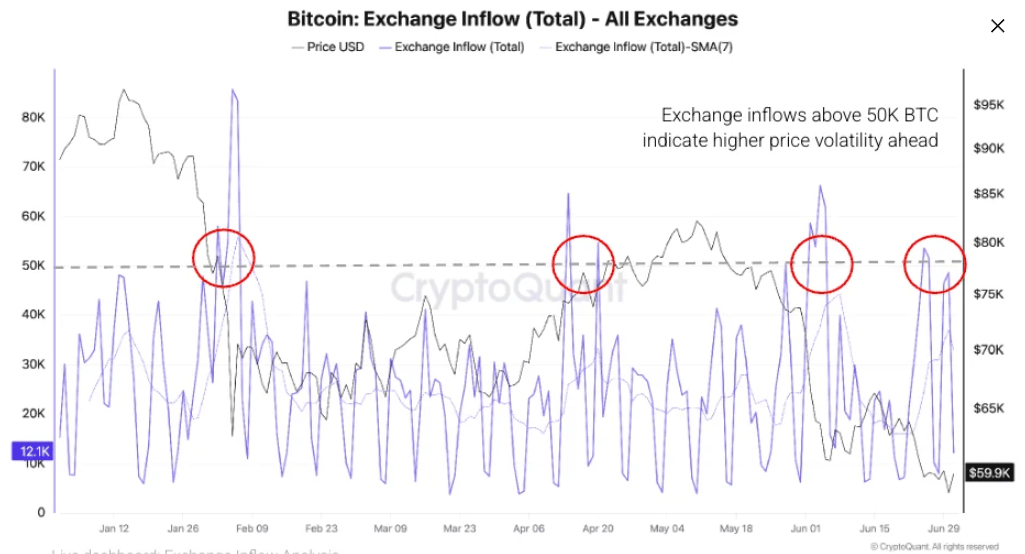
CryptoQuant’s weekly report highlighted that Bitcoin exchange inflows indicate higher price volatility ahead after total deposits spiked towards 50KBTC in a day, a rare extreme seen only four other times in 2026. On Tuesday, Bitcoin exchange inflows surged to 49K BTC, an extremely high reading that has occurred only four other times this year. Each prior instance was associated with a time of sharply higher price volatility.
The analyst at CryptoQuant further explained that the spike coincides with Bitcoin testing the critical $60,000 support level, which, if breached, could take BTC towards $53,000, the realized price.
“At these inflow levels, the market is absorbing a large volume of Bitcoin being repositioned to exchanges, a pattern that has historically preceded significant directional moves”, added the report.
Progress in US-Iran peace talks boosts BTC recovery
Improving geopolitical sentiment helped lift risk appetite in the latter half of the week, with BTC reclaiming $61,000 and seeing a mild recovery after dropping to a 21-month low of $57,800 on Wednesday.
Qatar’s Foreign Ministry said on Wednesday that the US and Iran had made “positive progress” in indirect talks held in Doha, with discussions advancing issues related to the June ceasefire memorandum.
The spokesperson added that negotiators were “building on the outcomes” of a recent summit in Switzerland, raising hopes for a more durable peace agreement.
US President Donald Trump has echoed these comments, adding that the talks delivered some progress on the possible limits to Iran’s nuclear program and that the “denuclearization of the country is moving along well”. US Vice President JD Vance, on the other hand, said that the nuclear matter will be addressed at a later time.
The next meeting for negotiations will take place after funeral processions for Iran’s late Supreme Leader Ayatollah Ali Khamenei, who is due to be buried on July 9, Qatar’s Foreign Ministry said.
The status of the key Strait of Hormuz, however, remains in the air. Traffic through the corridor has increased significantly, contributing to fuel investors’ optimism, but it remains far from the 160 ships that used to cross the waterway before the conflict started.
Traders should keep an eye on the Middle East’s developments, as the fragile situation continues to pose a risk to market sentiment. Any renewed geopolitical tension between the US and Iran over the weekend could bring fresh selling pressure to risk-sensitive assets such as BTC.
Cooling US employment eases Fed tightening expectations
On the macroeconomic front, cooling US employment eases Federal Reserve (Fed) tightening expectations, supporting a recovery in risky assets.
Traders scaled back their bets on Fed rate hikes following the release of softer-than-expected US employment data on Thursday. The closely watched US Nonfarm Payrolls (NFP) report showed that the economy added only 57K new jobs in June, compared with the 110K consensus estimate. Moreover, the previous month’s reading was revised down from 172K to 129K, while the Unemployment Rate edged lower to 4.2% in June.
Nevertheless, the crucial data pointed to softening labor conditions and came on top of easing inflation fears amid the recent slump in Crude Oil prices, tempering expectations of higher-for-longer interest rates. In fact, traders shifted expectations from one to two Fed rate increases in 2026 to between zero and one hike. The shift has weighed on the US Dollar (USD), providing support for Bitcoin’s ongoing recovery.
Is quarter-end rebalancing BTC’s next bullish catalyst?
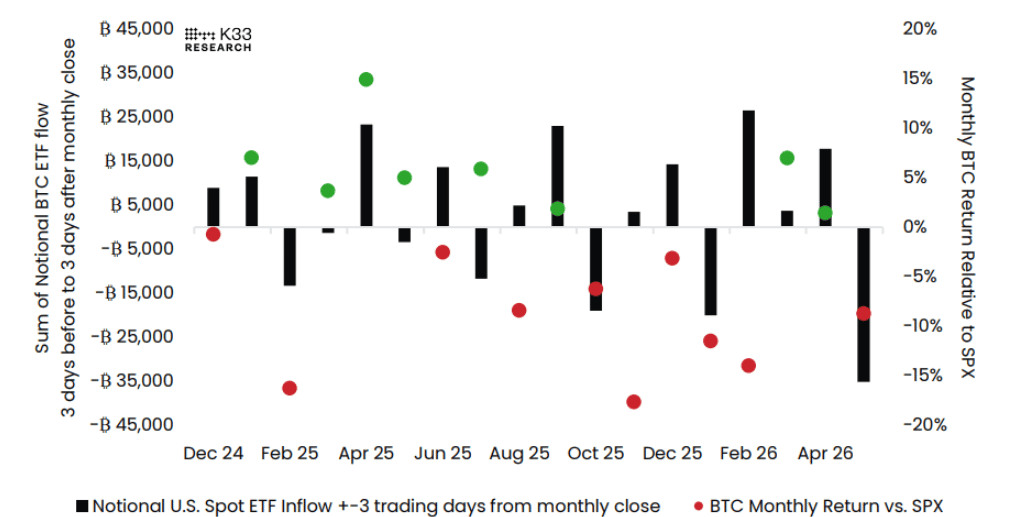
A K33 research report on Tuesday suggests quarter-end portfolio rebalancing could provide short-term support for Bitcoin.
The chart below shows that over the past 18 months, 9 months have seen net ETF flows during the six-day window surrounding month-end (three trading days before and three trading days after month-end) diverge materially from the prevailing trend during the rest of the month.
“In several of these cases, months in which Bitcoin underperformed the S&P 500 were followed by stronger ETF inflows around month-end and into the start of the following month,” said K33 Research analyst.
The analyst further explained that this behavior is consistent with portfolio rebalancing, as investors may increase their Bitcoin exposure after periods of relative underperformance to restore target asset allocations. However, the relationship has not been universal. The remaining nine months in the sample did not exhibit the same pattern, indicating that portfolio rebalancing is not a persistent driver of Bitcoin ETF flows and likely represents just one of several factors influencing institutional demand.
Meanwhile, the trend has become more consistent over the past four quarters. If this pattern continues, quarter-end portfolio rebalancing could provide a much-needed tailwind for Bitcoin, potentially supporting a short-term recovery during the first few trading days of July.
Ryan Lee, Chief Analyst at Bitget, told Fxstreet that “Quarter-end portfolio rebalancing may create short-term trading activity, but it is unlikely to be the catalyst that changes Bitcoin's broader trend. With Bitcoin trading between $58,000-$62,000 following a roughly 14% decline in Q2, the market continues to face pressure from persistent spot ETF outflows and softer institutional demand. While portfolio adjustments can generate opportunistic buying when crypto allocations fall below target weights, Bitcoin's next meaningful move will depend more on ETF flows, macroeconomic data and broader risk sentiment.”
However, in an exclusive interview, Dean Chen, an analyst at Bitunix Exchange, believes quarter-end rebalancing is unlikely to serve as a meaningful bullish catalyst for Bitcoin.
According to Chen, the process is better viewed as a short-term liquidity redistribution mechanism rather than a source of fresh capital entering the market.
He explained that in a market that has been in a sustained downtrend, quarter-end flows can move in either direction. Some portfolios may mechanically rebalance into underweighted risk assets, creating short-term demand. At the same time, others may reduce exposure due to risk compression and de-leveraging.
As a result, Chen argues that quarter-end rebalancing tends to amplify short-term volatility rather than establish a clear directional trend. “Quarter-end rebalancing does not create new capital. It only reshuffles existing exposure, making it a timing effect rather than a trend driver,” he said.
In Chen’s view, quarter-end portfolio adjustments should be regarded as short-term market noise rather than a structural catalyst capable of changing Bitcoin’s broader price trajectory.
Technical outlook: Is BTC bottoming?
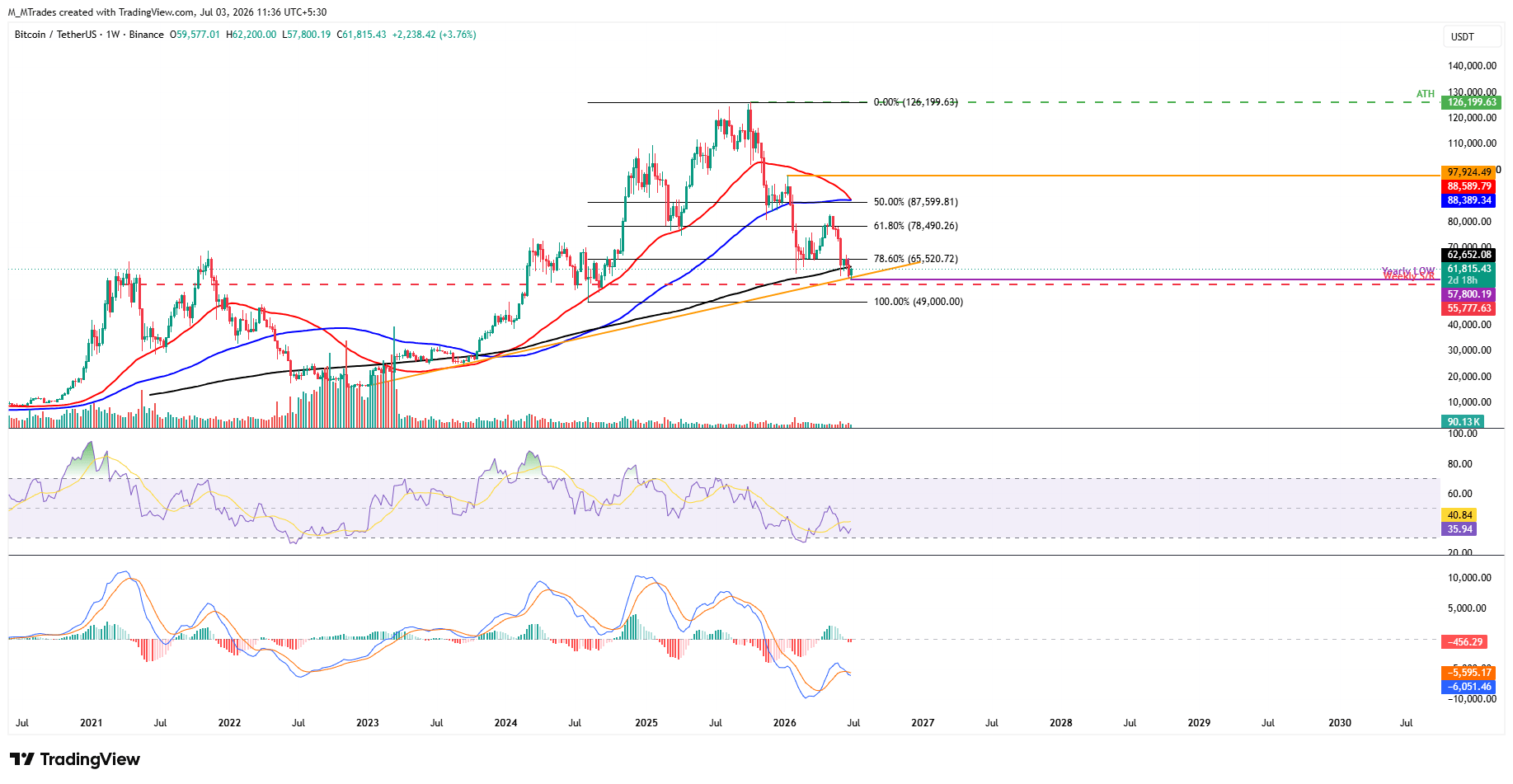
Bitcoin recovered over 3%, trading above $61,800 on Friday after finding support around the ascending trendline (drawn by connecting multiple lows since January 2023) earlier this week. Meanwhile, the Crypto King has dropped to a new yearly low of $57,800, the lowest level since September 2024, during the same week.
If BTC continues to hold this ascending trendline support roughly around $58,000, it could extend the recovery toward the 200-week Simple Moving Average (SMA) at $62,652. A successful weekly close above this level could extend gains toward the 78.60% Fibonacci retracement level at $65,520 (drawn from the August 2024 low of $49,000 to the October 2025 record high at $126,199).
Momentum indicators on the weekly chart show signs of concern: the Relative Strength Index (RSI) is trending lower and nearing oversold territory, with a reading of 35 on Friday. Meanwhile, the Moving Average Convergence Divergence (MACD) flipped to a bearish crossover on June 22, and the bearish signal remains intact, supporting a negative outlook.
However, if BTC closes below the ascending trendline support, roughly around $58,000 on a weekly basis, it could extend the losses toward the next weekly support at $55,777.
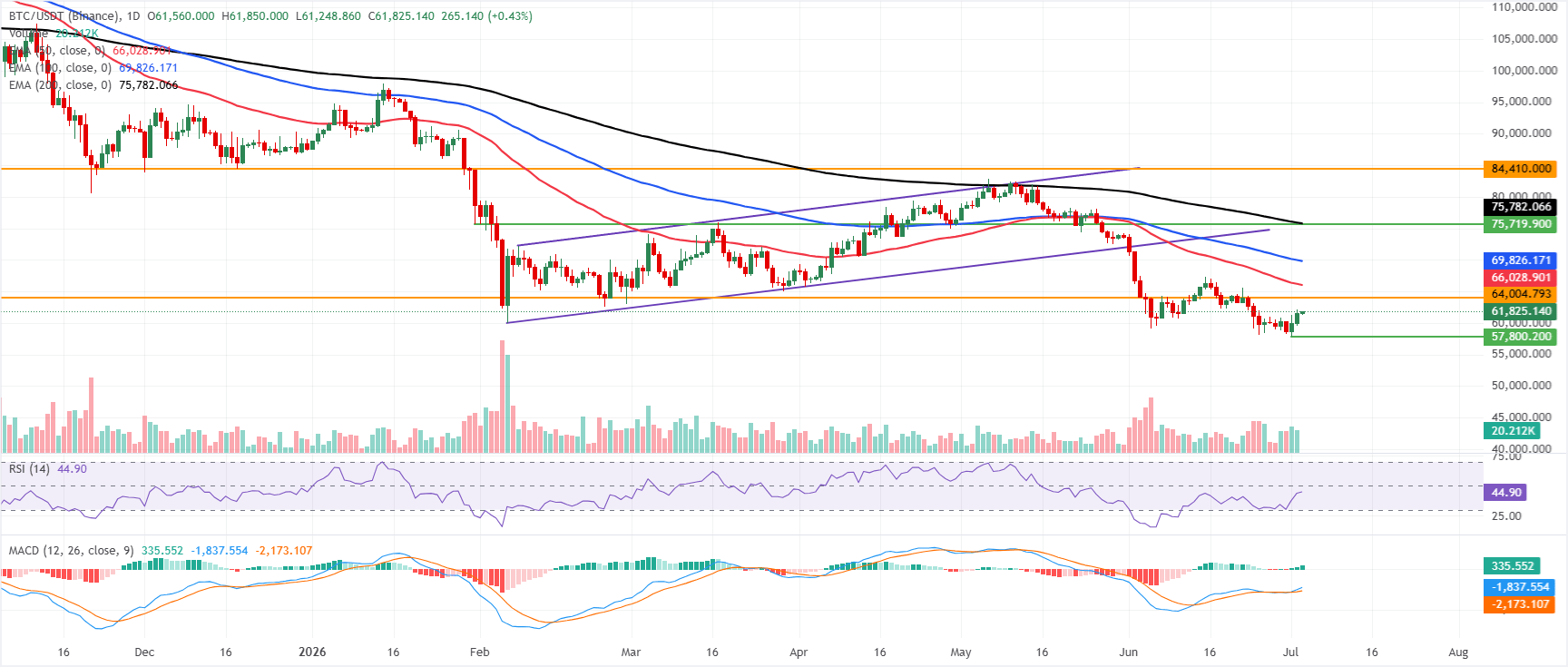
On the daily chart, BTC reclaims $61,300 on Friday, after rebounding from a 21-month low of $57,800 earlier this week. However, BTC maintains a bearish bias, as it decisively remains below the 50-day, 100-day, and 200-day Exponential Moving Averages (EMAs) at $66,028, $69,826, and $75,782, respectively.
The Relative Strength Index (RSI) at 44 stays below the midline, hinting at subdued buying pressure, while the Moving Average Convergence Divergence (MACD) shows a positive reading with the MACD line above its signal and above zero, indicating improving but still insufficient momentum to challenge the prevailing overhead supply.
On the topside, initial resistance appears near the horizontal barrier at $64,004, ahead of the 50-day EMA at $66,028, which reinforces a wider cap zone for any bounce. Further up, the 100-day EMA at $69,826 and the 200-day EMA at $75,782 align as successive resistance levels before the more distant horizontal level at $84,410.
On the downside, a failure to reclaim the $64,000 area would leave BTC vulnerable to renewed pressure targeting the key psychological level at $55,000.
(The technical analysis of this story was written with the help of an AI tool.)
Bitcoin, altcoins, stablecoins FAQs
Bitcoin is the largest cryptocurrency by market capitalization, a virtual currency designed to serve as money. This form of payment cannot be controlled by any one person, group, or entity, which eliminates the need for third-party participation during financial transactions.
Altcoins are any cryptocurrency apart from Bitcoin, but some also regard Ethereum as a non-altcoin because it is from these two cryptocurrencies that forking happens. If this is true, then Litecoin is the first altcoin, forked from the Bitcoin protocol and, therefore, an “improved” version of it.
Stablecoins are cryptocurrencies designed to have a stable price, with their value backed by a reserve of the asset it represents. To achieve this, the value of any one stablecoin is pegged to a commodity or financial instrument, such as the US Dollar (USD), with its supply regulated by an algorithm or demand. The main goal of stablecoins is to provide an on/off-ramp for investors willing to trade and invest in cryptocurrencies. Stablecoins also allow investors to store value since cryptocurrencies, in general, are subject to volatility.
Bitcoin dominance is the ratio of Bitcoin's market capitalization to the total market capitalization of all cryptocurrencies combined. It provides a clear picture of Bitcoin’s interest among investors. A high BTC dominance typically happens before and during a bull run, in which investors resort to investing in relatively stable and high market capitalization cryptocurrency like Bitcoin. A drop in BTC dominance usually means that investors are moving their capital and/or profits to altcoins in a quest for higher returns, which usually triggers an explosion of altcoin rallies.














