

British Pound Sterling Runs Out of American Bad News After Nine Straight Days
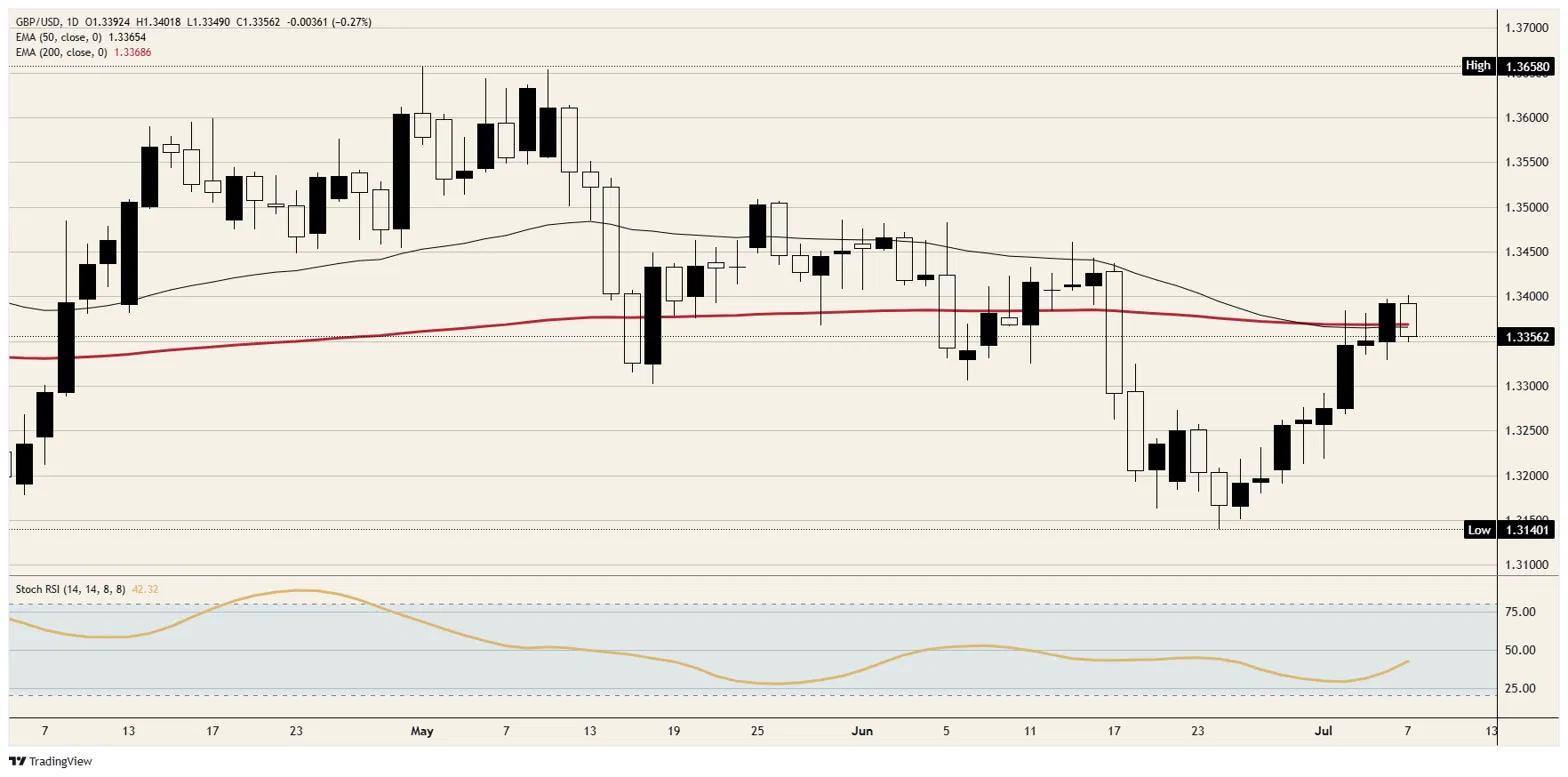
- GBP/USD snapped a nine-session winning streak on Tuesday, closing near 1.3356 after an early rejection at the 1.3400 handle.
- Iranian missile strikes on commercial shipping in the Strait of Hormuz revived the safe-haven Dollar bid and dragged risk assets lower from Asia onward.
- FOMC Minutes land Wednesday at 18:00 GMT, with July hike odds still priced near one-in-four and cuts at zero.
The Pound's nine-session march against the Dollar ended on Tuesday, and it took exactly one geopolitical headline to finish it. Cable opened near 1.3392, poked above the 1.3400 handle in early European trade, and then spent the balance of the session giving ground to settle around 1.3356, down 0.27% and back below a daily moving-average cluster that has been waiting overhead for weeks.
A winning streak with no British content
The streak that died on Tuesday was never a Sterling story to begin with, and its fuel was entirely imported: nine consecutive gains off the 1.3140 base in late June, powered by a deteriorating American labour tape. June nonfarm payrolls printed 57,000 against a consensus near 115,000, earlier months were revised lower, and Tuesday's ADP four-week average employment change slipped to 21,000 from 24,250, extending the softening trend.
Rallies borrowed from the other side's misfortune carry no domestic floor when the lending stops. Markets still assign roughly one-in-four odds to a Federal Reserve hike at the July 28 to 29 meeting, up from near one-in-eight a month ago, and the Federal Reserve Chair used last week's Sintra forum to call inflation too high while refusing to signal a direction. The payrolls miss trimmed the hawkish tail without creating a dovish one; rate cuts are priced at effectively zero.
Missiles in the strait, and the bid goes home
Overnight, Iranian missiles struck two commercial vessels transiting the Strait of Hormuz, and a third ship was attacked Tuesday morning. A Qatari liquefied natural gas carrier caught fire off the Omani coast after taking a projectile to its port side, in the most serious assault on the waterway since the agreement signed at Versailles was meant to have settled it.
Tehran insists all traffic use its approved routes and intends to charge passage fees, terms Washington and the Gulf states reject outright, and the strikes read as enforcement of that claim rather than random violence. The American President responded that his administration will either complete a deal or finish the job militarily, which kept the escalation premium alive through the New York session.
Risk appetite did what it always does when tankers burn, rotating into the Dollar and out of anything priced off global trade, with an Asian technology sell-off deepening the defensive tone. The Bank of England's Financial Stability Report, published at 09:30 GMT, landed as a footnote to its own tape: stability risks have risen in 2026, artificial intelligence valuations look stretched, private credit vulnerabilities are more pronounced, and the odds of several risks crystallizing at once have grown.
The Bank of England's unpaid hawks
Sterling carries a hawkish story of its own on paper, and it is not a subtle one. The Bank of England held Bank Rate at 3.75% in June on a seven-to-two vote, with the dissenters demanding an immediate hike; the Monetary Policy Committee's most vocal external hawk spent last week advertising readiness for an activist move if expectations fail to subside; household one-year inflation expectations sit at 4%, double the target, while services inflation runs near 4.5%.
None of that hawkishness is being paid by the rates market, which prices no full quarter-point hike until March 2027, a repricing the hawks themselves argue has loosened financial conditions and strengthened the case for acting. The fiscal handover from Keir Starmer to Labour leader-designate Andy Burnham hangs a question mark over the budget stance that no committee rhetoric can remove, so the Pound rallies on American weakness because its own catalysts refuse to price.
Minutes first, then the claims
Wednesday's Federal Open Market Committee Minutes, due at 18:00 GMT, are the week's binary event. The June meeting stripped the easing bias from the statement and lifted the median projection to one hike by year-end, with nine of nineteen officials pencilling in at least one increase, so the Minutes will reveal how broad that camp runs and how low its bar sits. A hawkish read into a fragile risk tape is the cleanest recipe going for renewed Dollar strength.
Thursday stacks a Bank of England Deputy Governor appearance at 09:30 GMT, Initial Jobless Claims at 12:30 GMT against a 218,000 consensus, a New York Federal Reserve President speech at 13:00 GMT, and June Existing Home Sales at 14:00 GMT. Claims are the only release with real teeth; an upside surprise would extend the labour-softening narrative that built the streak, while an in-line print leaves the Minutes standing as the week's verdict on the Dollar.
Levels to watch
Resistance: The flattened 50-day and 200-day Exponential Moving Averages sit inside a five-pip band just under 1.3370, with the shorter average now a whisker below the longer, and Tuesday's rejection at the 1.3400 handle marks the ceiling above them; beyond that, the mid-June pivot near 1.3450 caps the recovery.
Support: The round 1.3300 handle is first demand, backed by the early-July shelf around 1.3250; below there, the 1.3140 base is the level whose loss ends the recovery argument entirely.
Bias: Lower. A nine-session run died on first contact with the daily moving-average cluster, Wednesday's Minutes risk skews hawkish, and the tape is trading tankers rather than payrolls; sellers hold the advantage toward 1.3300 unless buyers reclaim the 1.3400 handle on a daily close.
GBP/USD daily chart
Pound Sterling FAQs
The Pound Sterling (GBP) is the oldest currency in the world (886 AD) and the official currency of the United Kingdom. It is the fourth most traded unit for foreign exchange (FX) in the world, accounting for 12% of all transactions, averaging $630 billion a day, according to 2022 data. Its key trading pairs are GBP/USD, also known as ‘Cable’, which accounts for 11% of FX, GBP/JPY, or the ‘Dragon’ as it is known by traders (3%), and EUR/GBP (2%). The Pound Sterling is issued by the Bank of England (BoE).
The single most important factor influencing the value of the Pound Sterling is monetary policy decided by the Bank of England. The BoE bases its decisions on whether it has achieved its primary goal of “price stability” – a steady inflation rate of around 2%. Its primary tool for achieving this is the adjustment of interest rates. When inflation is too high, the BoE will try to rein it in by raising interest rates, making it more expensive for people and businesses to access credit. This is generally positive for GBP, as higher interest rates make the UK a more attractive place for global investors to park their money. When inflation falls too low it is a sign economic growth is slowing. In this scenario, the BoE will consider lowering interest rates to cheapen credit so businesses will borrow more to invest in growth-generating projects.
Data releases gauge the health of the economy and can impact the value of the Pound Sterling. Indicators such as GDP, Manufacturing and Services PMIs, and employment can all influence the direction of the GBP. A strong economy is good for Sterling. Not only does it attract more foreign investment but it may encourage the BoE to put up interest rates, which will directly strengthen GBP. Otherwise, if economic data is weak, the Pound Sterling is likely to fall.
Another significant data release for the Pound Sterling is the Trade Balance. This indicator measures the difference between what a country earns from its exports and what it spends on imports over a given period. If a country produces highly sought-after exports, its currency will benefit purely from the extra demand created from foreign buyers seeking to purchase these goods. Therefore, a positive net Trade Balance strengthens a currency and vice versa for a negative balance.














