

Dow Jones Industrial Average slides below 49,000 as tariff chaos returns
- The Dow Jones shed around 700 points on Monday as Trump's new 15% global tariff rattled markets.
- Novo Nordisk plunged after its next-gen obesity drug failed to match Eli Lilly's Zepbound in a head-to-head trial.
- Software and payment stocks extended their 2026 selloff on AI displacement fears ahead of Nvidia earnings.
- Gilead Sciences announced a $7.8 billion acquisition of Arcellx, sending the biotech's shares up nearly 80%.
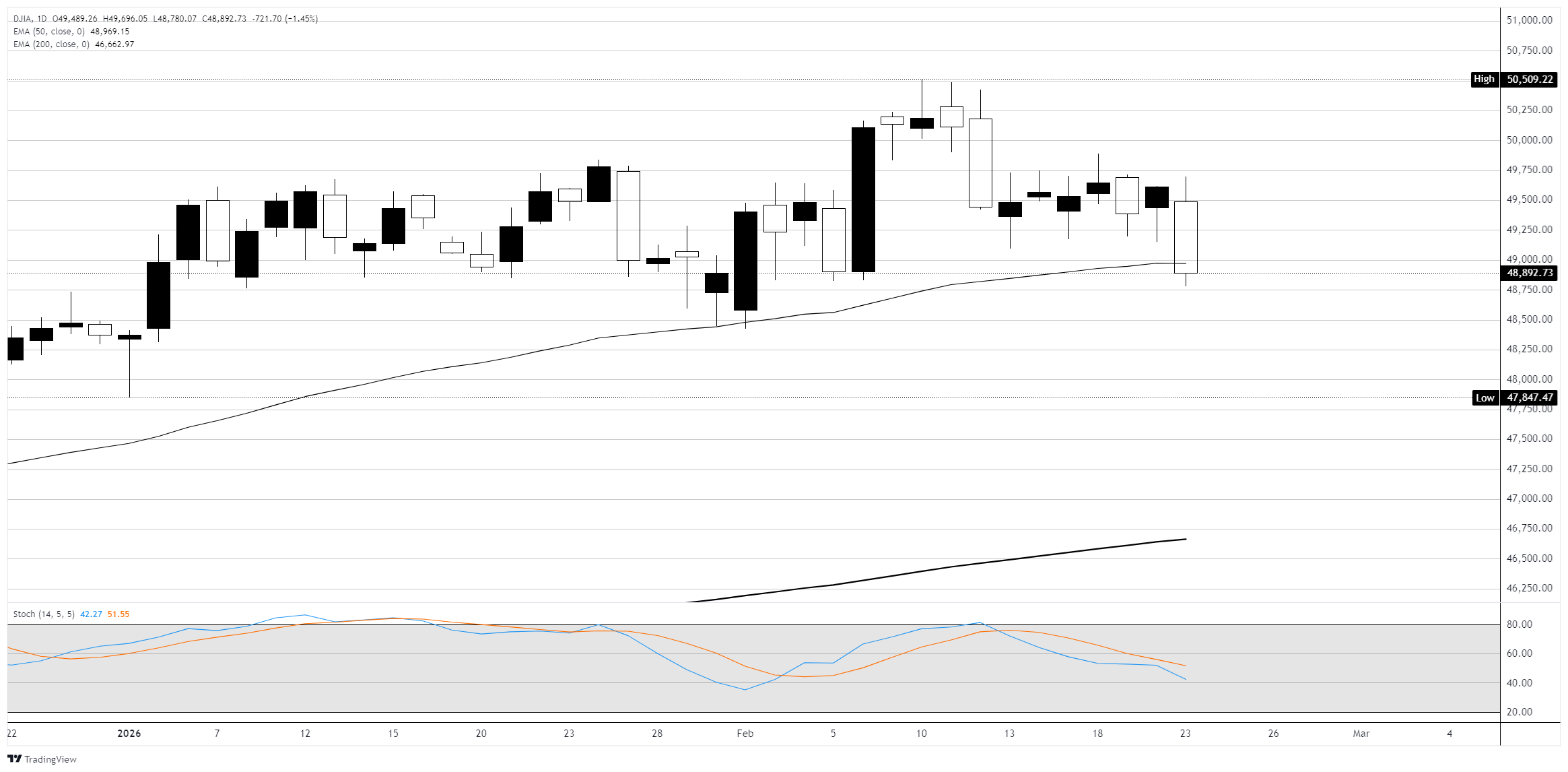
The Dow Jones Industrial Average (DJIA) fell sharply on Monday, shedding around 700 points or 1.45%, as fresh tariff uncertainty weighed on sentiment. The S&P 500 slipped 0.6% while the Nasdaq Composite dropped 0.7%. President Donald Trump's decision over the weekend to raise his new Section 122 global tariff from 10% to the maximum 15% — a move made days after the US Supreme Court struck down his sweeping tariffs imposed under the International Emergency Economic Powers Act (IEEPA) — drove markets to trim riskier positions. Major US trading partners signaled they may revisit deals previously agreed under the now-invalidated tariff framework, adding to the uncertainty. The 15% levy is capped at 150 days under Section 122, meaning Congress will need to act to extend it, and the administration has already flagged plans to launch Section 301 investigations to establish a more durable tariff structure.

Novo Nordisk crushed by CagriSema trial miss
Novo Nordisk (NVO) shares cratered as much as 16% after its next-generation weight loss drug CagriSema failed to demonstrate non-inferiority against Eli Lilly's (LLY) tirzepatide in the REDEFINE 4 head-to-head trial. CagriSema achieved 20.2% weight loss after 84 weeks versus 23.6% for tirzepatide on a treatment-regimen basis, a significant miss for a drug Novo had positioned as its key weapon to reclaim ground in the obesity market. Eli Lilly shares climbed around 3% on the news, further widening the competitive gap. Novo CEO Maziar Mike Doustdar pushed back against an analyst who called the drug "obsolete," noting CagriSema has already been submitted to the FDA and could still be the first GLP-1/amylin combo product to market. An FDA decision is expected by late 2026, but with tirzepatide already setting the efficacy bar, Novo's stock is now trading at levels not seen since mid-2021.
Software and payment stocks extend selloff on AI fears
The AI-driven rotation out of software and payments accelerated on Monday. Oracle (ORCL) and Palantir Technologies (PLTR) both dropped around 4%, extending their recent selloffs as investors increasingly price in the risk that AI tools like coding assistants and automated workflows could eat into legacy software margins. American Express (AXP) tanked roughly 5-7%, pressuring the Dow, as similar AI displacement concerns weighed on financial services names. The iShares Software ETF is now down around 20% year-to-date, reflecting one of the most aggressive sector unwinds of the cycle. The pressure comes ahead of a packed earnings week, with Nvidia Corporation (NVDA) set to report Wednesday afternoon. Nvidia was one of the few bright spots on the day, ticking up around 1.7% as analysts at Goldman Sachs and Wells Fargo both raised their price targets ahead of the print. The Street expects earnings of $1.53 per share on revenue of $65.7 billion.
Gilead bets big on cell therapy with Arcellx buyout
Gilead Sciences (GILD) announced it will acquire Arcellx (ACLX) for $7.8 billion in a deal centered on anito-cel, an investigational CAR-T therapy for multiple myeloma. Arcellx shares surged nearly 80% to the $115 per share offer price, which includes a contingent value right of $5 per share tied to cumulative sales targets. Gilead already owned about 11.5% of Arcellx's equity and has been a development partner since 2022. The FDA is expected to make a decision on anito-cel by December 23, 2026. Gilead shares dipped modestly on the announcement, a typical reaction when a large-cap buyer commits significant cash to an acquisition.
Gold rallies, Domino's delivers ahead of heavy earnings week
Gold climbed over 1% to around $5,168 per ounce while Silver pushed toward $88 as the tariff shakeup boosted safe-haven demand. Bitcoin continued its 2026 slide, falling to around $65K. In corporate news, Domino's Pizza (DPZ) reported fourth-quarter results that topped revenue expectations at $1.54 billion, with US same-store sales growing 3.7%. Shares jumped around 5% despite a narrow EPS miss. Looking ahead, the week's marquee event is Nvidia's Wednesday report, with Salesforce (CRM), Snowflake (SNOW), Home Depot (HD), and several other high-profile names also on deck.
Dow Jones daily chart
Dow Jones FAQs
The Dow Jones Industrial Average, one of the oldest stock market indices in the world, is compiled of the 30 most traded stocks in the US. The index is price-weighted rather than weighted by capitalization. It is calculated by summing the prices of the constituent stocks and dividing them by a factor, currently 0.152. The index was founded by Charles Dow, who also founded the Wall Street Journal. In later years it has been criticized for not being broadly representative enough because it only tracks 30 conglomerates, unlike broader indices such as the S&P 500.
Many different factors drive the Dow Jones Industrial Average (DJIA). The aggregate performance of the component companies revealed in quarterly company earnings reports is the main one. US and global macroeconomic data also contributes as it impacts on investor sentiment. The level of interest rates, set by the Federal Reserve (Fed), also influences the DJIA as it affects the cost of credit, on which many corporations are heavily reliant. Therefore, inflation can be a major driver as well as other metrics which impact the Fed decisions.
Dow Theory is a method for identifying the primary trend of the stock market developed by Charles Dow. A key step is to compare the direction of the Dow Jones Industrial Average (DJIA) and the Dow Jones Transportation Average (DJTA) and only follow trends where both are moving in the same direction. Volume is a confirmatory criteria. The theory uses elements of peak and trough analysis. Dow’s theory posits three trend phases: accumulation, when smart money starts buying or selling; public participation, when the wider public joins in; and distribution, when the smart money exits.
There are a number of ways to trade the DJIA. One is to use ETFs which allow investors to trade the DJIA as a single security, rather than having to buy shares in all 30 constituent companies. A leading example is the SPDR Dow Jones Industrial Average ETF (DIA). DJIA futures contracts enable traders to speculate on the future value of the index and Options provide the right, but not the obligation, to buy or sell the index at a predetermined price in the future. Mutual funds enable investors to buy a share of a diversified portfolio of DJIA stocks thus providing exposure to the overall index.














