

Gold struggles around $4,700 as yields jump and war fears persist
- Rising US Treasury yields pressures Gold and drags prices to eight-day lows.
- Strong US flash PMIs offset weaker jobless claims and supported yields.
- Middle East headlines and higher Oil prices keep inflation fears elevated.
Gold (XAU/USD) price eases on Thursday as tensions between the US and Iran remain high, while Israel and Lebanon prepare for talks, with both ambassadors in the US set to meet at the White House with President Donald Trump in attendance. At the time of writing, XAU/USD trades at $4,716, down 0.48%, after reaching a daily low of $4,664.

Bullion slides as strong PMIs and rising rates blunt haven appeal
The flow of headlines from the Middle East continues as the Israeli press reported that Iran’s Parliament Speaker Mohammad Bagher Ghalibaf resigned from the negotiating team, citing growing interference from Islamic Revolutionary Guard Corps (IRGC). News from Al Arabiya reported that Israel is on alert in anticipation of a possible resumption of the war by the end of the week.
Meanwhile, the Strait of Hormuz remains shut as the US and Iran continue to seize ships. Recently, WTI Crude Oil prices rose on the headline of Ghalibaf’s resignation, while bullion is extending its losses near $4,700.
In the meantime, economic data in the US revealed that the number of Americans filing for unemployment benefits rose by 214K, exceeding forecasts for a 212K rise.
At the same time, business activity in the US expanded as S&P Global revealed Flash PMIs for April. The S&P Global Manufacturing PMI rose from 52.3 to 54, while the Services PMI increased from 49.8 to 51.3, both exceeding forecasts.
The US 10-year Treasury yield surges nearly 4.5 basis points to 4.349%, a headwind for the yellow metal, which sinks to an eight-day low.
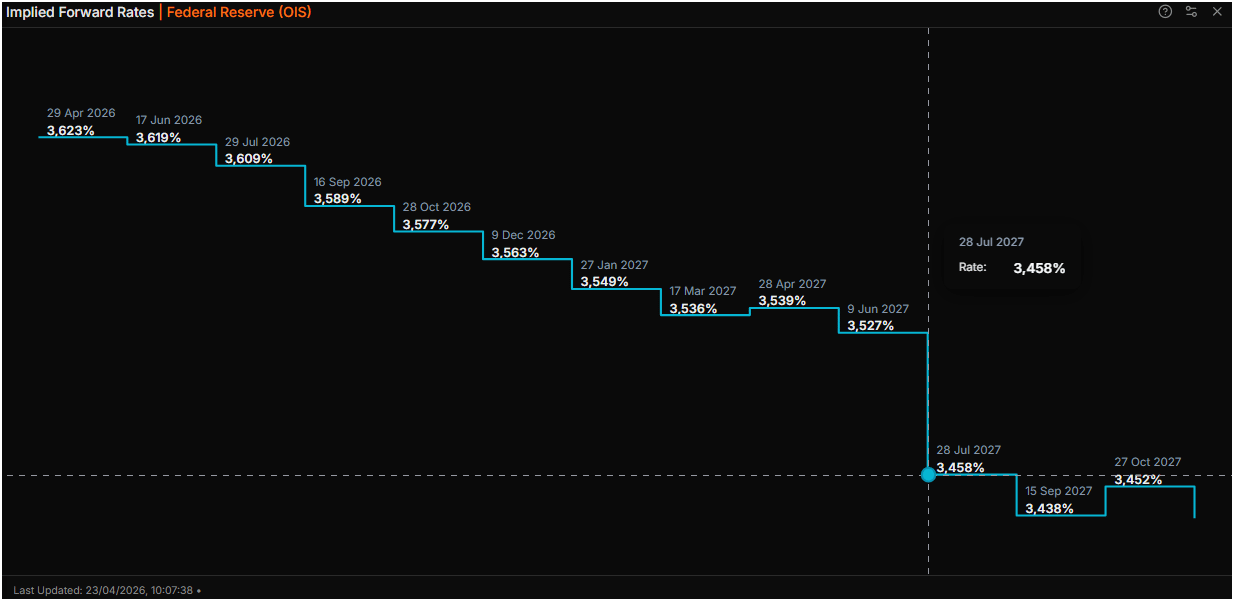
High energy prices are keeping investors pricing in rate hikes by global central banks. At the beginning of 2026, the swaps market expected at least two 25-basis-point rate cuts by the Federal Reserve. So far, they foresee the US central bank holding rates unchanged while eyeing the first rate cut at the July 2027 meeting, as depicted by the Implied Forward Rates curve from Prime Terminal.
Fed implied forward rates
What’s in the US schedule for Friday?
In the US, traders will eye the final revision of the University of Michigan Consumer Sentiment reading for April.
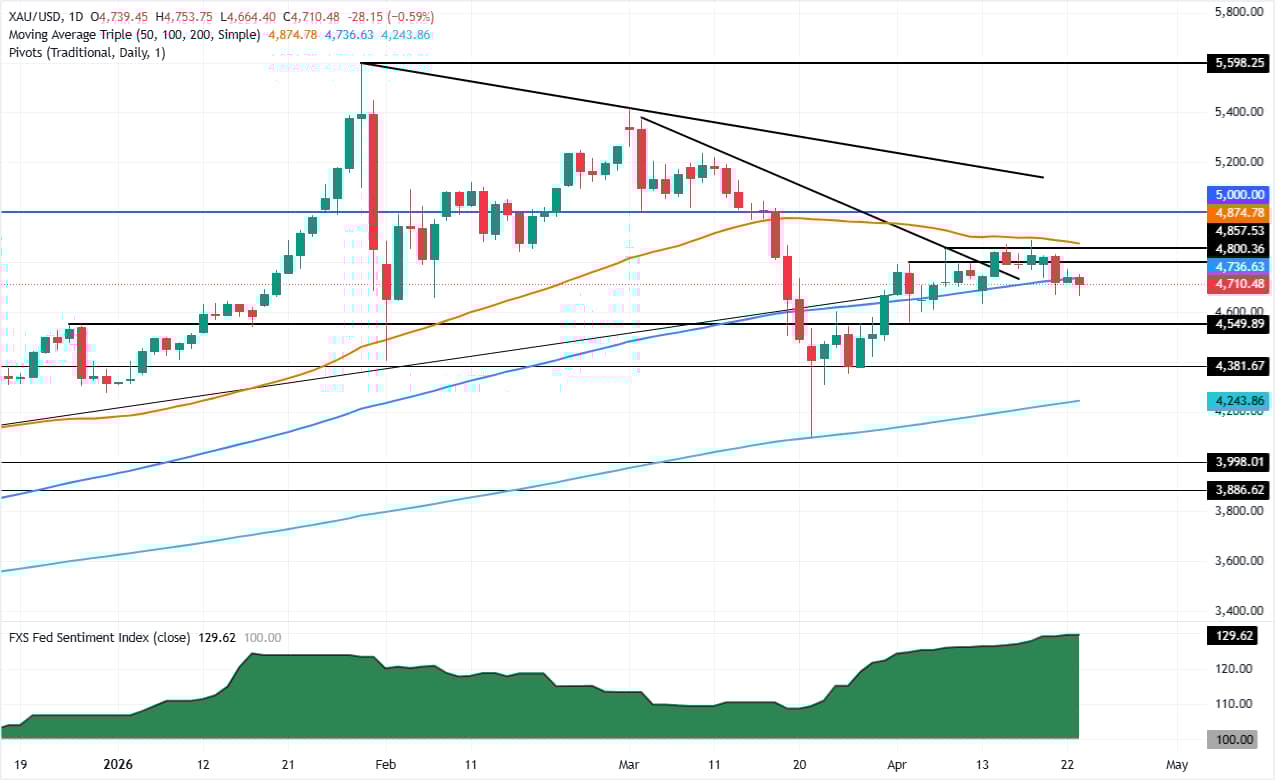
XAU/USD technical outlook: Bears capitalize on headline, further losses seen at $4,650
Gold is posting losses, close to clearing the $4,700 figure and key dynamic support levels, including the 100- and 20-day Simple Moving Averages (SMAs), each at $4,723 and $4,706, respectively.
The Relative Strength Index (RSI) has fallen further into bearish territory, indicating that sellers are gaining steam.
With that said, if XAU/USD clears $4,650, further losses are eyed, with the next area of interest at $4,600. A breach of the latter will expose the December 26 daily high, which has turned into support at $4,549.
For a bullish continuation, Gold must climb above the 100-day SMA and the $4,800 milestone. Above this area, the next key resistance would be the 50-day SMA at $4,876, ahead of $4,900.
Gold FAQs
Gold has played a key role in human’s history as it has been widely used as a store of value and medium of exchange. Currently, apart from its shine and usage for jewelry, the precious metal is widely seen as a safe-haven asset, meaning that it is considered a good investment during turbulent times. Gold is also widely seen as a hedge against inflation and against depreciating currencies as it doesn’t rely on any specific issuer or government.
Central banks are the biggest Gold holders. In their aim to support their currencies in turbulent times, central banks tend to diversify their reserves and buy Gold to improve the perceived strength of the economy and the currency. High Gold reserves can be a source of trust for a country’s solvency. Central banks added 1,136 tonnes of Gold worth around $70 billion to their reserves in 2022, according to data from the World Gold Council. This is the highest yearly purchase since records began. Central banks from emerging economies such as China, India and Turkey are quickly increasing their Gold reserves.
Gold has an inverse correlation with the US Dollar and US Treasuries, which are both major reserve and safe-haven assets. When the Dollar depreciates, Gold tends to rise, enabling investors and central banks to diversify their assets in turbulent times. Gold is also inversely correlated with risk assets. A rally in the stock market tends to weaken Gold price, while sell-offs in riskier markets tend to favor the precious metal.
The price can move due to a wide range of factors. Geopolitical instability or fears of a deep recession can quickly make Gold price escalate due to its safe-haven status. As a yield-less asset, Gold tends to rise with lower interest rates, while higher cost of money usually weighs down on the yellow metal. Still, most moves depend on how the US Dollar (USD) behaves as the asset is priced in dollars (XAU/USD). A strong Dollar tends to keep the price of Gold controlled, whereas a weaker Dollar is likely to push Gold prices up.













