

Ripple faces pressure as card giants Visa and Mastercard enter the stablecoin race
- Ripple supports roughly 2 million daily transactions while expanding the value of real-world assets on its platform.
- Mastercard’s $1.8 billion BVNK acquisition deal and Visa’s plan to launch Stablecoin‑linked cards globally boost competition against Ripple.
- Ripple continues to expand its stablecoin payment rails amid RLUSD's slow growth, while planning to launch a lending protocol and other services.
Ripple is facing new competition in the stablecoin payments race from payment giants such as Visa and Mastercard. The shift in market focus to stablecoins for cross-border payments, micro-transactions, and agentic-economy support is brewing competition and reinvigorating investor interest in Ripple.

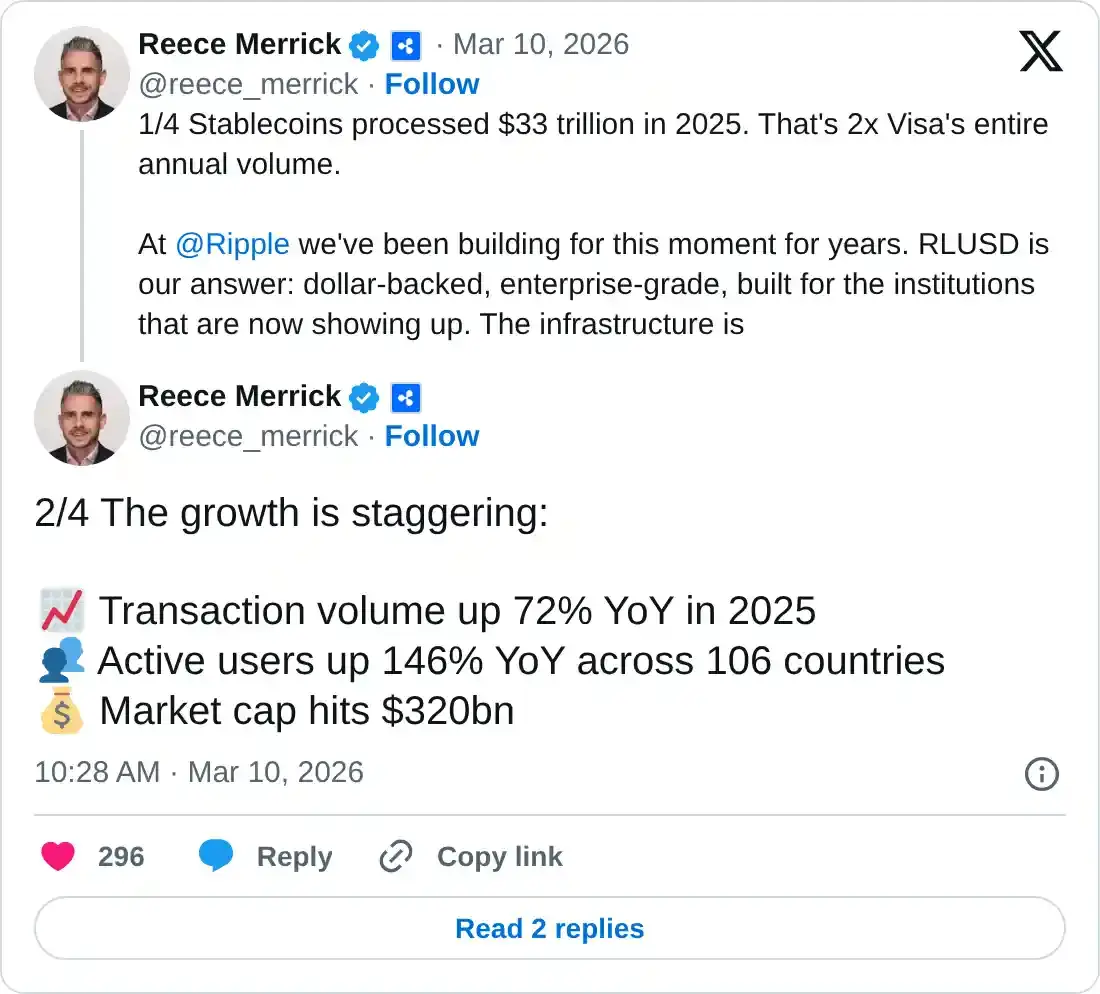
Stablecoins processed $33 trillion in volume, more than double Visa's annual volume, while offering 24x7 quick settlements.
Ripple’s XRP Ledger shows healthy growth
Ripple’s XRP Ledger (XRPL) is a public blockchain designed for low-cost global payments and supports stablecoins, Real-World Assets (RWAs), Decentralized Exchanges (DEXs), and more.
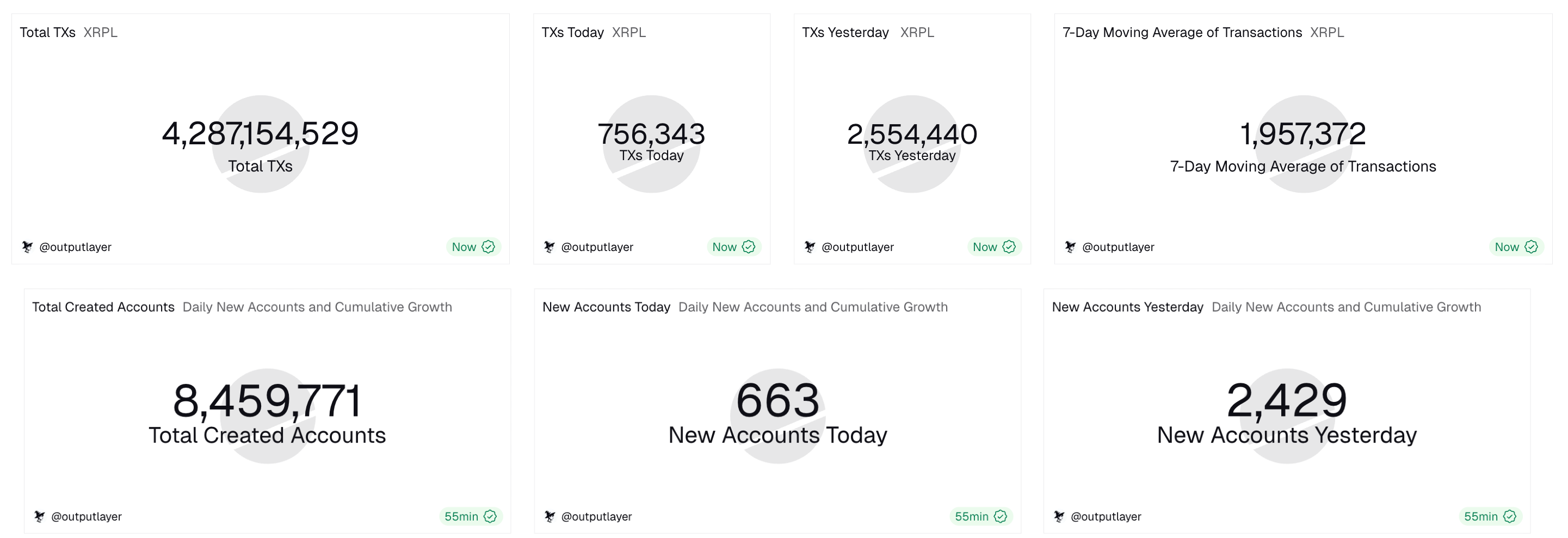
According to a user dashboard on Dune, the total transactions on the XRP ledger stand at 4.28 billion on Wednesday (March 18), with an average of 1.95 million daily transactions over the last seven days. Meanwhile, the total number of accounts on the ledger stands at 8.4 million, with an average of 16,556 daily active users over the same period.
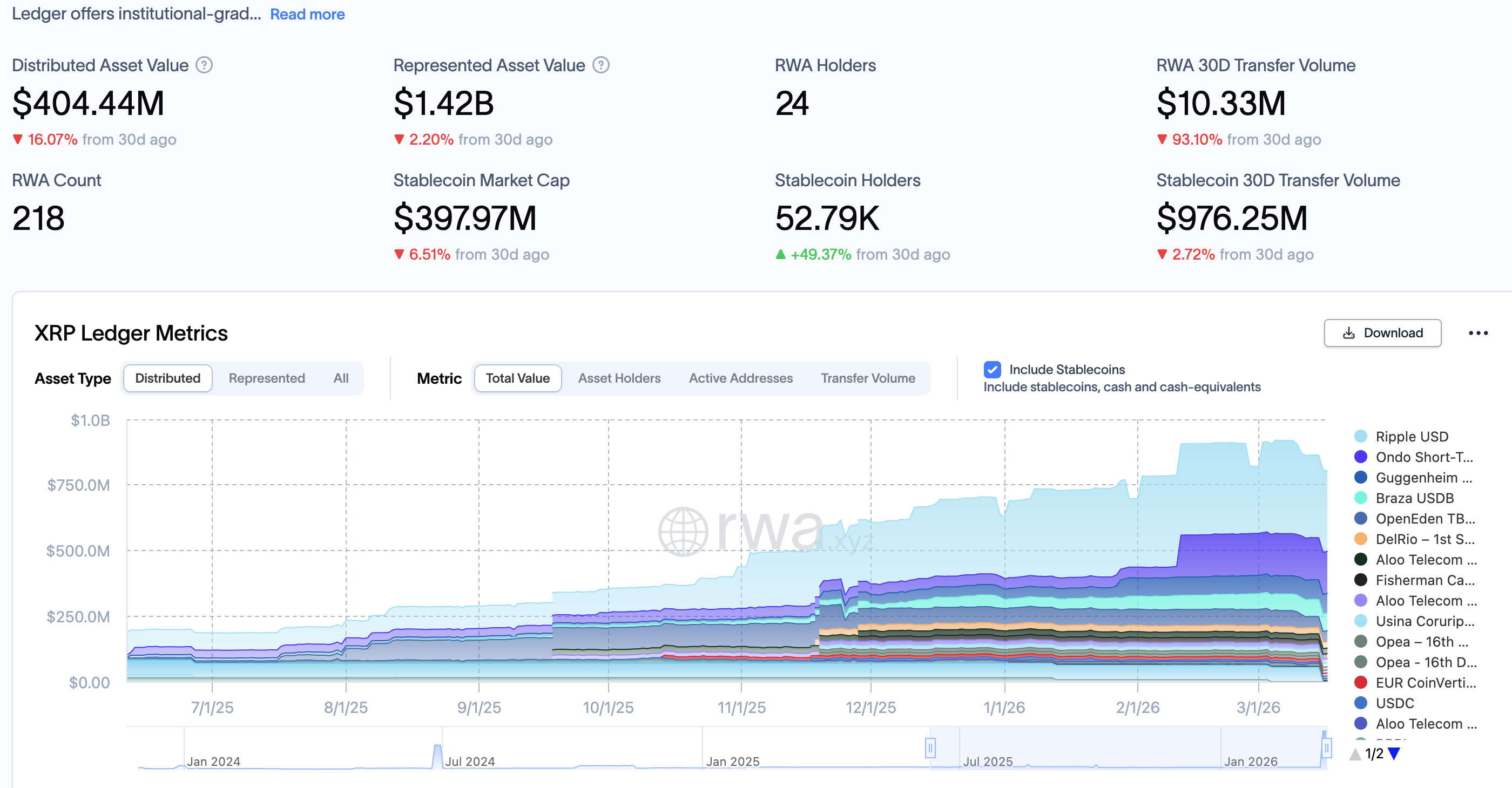
On the other hand, the RWAs are valued at $404 million on the ledger, excluding stablecoins such as $305 million in Ripple’s US Dollar-pegged RLUSD and other cash equivalents. Additionally, the number of stablecoin holders on Ripple has increased to 52,790, up nearly 50% in the last 30 days.
According to Reece Merrick, Senior Executive Officer at Ripple, transaction volume is up 72% Year-on-Year (YoY) in 2025, while active users have increased 146% YoY across 106 countries as Ripple increases its market share in remittances across the Middle East and Africa.
Traditional giants expand their reach to stablecoin
The total stablecoin market cap is at $316 billion as of Wednesday, March 18. But the share of stablecoins in cross-border remittances has increased to $226 billion, up 733% over the past year. Citigroup predicts stablecoin supply could reach $3.7 trillion by 2030, describing stablecoins as blockchain’s “ChatGPT moment.”
The payment networks, such as Visa and Mastercard, are better positioned than US banks, which are extending support for stablecoins while continuing to delegate rewards on stablecoins to cryptocurrency leaders and US regulators in the US CLARITY Act.
Mastercard acquired BVNK, a UK-based stablecoin infrastructure firm, for $1.8 billion to enable 24/7 stablecoin rails on its existing network and to offer faster cross-border settlements, likely at reduced cost. This deal aligns with Mastercard’s aim to increase support for digital assets and its transactions across currencies, rails, and regions.
“We expect that most financial institutions and fintechs will, in time, provide digital currency services, be it with stablecoins or tokenized deposits. We want to support them and their customers with a best-in-class, highly compliant, interoperable offering that brings the benefits of tokenized money to the real world,” said Jorn Lambert, Chief Product Officer at Mastercard.
Meanwhile, Visa has partnered with Bridge, a leading stablecoin infrastructure firm, and Stripe to expand its global card issuance across 100 countries. This will allow users to make daily transactions using stablecoins at Visa merchant locations.
Cuy Sheffield, Head of Crypto at Visa, said, “Visa is committed to meeting businesses where they operate, and increasingly, that’s on-chain,” reflecting the commitment to expand and likely provide further services once stablecoins become mainstream.
Ripple’s XRPL expansion strategy
Ripple intends to expand its stablecoin business with new platforms and services amid regulatory support. Ripple plans to scale the XRP ledger to support institutional-grade Decentralized Finance (DeFi) services for XRP, RLUSD, and other stablecoins, with a new Decentralized Exchange (DEX), the Ledger protocol XLS-65/66, and smart escrows in Q2 2026.
The permissioned DEX will enable secondary markets for RWAs, while the protocol will boost lending activity across single-asset vaults with fixed-term uncollateralized loans.
Meanwhile, smart escrows will add programmability to the existing escrow mechanism beyond time-based or simple conditional triggers. With upcoming features, smart programmability for lending and escrows will boost decentralized finance activity on the XRP ledger.
Traditional card networks (Mastercard and Visa) are racing to integrate stablecoins into their networks to avoid disruption while Ripple expands its stablecoin infrastructure and enterprise-grade cross-border services, making it a battlefield between first-movers and fast-movers.














