

The future of Dogecoin: Will real-world adoption support prices?
- Mainstream adoption of Dogecoin could increase its real utility for everyday spending, according to Timothy Stebbing, director of the Dogecoin Foundation.
- Crypto projects need to deliver value to the next generation, aged around 15 or older, who will experience mainstream crypto.
- DOGE price is down over 85% from its record high of $0.7376 from May 8, 2021.
Prices of meme coins, including Dogecoin (DOGE), have been on a continued downward trend since their boom in 2021. Their future remains a key question among investors, who are increasingly scrutinizing which crypto projects have real-world utility and thus have the highest potential ahead.

Meme coins are widely seen as speculative digital assets driven by internet culture and hype rather than having inherent real-world utility. While some projects are backed by a strong community of supporters, leading tokens within the category are adapting to offer more and more functional use cases.
These efforts, however, don’t always go hand in hand with markets. In DOGE’s case, the price has dropped below $0.1000 as of Friday, trading at a discount of 85% from its all-time high of $0.7376 from five years ago on May 8, 2021.
Dogecoin’s future in real-world utility
The original cryptocurrencies, Bitcoin (BTC) as a store of value, Ethereum (ETH) as a programmable blockchain, and Dogecoin as the first-ever meme coin, stand on the sidelines of the traditional market. Although Bitcoin’s utility remains limited to institutional investment and high-value transactions, Ethereum emerges as the largest network of tokenized Real World Assets (RWAs).
Dogecoin, on the other hand, being a highly speculative community-driven meme coin, remains volatile as ever. Still, the launch of DOGE-focused Exchange-Traded Funds (ETFs) by 21Shares and Bitwise, with total assets under management of roughly $14 million, reflects growing acceptance of a meme coin in the traditional financial market.
Despite its institutional inclusion, Dogecoin’s real-world utility remains limited, with low penetration in the merchant payment sector, while big names such as Tesla have stopped accepting DOGE payments.
In an exclusive interview with FXStreet, Timothy Stebbing, director of the Dogecoin Foundation, says that DOGE “differs” from most meme coins and highlights its increasing real-world utility. “I believe over the next few years you’ll see Dogecoin continue to grow its real utility for everyday spending, debit cards, payment rails, neo-banking acceptance, and merchant utility,” he said.
Dogecoin’s growing popularity
Although Dogecoin’s real-world penetration is limited, it's one of the most popular cryptocurrencies. A 2026 report on Cryptocurrency Adoption by Security.org shows that over 70 million US citizens hold crypto, with 25% of investors holding Dogecoin and 17% planning to acquire more DOGE in the next 12 months. The data support Dogecoin's current standing as one of the top 10 cryptocurrencies by market capitalization.
“Dogecoin has always aspired to be the people’s crypto, a real means of exchange for all humanity, while maintaining what makes us unique, our sense of fun and a desire to Do Only Good Everyday,” Stebbing said.
Although Dogecoin's popularity stems from the US-based population and President Donald Trump’s pro-crypto policies, Stebbing believes Asia to be the powerhouse of the future global economy, where Dogecoin could play a crucial role in its local adoption.
The next generation of crypto users and future trends
The report also reveals that 19% of the 70 million US crypto investors are aged 18 to 29, which is significantly lower than the over 60% of investors aged 30 to 59.
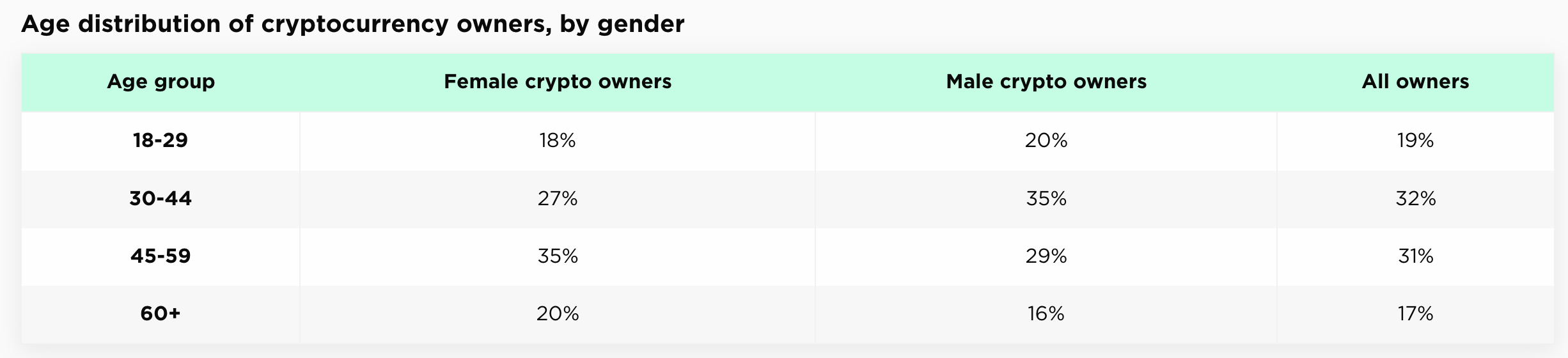
Despite lower adoption among young US citizens, Stebbing believes that projects are underestimating youth. “Crypto needs to be delivering value for people aged 15 plus if we want it to be ‘normal’ when they are hiring the workforce, yet so much of crypto is targeted directly at people in my generation,” he said.
On the flip side, crypto projects are struggling to expand. At Dogecoin Foundation, Stebbing and his team walk a thin line between defending trademarks and encouraging community developers.
Apart from the optimistic perspective on Dogecoin, Stebbing positions projects that support tokenized RWAs as better suited for the long run. Although Dogecoin shows no prospect of support for RWAs, a potential shift could improve the chances of its evolving from a meme coin into a serious, real-world project.














