

USD/JPY adrift ahead of BoJ and Fed twin policy week
- The BoJ's April hike pricing collapsed from 18 basis points to near zero, with focus now on a likely June move to 1.00%.
- The Fed is set to hold at 3.50% to 3.75% Wednesday in Powell's final meeting before his May 15 chair term ends.
- Thursday's Tokyo CPI and US Core PCE data will test the post-decision tone from both central banks.
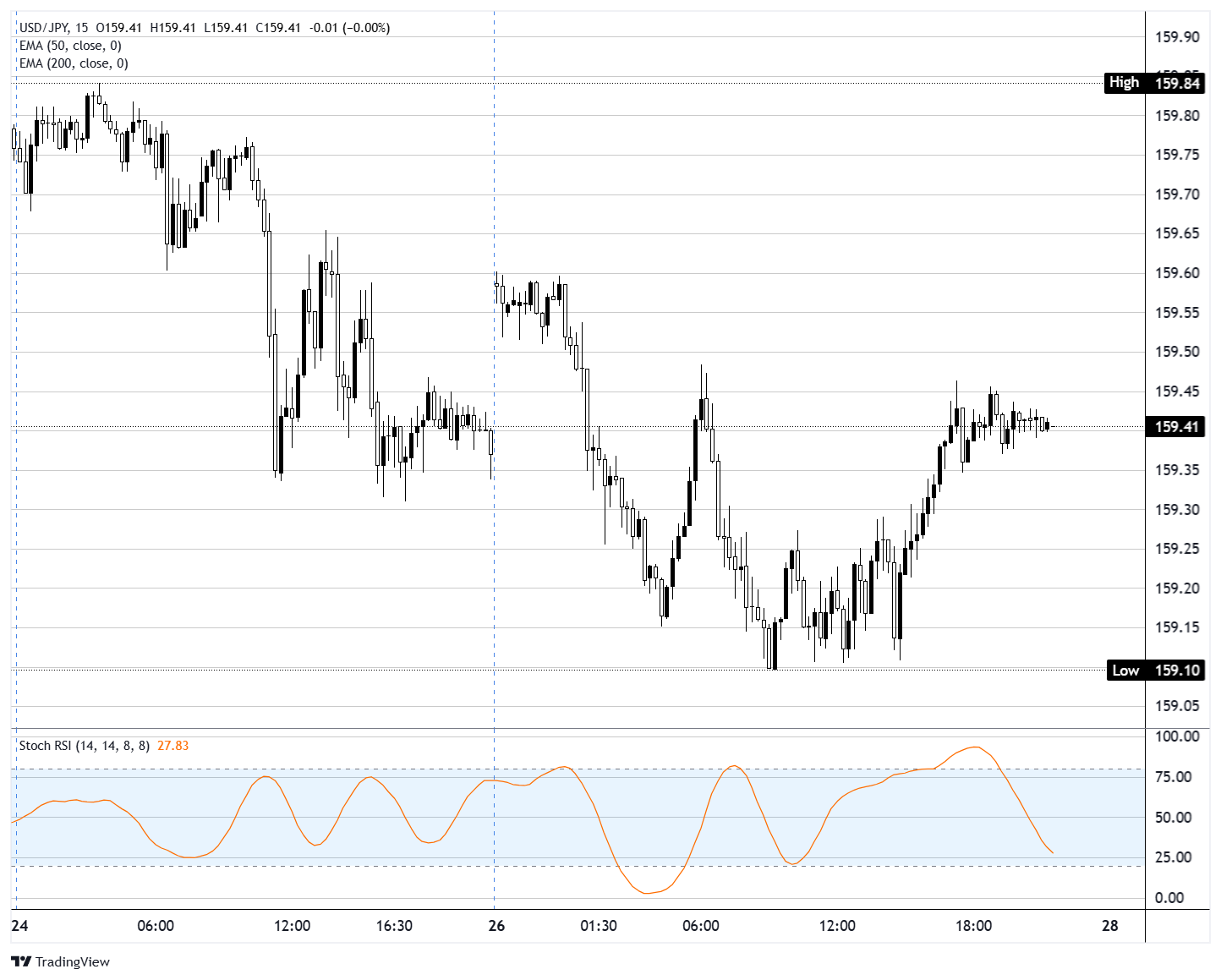
USD/JPY ended Monday largely unchanged from Friday's closing bids near 159.40, oscillating in a tight 75-pip range between 159.10 and 159.85. The session produced a cluster of small-bodied candles reflecting indecision ahead of Tuesday's Bank of Japan (BoJ) decision. Daily candles continue to consolidate just below the 160.00 handle that has capped rallies for the past three weeks.

On the Japanese Yen side, the BoJ is widely expected to hold its policy rate at 0.75% on Tuesday after April hike pricing collapsed from 18 basis points at the start of the month to near zero in recent weeks. Governor Kazuo Ueda will need to balance cautious commentary on Middle East risks with signals of continued tightening, and markets are now pricing a likely move to 1.00% at the June meeting. Updated forecasts in Tuesday's Outlook Report are expected to lift core inflation projections above the 2.0% target, while Thursday's Tokyo Consumer Price Index (CPI) print, with the ex-fresh food measure forecast at 1.8% YoY, is the next domestic catalyst. Finance Minister Satsuki Katayama reiterated last week that authorities retain a "free hand" to intervene to stabilize Yen, with the 160.00 handle continuing to act as a soft intervention threshold.
On the US Dollar side, the Federal Open Market Committee (FOMC) is similarly expected to hold the federal funds rate at 3.50% to 3.75% on Wednesday in Chair Jerome Powell's final meeting before his term expires May 15. April carries no Summary of Economic Projections, leaving the statement and press conference to do the work amid March headline inflation at a two-year high of 3.3% and Q4 2025 Gross Domestic Product (GDP) revised to just 0.5%. Thursday's advance Q1 GDP read (consensus 2.2%) and Core Personal Consumption Expenditures (PCE) print (forecast 3.2% YoY) are the next major signposts, with ISM Manufacturing Purchasing Managers Index (PMI) closing the week on Friday. The Senate Banking Committee is also scheduled to vote on Kevin Warsh's nomination as Powell's successor on Wednesday, adding leadership-transition risk to the Dollar's near-term outlook as the Iran ceasefire continues to wobble in the background.
USD/JPY 15-minute chart
Japanese Yen FAQs
The Japanese Yen (JPY) is one of the world’s most traded currencies. Its value is broadly determined by the performance of the Japanese economy, but more specifically by the Bank of Japan’s policy, the differential between Japanese and US bond yields, or risk sentiment among traders, among other factors.
One of the Bank of Japan’s mandates is currency control, so its moves are key for the Yen. The BoJ has directly intervened in currency markets sometimes, generally to lower the value of the Yen, although it refrains from doing it often due to political concerns of its main trading partners. The BoJ ultra-loose monetary policy between 2013 and 2024 caused the Yen to depreciate against its main currency peers due to an increasing policy divergence between the Bank of Japan and other main central banks. More recently, the gradually unwinding of this ultra-loose policy has given some support to the Yen.
Over the last decade, the BoJ’s stance of sticking to ultra-loose monetary policy has led to a widening policy divergence with other central banks, particularly with the US Federal Reserve. This supported a widening of the differential between the 10-year US and Japanese bonds, which favored the US Dollar against the Japanese Yen. The BoJ decision in 2024 to gradually abandon the ultra-loose policy, coupled with interest-rate cuts in other major central banks, is narrowing this differential.
The Japanese Yen is often seen as a safe-haven investment. This means that in times of market stress, investors are more likely to put their money in the Japanese currency due to its supposed reliability and stability. Turbulent times are likely to strengthen the Yen’s value against other currencies seen as more risky to invest in.














