




WTI Price Forecast: Bears target the 200-day SMA after losing the $80 mark
- WTI falls below $80, extending Monday’s 9% decline as the pause in US-Iran attacks reduces the geopolitical risk premium.
- The technical outlook turns bearish below the 50-day SMA, with the 200-day SMA at $74.78 offering key support.
- Momentum weakens as the RSI retreats toward 50 and the positive MACD loses strength.
West Texas Intermediate (WTI) Oil extends its decline on Tuesday after falling 9% the previous day following a pause in attacks between the United States and Iran. At the time of writing, WTI trades around $77.90, down nearly 4% on the day.

Easing hostilities between the US and Iran have raised hopes that security risks around the Strait of Hormuz could ease, prompting traders to unwind part of the geopolitical premium built into Oil prices.
US President Donald Trump said on Tuesday that it was a “good time for Iran to make a deal,” but warned that the US would “go back and finish the job” if no agreement was reached.
Separately, Oman presented Iran with a proposal for the joint management of the Strait of Hormuz through “voluntary fees,” under which Tehran would not exercise sole control over the key shipping route.
Despite the diplomatic efforts, the pullback could prove short-lived. The risk of renewed military action is likely to keep a geopolitical premium embedded in Oil prices, leaving WTI vulnerable to sharp swings.
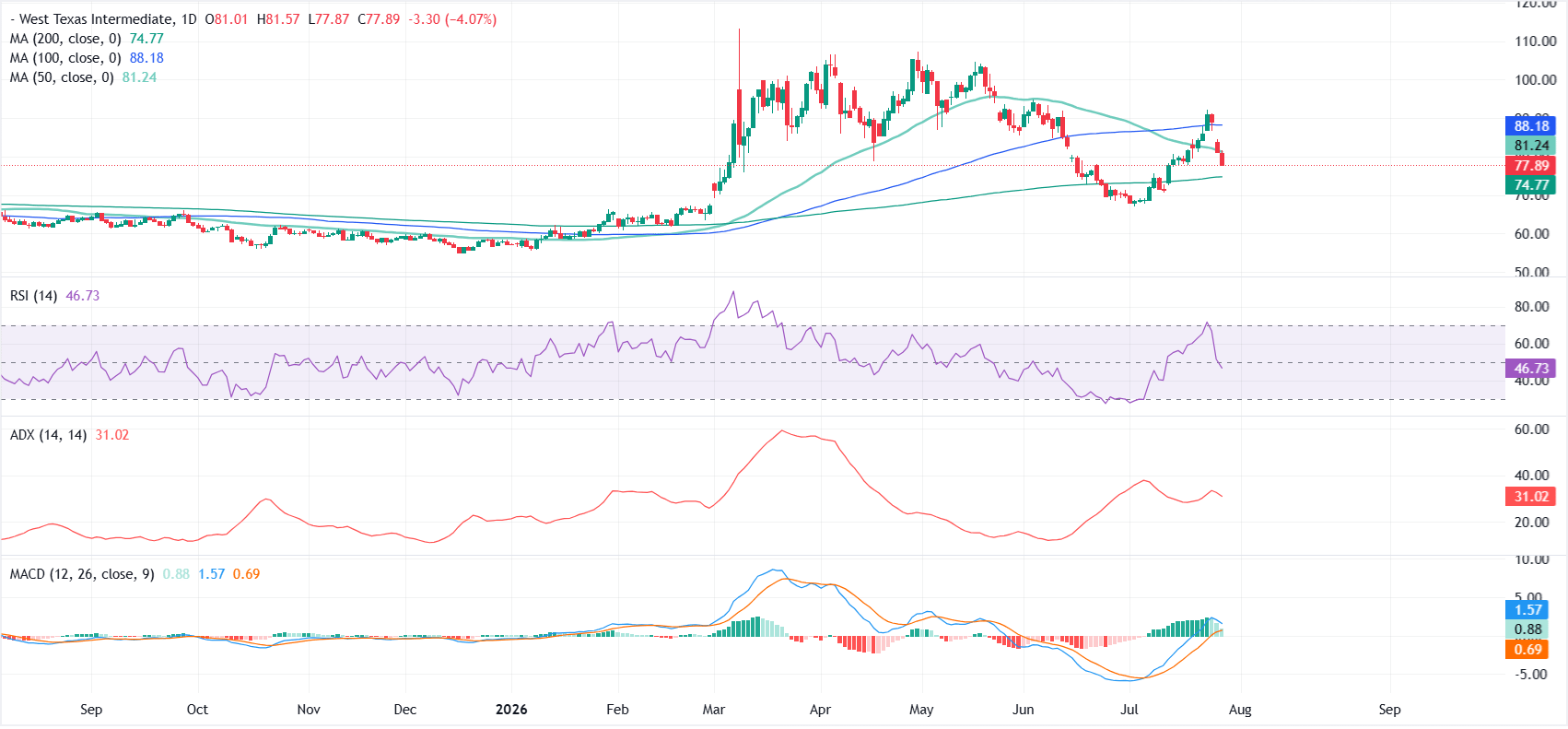
From a technical perspective, WTI has failed to hold above the 100-day Simple Moving Average (SMA) at $88.19, which it briefly reclaimed last week. Prices have now slipped below the 50-day SMA at $81.26, pointing to a bearish near-term bias.
Momentum indicators offer mixed signals. The Relative Strength Index (RSI) has eased toward the neutral 50 level after briefly entering overbought territory, while the Moving Average Convergence Divergence (MACD) is still positive but losing altitude, which hints at waning upside pressure.
On the downside, the 200-day SMA at $74.78 provides key support. A decisive daily close below this level could open the door to a deeper decline toward the pre-war region of $67-$65.
On the upside, initial resistance is located at the 50-day SMA at $81.26. A sustained break above this barrier would expose the 100-day SMA near $88.19, followed by the psychological $90 mark.
WTI Oil FAQs
WTI Oil is a type of Crude Oil sold on international markets. The WTI stands for West Texas Intermediate, one of three major types including Brent and Dubai Crude. WTI is also referred to as “light” and “sweet” because of its relatively low gravity and sulfur content respectively. It is considered a high quality Oil that is easily refined. It is sourced in the United States and distributed via the Cushing hub, which is considered “The Pipeline Crossroads of the World”. It is a benchmark for the Oil market and WTI price is frequently quoted in the media.
Like all assets, supply and demand are the key drivers of WTI Oil price. As such, global growth can be a driver of increased demand and vice versa for weak global growth. Political instability, wars, and sanctions can disrupt supply and impact prices. The decisions of OPEC, a group of major Oil-producing countries, is another key driver of price. The value of the US Dollar influences the price of WTI Crude Oil, since Oil is predominantly traded in US Dollars, thus a weaker US Dollar can make Oil more affordable and vice versa.
The weekly Oil inventory reports published by the American Petroleum Institute (API) and the Energy Information Agency (EIA) impact the price of WTI Oil. Changes in inventories reflect fluctuating supply and demand. If the data shows a drop in inventories it can indicate increased demand, pushing up Oil price. Higher inventories can reflect increased supply, pushing down prices. API’s report is published every Tuesday and EIA’s the day after. Their results are usually similar, falling within 1% of each other 75% of the time. The EIA data is considered more reliable, since it is a government agency.
OPEC (Organization of the Petroleum Exporting Countries) is a group of 12 Oil-producing nations who collectively decide production quotas for member countries at twice-yearly meetings. Their decisions often impact WTI Oil prices. When OPEC decides to lower quotas, it can tighten supply, pushing up Oil prices. When OPEC increases production, it has the opposite effect. OPEC+ refers to an expanded group that includes ten extra non-OPEC members, the most notable of which is Russia.













