

Trade The World
USD/INR rises while investors await US-India trade talks
Por Sagar Dua
Data de Publicação: 13 Jan 2026 | Data de Modificação: 13 Jan 2026


POPULAR ARTICLES

The Indian Rupee (INR) trades lower against the US Dollar (USD) on Tuesday at around 90.50, ahead of trade talks between the United States (US) and India during the day.
- The Indian Rupee opens on a cautious note against the US Dollar ahead of trade talks between the US and India.
- India’s retail inflation increased to 1.31% in December, missing the estimate of 1.5%.
- Investors await US CPI data for fresh cues on the Fed’s monetary policy outlook.
The Indian Rupee (INR) trades lower against the US Dollar (USD) on Tuesday at around 90.50, ahead of trade talks between the United States (US) and India during the day. The USD/INR pair is expected to remain on the sidelines as the impact of the trade meeting outcome will be significant on the Indian Rupee, given that the Indian currency remained the worst-performing Asian currency in 2025 due to hefty tariffs on imports from New Delhi to Washington.
On Monday, US Ambassador to India, Sergio Gor, said that both nations will meet to discuss trade issues on Tuesday. Gor also said that India will be invited to join Pax Silica in February. Gor's announcement of US-India trade talks led to a significant recovery in the Indian equity market. Nifty50 clawed back the intraday decline of almost 250 points or 0.9% and turned positive before closing.
In 2025, US President Donald Trump raised import duty on goods from India to 50% after including 25% punitive tariffs for buying oil from Russia, making Indian goods less competitive in the global market. Earlier this month, Trump also threatened that he could raise tariffs on India for not supporting the Russian oil issue.
Trade frictions between the US and India had also hit the interests of overseas investors in the Indian stock market. Foreign Institutional Investors (FIIs) remained net sellers in eight out of 12 months in 2025, and have extended the pessimism in 2026 too. So far in January, FIIs have offloaded their stake worth Rs. 15,425.22 crore.
The table below shows the percentage change of Indian Rupee (INR) against listed major currencies today. Indian Rupee was the weakest against the Canadian Dollar.
| USD | EUR | GBP | JPY | CAD | AUD | INR | CHF | |
|---|---|---|---|---|---|---|---|---|
| USD | 0.07% | -0.04% | 0.46% | -0.05% | 0.09% | 0.14% | -0.01% | |
| EUR | -0.07% | -0.11% | 0.39% | -0.11% | 0.02% | 0.09% | -0.07% | |
| GBP | 0.04% | 0.11% | 0.47% | -0.01% | 0.13% | 0.18% | 0.03% | |
| JPY | -0.46% | -0.39% | -0.47% | -0.49% | -0.35% | -0.28% | -0.45% | |
| CAD | 0.05% | 0.11% | 0.00% | 0.49% | 0.14% | 0.21% | 0.03% | |
| AUD | -0.09% | -0.02% | -0.13% | 0.35% | -0.14% | 0.07% | -0.10% | |
| INR | -0.14% | -0.09% | -0.18% | 0.28% | -0.21% | -0.07% | -0.15% | |
| CHF | 0.00% | 0.07% | -0.03% | 0.45% | -0.03% | 0.10% | 0.15% |
The heat map shows percentage changes of major currencies against each other. The base currency is picked from the left column, while the quote currency is picked from the top row. For example, if you pick the Indian Rupee from the left column and move along the horizontal line to the US Dollar, the percentage change displayed in the box will represent INR (base)/USD (quote).
Daily Digest Market Movers: US Dollar trades slightly higher ahead of US CPI data
- A slight uptick in the USD/INR pair is also driven by a marginally higher US Dollar. As of writing, the US Dollar Index (DXY), which tracks the Greenback’s value against six major currencies, trades 0.1% higher to near 99.00.
- On Monday, the DXY corrected sharply from the monthly high of 98.25 after Federal Reserve (Fed) Chair Jerome Powell was charged by US federal prosecutors for mismanaging funds utilized in the renovation of Washington’s headquarters.
- In response, Fed Chair Powell has stated that he “carried out my duties without political fear or favor and will continue to do so”, and the “new threat is not about his testimony or the renovation project but a pretext”. Powell clarified that criminal charges against him are a “consequence of the Fed setting interest rates based on its assessment of the public interest rather than the president's preferences”.
- Renewed tussle between US President Trump and Fed’s Powell prompted concerns over the central bank’s independence and credibility of US assets. Analysts at Fitch Ratings have stated that the Fed’s independence has been a key factor for a strong US credit rating, and an attack on the same could hit the sovereign rating.
- On the economic front, investors await the US Consumer Price Index (CPI) data for December, which will be published at 13:30 GMT. The US core inflation – which excludes volatile food and energy items – is expected to have risen at a faster pace to 2.7% YoY from 2.6% in November, with headline figures growing steadily by 2.7%.
- In 2025, the Fed reduced interest rates by 75 basis points (bps) to 3.50%-3.75% to support weakening job conditions, while inflation remained well above the 2% target. As the Fed has loosened monetary conditions to contain employment risks, it is expected to shift its focus to bring inflation under control.
- In India, the retail CPI data for December came in at 1.33% Year-on-year (YoY), higher than the prior reading of 0.71%, but lower than estimates of 1.5%. Though inflation in India has accelerated, it is still below the Reserve Bank of India’s tolerance band of 2%-6%, a scenario that could boost hopes of more interest rate cuts in the near term. In 2025, the RBI cut its Repo Rate by 125 basis points (bps) to 5.25% to contain inflation risks.
Technical Analysis: USD/INR holds key 20-day EMA
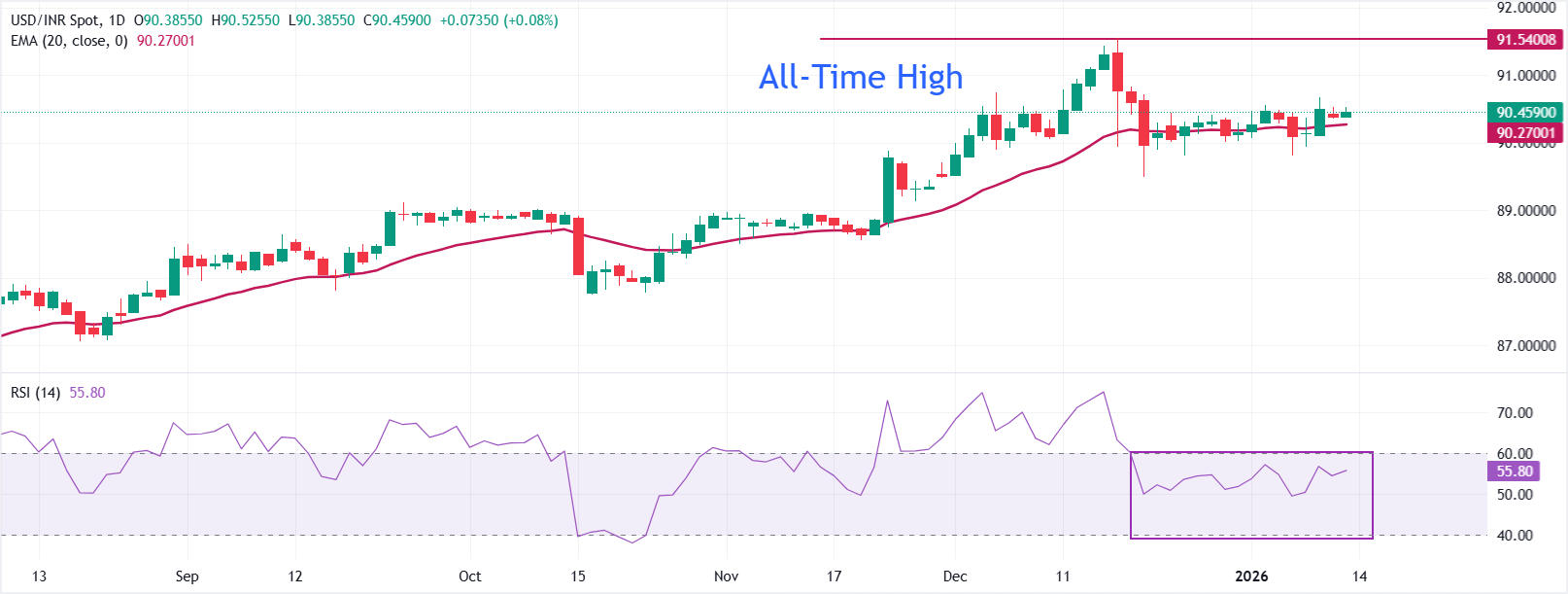
USD/INR trades higher at around 90.50 as of writing. Price holds above the 20-day Exponential Moving Average (EMA), which edges higher at 90.27, maintaining a mild bullish bias. The ascending 20-day EMA supports dips, and a break below it would temper the advance.
The 14-day Relative Strength Index (RSI) at 55.75 sits in neutral territory with a slight positive tilt, after easing from prior overbought readings earlier in the sequence.
Momentum remains steady, and continued traction above the 20-day EMA at 90.27 could keep upside risks in play, while a daily close beneath that gauge would point to range-building instead.
(The technical analysis of this story was written with the help of an AI tool.)
Indian economy FAQs
The Indian economy has averaged a growth rate of 6.13% between 2006 and 2023, which makes it one of the fastest growing in the world. India’s high growth has attracted a lot of foreign investment. This includes Foreign Direct Investment (FDI) into physical projects and Foreign Indirect Investment (FII) by foreign funds into Indian financial markets. The greater the level of investment, the higher the demand for the Rupee (INR). Fluctuations in Dollar-demand from Indian importers also impact INR.
India has to import a great deal of its Oil and gasoline so the price of Oil can have a direct impact on the Rupee. Oil is mostly traded in US Dollars (USD) on international markets so if the price of Oil rises, aggregate demand for USD increases and Indian importers have to sell more Rupees to meet that demand, which is depreciative for the Rupee.
Inflation has a complex effect on the Rupee. Ultimately it indicates an increase in money supply which reduces the Rupee’s overall value. Yet if it rises above the Reserve Bank of India’s (RBI) 4% target, the RBI will raise interest rates to bring it down by reducing credit. Higher interest rates, especially real rates (the difference between interest rates and inflation) strengthen the Rupee. They make India a more profitable place for international investors to park their money. A fall in inflation can be supportive of the Rupee. At the same time lower interest rates can have a depreciatory effect on the Rupee.
India has run a trade deficit for most of its recent history, indicating its imports outweigh its exports. Since the majority of international trade takes place in US Dollars, there are times – due to seasonal demand or order glut – where the high volume of imports leads to significant US Dollar- demand. During these periods the Rupee can weaken as it is heavily sold to meet the demand for Dollars. When markets experience increased volatility, the demand for US Dollars can also shoot up with a similarly negative effect on the Rupee.

FXStreet
Mais de um milhão de usuários confiam na FXStreet para dados de mercado em tempo real, ferramentas de gráficos, insights de especialistas e notícias de Forex. Seu calendário econômico abrangente e webinars educacionais ajudam os traders a se manterem informados e tomarem decisões calculadas. A FXStreet conta com uma equipe de cerca de 60 profissionais, divididos entre a sede em Barcelona e diversas regiões globais.
Read More








