

Торговля
Изучите широкий спектр рынков с конкурентными ценами, высокой ликвидностью и передовыми торговыми инструментами.
Узнать больше 
Платформа
Торгуйте без сбоев на мощной платформе TMGM, созданной для скорости, точности и превосходного торгового опыта.
Узнать больше Торговая платформа
Торговые инструменты
Академия
Изучите основы торговли с помощью материалов для начинающих, включая руководства, вебинары и аналитические обзоры рынка.
Узнать больше Новости и аналитика
Получайте актуальные рыночные обновления и экспертную аналитику, чтобы быть на шаг впереди торговых возможностей
Узнать больше Новости и аналитика
О нас
Узнайте, что отличает TMGM — наше глобальное присутствие, надежное регулирование и приверженность инновациям в трейдинге.
Узнать больше Почему выбирают TMGM
Спонсорство
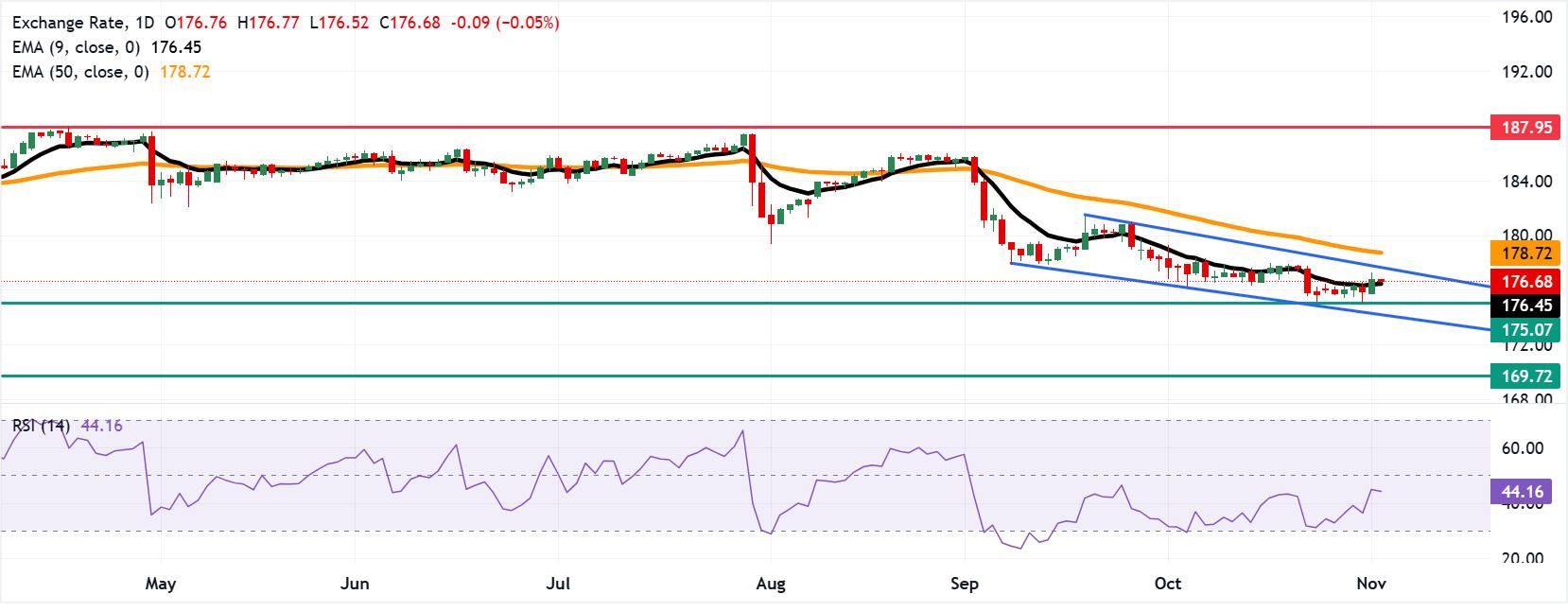
EUR/JPY Price Forecast: Holds above 176.50 near nine-day EMA
- EUR/JPY may test the immediate support at the nine-day EMA of 176.45.
- The 14-day Relative Strength Index is at 44.16, suggesting modest downside momentum.
- The primary barrier lies at the descending channel's upper boundary near 177.90.
EUR/JPY inches lower after posting modest gains in the previous day, trading around 176.70 during Asian hours on Tuesday. The technical analysis of the daily chart suggests that the currency cross is remaining within a descending channel pattern, indicating a prevailing bearish bias.
The EUR/JPY cross is holding just above the nine-period Exponential Moving Average (EMA) but still capped by the 50-period EMA. This setup hints at a mildly bearish undertone, as price remains below the longer-term EMA, while the 14-day Relative Strength Index (RSI) at 44.16 stays in neutral territory, suggesting only modest downside momentum rather than aggressive selling.

The EUR/JPY cross tests the immediate support at the nine-day EMA of 176.45, followed by the 12-month low of 175.07, reached on October 30. Further support lies at the lower boundary of its descending channel around 174.30. A break below the channel would open the door for the currency cross to navigate the region around the 15-month low at 169.72.
On the upside, the EUR/JPY cross may rise toward the upper boundary of the descending channel near 177.90, followed by the 50-day EMA of 178.72. A successful break above the medium-term price average would cause a bullish reversal, supporting the EUR/JPY cross to explore the area around the all-time high of 187.95, reached on April 17.
Euro appeal tempered by Europe’s fiscal and energy headwinds
Analysts at DBS Group Research caution that the Dollar’s loss of momentum does not automatically make the Euro a compelling alternative, highlighting that “Europe’s fiscal and political uncertainties, particularly in France, and its vulnerability to elevated energy prices complicate the search for viable alternatives.” These overlapping risks, they suggest, limit the extent to which investors can confidently rotate out of the Dollar and into Eurozone assets despite recent currency moves.
(The technical analysis of this story was written with the help of an AI tool. Know more.)
Euro FAQs
The Euro is the currency for the 20 European Union countries that belong to the Eurozone. It is the second most heavily traded currency in the world behind the US Dollar. In 2022, it accounted for 31% of all foreign exchange transactions, with an average daily turnover of over $2.2 trillion a day. EUR/USD is the most heavily traded currency pair in the world, accounting for an estimated 30% off all transactions, followed by EUR/JPY (4%), EUR/GBP (3%) and EUR/AUD (2%).
The European Central Bank (ECB) in Frankfurt, Germany, is the reserve bank for the Eurozone. The ECB sets interest rates and manages monetary policy. The ECB’s primary mandate is to maintain price stability, which means either controlling inflation or stimulating growth. Its primary tool is the raising or lowering of interest rates. Relatively high interest rates – or the expectation of higher rates – will usually benefit the Euro and vice versa. The ECB Governing Council makes monetary policy decisions at meetings held eight times a year. Decisions are made by heads of the Eurozone national banks and six permanent members, including the President of the ECB, Christine Lagarde.
Eurozone inflation data, measured by the Harmonized Index of Consumer Prices (HICP), is an important econometric for the Euro. If inflation rises more than expected, especially if above the ECB’s 2% target, it obliges the ECB to raise interest rates to bring it back under control. Relatively high interest rates compared to its counterparts will usually benefit the Euro, as it makes the region more attractive as a place for global investors to park their money.
Data releases gauge the health of the economy and can impact on the Euro. Indicators such as GDP, Manufacturing and Services PMIs, employment, and consumer sentiment surveys can all influence the direction of the single currency. A strong economy is good for the Euro. Not only does it attract more foreign investment but it may encourage the ECB to put up interest rates, which will directly strengthen the Euro. Otherwise, if economic data is weak, the Euro is likely to fall. Economic data for the four largest economies in the euro area (Germany, France, Italy and Spain) are especially significant, as they account for 75% of the Eurozone’s economy.
Another significant data release for the Euro is the Trade Balance. This indicator measures the difference between what a country earns from its exports and what it spends on imports over a given period. If a country produces highly sought after exports then its currency will gain in value purely from the extra demand created from foreign buyers seeking to purchase these goods. Therefore, a positive net Trade Balance strengthens a currency and vice versa for a negative balance.
Лучшие статьи
1Swiss Franc: Upside momentum accelerates against US Dollar – UOB2Euro weakens against British Pound on soft German Retail Sales, traders await BoE rate decision 3Turkish Lira: Inflation risks keep pressure on TRY – Commerzbank4Gold: Recovery from one-year low remains fragile – ING5Swiss Franc gains momentum ahead of inflation data6NEAR Protocol Forecast: Bearish move extends despite House of Stake issuance cut approval7Euro: Key support at 1.1135 in focus against US Dollar – UOB8Cardano Price Forecast: ADA extends losses as sellers stay in control9Indian Rupee extends winning streak against US Dollar amid lower oil prices


Начать!
Зарегистрируйтесь и получите доступ к глобальным рынкам менее чем за 3 минуты

Свяжитесь с нами









Контакты
Телефон: +61 2 8036 8388
Факс: +61 2 8036 8388
Эл. почта: support@tmgm.com
Веб-сайт: https://www.tmgm.com



Информация, представленная на этом веб-сайте, носит исключительно общий характер и не является персональной финансовой консультацией. Прежде чем действовать на основании любой информации на этом веб-сайте, вам следует оценить ее уместность с учетом ваших целей, финансового положения и потребностей. Инвестирование в CFD и маржинальные контракты на FX сопряжено со значительными рисками и подходит не всем инвесторам. Вы можете потерять больше, чем ваш первоначальный депозит. Вы не владеете базовым активом и не имеете в нем какой-либо доли. Мы рекомендуем вам обратиться за независимой консультацией и убедиться, что вы полностью понимаете связанные с этим риски, прежде чем начинать торговлю. Важно прочитать и принять во внимание документ с раскрытием информации, прежде чем приобретать любой продукт, указанный на веб-сайте. Информация и рекламные материалы, предлагаемые на этом веб-сайте, не предназначены для использования любым лицом в любой стране или юрисдикции, где такое использование противоречило бы местным законам и нормативным актам. Продукты и услуги, предлагаемые на этом веб-сайте, не предназначены для резидентов США, Малайзии и Таиланда.
TMGM уполномочена и регулируется в различных юрисдикциях.
Trademax Australia Limited, работающая под брендом TMGM, регулируется Australian Securities and Investments Commission (ASIC), AFSL № 436416 и находится по адресу: Level 28, One International Tower, 100 Barangaroo Avenue, 2000 Sydney, NSW Australia.
Email: support@tmgm.com.au
Trademax Global Limited, работающая под брендом TMGM, уполномочена и регулируется Vanuatu Financial Services Commission (VFSC), регистрационный номер 40356, и зарегистрирована по адресу: 1276, Kumul Highway, Port Vila, Vanuatu, Republic of Vanuatu.
Email: support@tmgm.com
Trademax Global Markets (SE) Limited, работающая под брендом TMGM, уполномочена и регулируется Financial Services Authority (FSA) Сейшельских Островов, номер лицензии SD224. Компания зарегистрирована по адресу: Office No 13, Providence Estate ABIS Centre, Mahe, Seychelles.
Email: support@tmgm.com
Trademax Global Markets (International) Pty Ltd, работающая под брендом TMGM, уполномочена и регулируется Financial Services Commission, Mauritius (FSC), лицензия № GB22201012, и зарегистрирована по адресу: 33, Edith Cavell Street C/o IQ EQ Fund Services (Mauritius) Ltd Port Louis, 11324 Mauritius.
Email: support@tmgm.com
Авторское право © TMGM. Все права защищены