

AUD/USD surges past 0.7050 as Trump suspends Iran strikes for two weeks
- Pakistan brokered a two-week ceasefire just before Trump's midnight GMT deadline, sending WTI Crude Oil below $90.
- The RBA faces a shifting inflation picture as the plunge in Oil could ease energy-driven price pressures ahead.
AUD/USD surged over 1.3% on Tuesday, rallying from around 0.6970 to trade close to 0.7060 by the close of the session. The move came as risk appetite roared back after President Trump announced a two-week suspension of military operations against Iran, sending WTI Crude Oil crashing from above $106 to below $90 per barrel. The pair reclaimed territory above a key moving average on the four-hour chart and posted its strongest single-session gain in weeks.

On the Australian Dollar side, the ceasefire could materially shift the inflation outlook that has been driving Reserve Bank of Australia (RBA) rate hike expectations. Markets had been pricing in a potential move to 4.35% or higher at the May meeting, fueled in part by surging energy costs since the Strait of Hormuz closure in late February. WTI Crude Oil's plunge below $90, still roughly 55% above its pre-war level near $58, may take some heat off the energy component if it holds, though analysts warn supply normalization could take months even under a permanent deal. Domestically, the S&P Global Composite Purchasing Managers Index (PMI) for March fell to 46.6 from 47, while the TD-MI Inflation Gauge jumped 1.3% MoM, with the annual rate rising to 4.3% from 3.6%. The weak PMI and hot inflation print continue to pull the RBA in opposite directions.
On the US Dollar side, the ceasefire announcement landed just before Trump's own midnight GMT Wednesday deadline, after which he had threatened to destroy Iranian bridges and power plants within four hours. Pakistan's Prime Minister brokered the pause, and Trump described a 10-point proposal from Tehran as a "workable basis" for negotiation, though Iran had publicly rejected a 45-day ceasefire just hours earlier and continues to demand a permanent end to hostilities. S&P 500 futures surged 1.1% and Nasdaq futures jumped 1.2% on confirmation, crushing the US Dollar's safe-haven bid.
The Federal Open Market Committee (FOMC) Minutes are due Wednesday, alongside speeches from Federal Reserve (Fed) officials Daly and Waller. February Durable Goods Orders fell 1.4% on Tuesday, missing expectations, though the ex-transportation reading came in firmer at 0.8%. The real test now is whether actual shipping traffic resumes through the Strait of Hormuz; traders have seen Trump set and extend deadlines four times since the conflict began in late February, and the market will need to see physical flows before pricing in a durable risk-on shift.
AUD/USD 4-hour chart
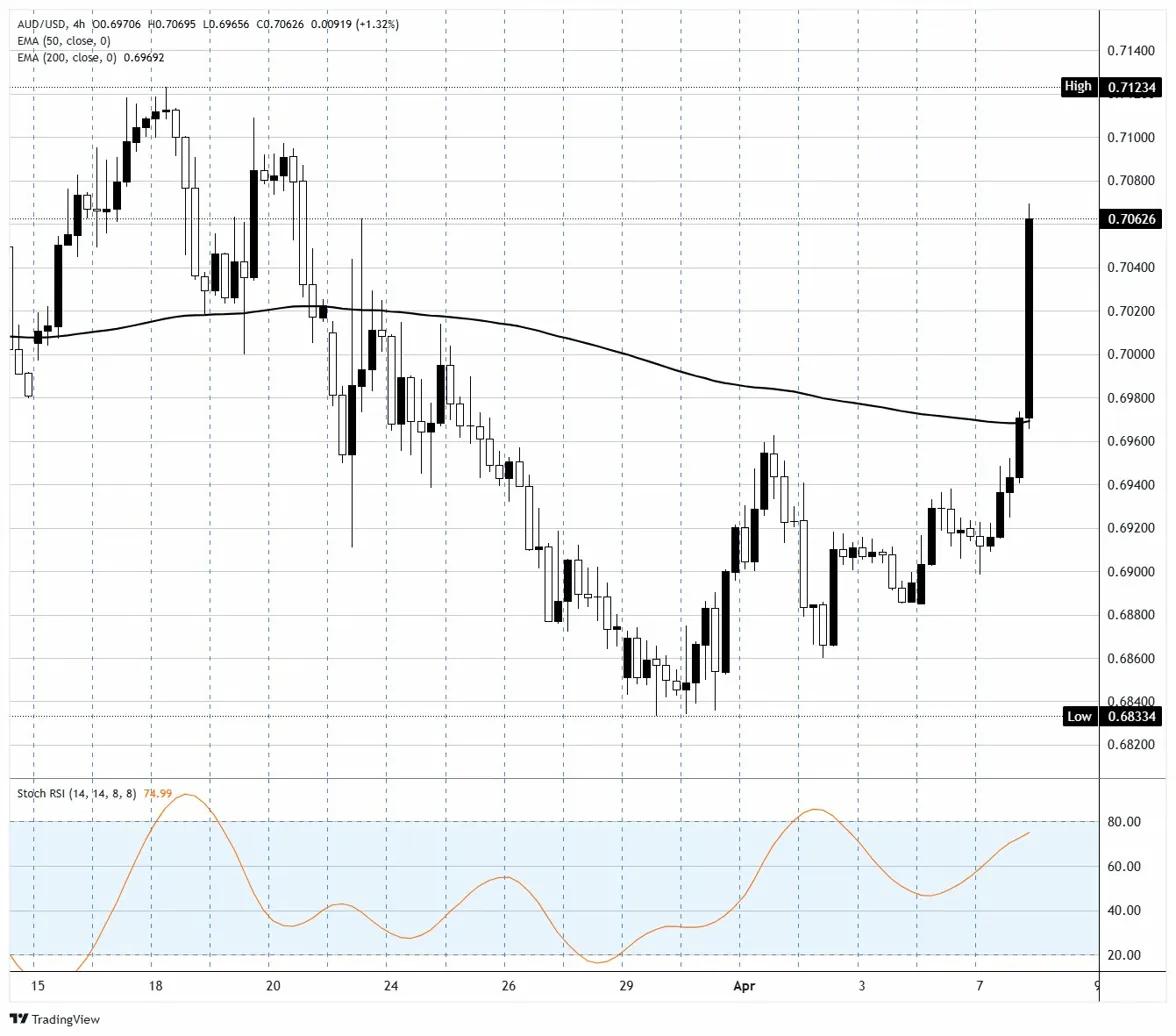
AUD/USD reclaims the 200-period EMA on the four-hour chart as Stochastic pushes toward overbought
On the four-hour chart, AUD/USD has broken sharply above the 200-period Exponential Moving Average (EMA) close to 0.6970, which had capped price for much of the past two weeks. The Stochastic Oscillator has surged from the lower half of its range and is now approaching the overbought zone, suggesting strong upside momentum but also warning of a potential near-term cooldown. A sustained hold above 0.7000 would open a path back toward the year-to-date high near 0.7120, while a failure to hold above the 200-period EMA around 0.6970 would suggest the rally was a one-off ceasefire reaction and shift focus back to support close to 0.6900.
Australian Dollar FAQs
One of the most significant factors for the Australian Dollar (AUD) is the level of interest rates set by the Reserve Bank of Australia (RBA). Because Australia is a resource-rich country another key driver is the price of its biggest export, Iron Ore. The health of the Chinese economy, its largest trading partner, is a factor, as well as inflation in Australia, its growth rate and Trade Balance. Market sentiment – whether investors are taking on more risky assets (risk-on) or seeking safe-havens (risk-off) – is also a factor, with risk-on positive for AUD.
The Reserve Bank of Australia (RBA) influences the Australian Dollar (AUD) by setting the level of interest rates that Australian banks can lend to each other. This influences the level of interest rates in the economy as a whole. The main goal of the RBA is to maintain a stable inflation rate of 2-3% by adjusting interest rates up or down. Relatively high interest rates compared to other major central banks support the AUD, and the opposite for relatively low. The RBA can also use quantitative easing and tightening to influence credit conditions, with the former AUD-negative and the latter AUD-positive.
China is Australia’s largest trading partner so the health of the Chinese economy is a major influence on the value of the Australian Dollar (AUD). When the Chinese economy is doing well it purchases more raw materials, goods and services from Australia, lifting demand for the AUD, and pushing up its value. The opposite is the case when the Chinese economy is not growing as fast as expected. Positive or negative surprises in Chinese growth data, therefore, often have a direct impact on the Australian Dollar and its pairs.
Iron Ore is Australia’s largest export, accounting for $118 billion a year according to data from 2021, with China as its primary destination. The price of Iron Ore, therefore, can be a driver of the Australian Dollar. Generally, if the price of Iron Ore rises, AUD also goes up, as aggregate demand for the currency increases. The opposite is the case if the price of Iron Ore falls. Higher Iron Ore prices also tend to result in a greater likelihood of a positive Trade Balance for Australia, which is also positive of the AUD.
The Trade Balance, which is the difference between what a country earns from its exports versus what it pays for its imports, is another factor that can influence the value of the Australian Dollar. If Australia produces highly sought after exports, then its currency will gain in value purely from the surplus demand created from foreign buyers seeking to purchase its exports versus what it spends to purchase imports. Therefore, a positive net Trade Balance strengthens the AUD, with the opposite effect if the Trade Balance is negative.














