

Gold slips as markets await clarity on US-Iran talks
- Gold trades with a mild bearish bias as a firmer US Dollar caps upside.
- US-Iran talks remain in doubt ahead of the ceasefire deadline, keeping markets cautious.
- On the 4-hour chart, XAU/USD remains range-bound below the Bollinger midline near $4,805.
Gold (XAU/USD) trades with a mild negative bias on Tuesday but lacks strong directional momentum, as investors hold back from aggressive positioning amid uncertainty over whether US-Iran peace talks will resume, following renewed tensions in the Strait of Hormuz over the weekend.

At the time of writing, XAU/USD is trading around $4,794, down nearly 0.53% on the day, pressured by a modest uptick in the US Dollar (USD).
US-Iran talks in doubt as ceasefire deadline approaches
Diplomatic efforts to end the US-Iran war remain uncertain, with mixed signals surrounding a potential second round of peace talks expected in Pakistan. US Vice President JD Vance is expected to lead a delegation to Islamabad for negotiations.
Multiple media reports suggested that Iran is sending a delegation for the talks. However, Iran’s state broadcaster pushed back on these claims, stating in a Telegram post that “so far, no delegation from Iran has travelled to Islamabad, neither a primary nor a secondary, neither initial nor follow-up.”
With the current two-week ceasefire set to expire on Wednesday, markets remain cautious. US President Donald Trump said on Monday it is “highly unlikely” that he will extend the truce, adding, “We will not open the Strait of Hormuz until a deal is signed.” Trump has also warned that fighting could resume if no agreement is reached.
On the Iranian side, Mohammad Bagher Ghalibaf said Tehran has been “preparing to show new cards on the battlefield” and would “not accept negotiations under the shadow of threats.”
Higher Oil prices keep pressure on Gold
Meanwhile, ongoing disruptions in the Strait of Hormuz, which remains under a dual blockade by US naval forces and Iran, continue to support elevated Oil prices. This is keeping inflation risks in focus and reinforcing expectations that major central banks, including the Federal Reserve (Fed), may keep interest rates higher for longer.
While Gold is often seen as a hedge against inflation, higher borrowing costs tend to weigh on its appeal by increasing the opportunity cost of holding the non-yielding metal. As a result, the precious metal remains under pressure in the near term, even as geopolitical risks provide some support and keep prices largely range-bound.
Looking ahead, traders will closely monitor developments around US-Iran talks and the ceasefire deadline, as well as movements in the US Dollar and Oil prices for fresh directional cues.
Focus will also be on the upcoming US Retail Sales data and confirmation hearing of Kevin Warsh, Donald Trump’s nominee for Federal Reserve Chair, scheduled for 14:00 GMT before the Senate Banking Committee.
Technical analysis: XAU/USD stuck in range as momentum weakens
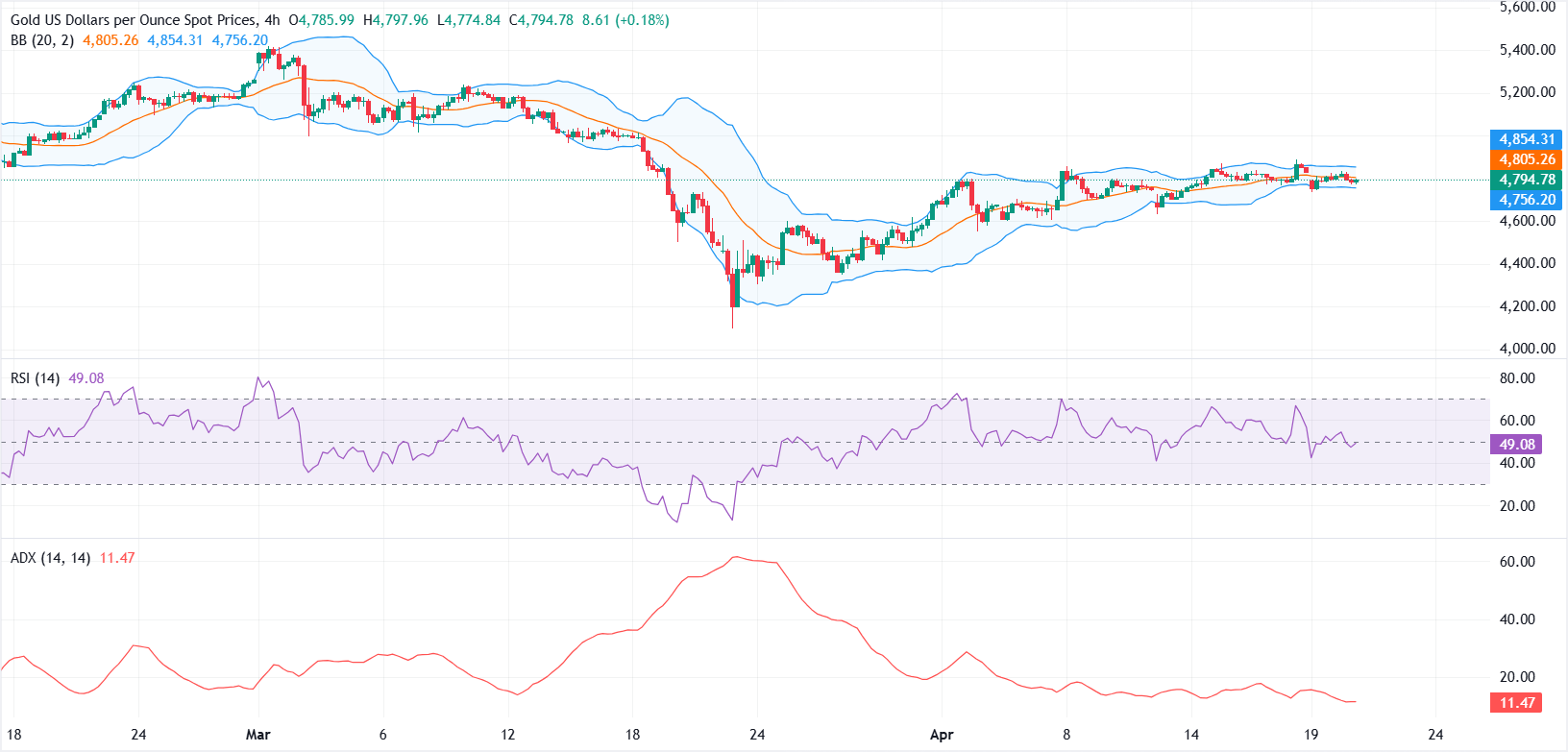
From a technical perspective, the near-term outlook remains neutral on the 4-hour chart, with price hovering just below the 20-period Bollinger Band middle line near $4,805 while holding above the lower band around $4,756.
The Relative Strength Index (RSI) around 49 and the subdued Average Directional Index (ADX) near 11 both hint at fading momentum and lack of a strong directional trend, leaving gold in consolidation
On the topside, initial resistance is located at the Bollinger middle band around $4,805, with a break above this level exposing the upper band near $4,854 as the next barrier.
On the downside, the lower Bollinger band at approximately $4,756 acts as immediate support, and a clear drop beneath this floor would signal that sellers are regaining control and could open the door to a deeper corrective phase.
Gold FAQs
Gold has played a key role in human’s history as it has been widely used as a store of value and medium of exchange. Currently, apart from its shine and usage for jewelry, the precious metal is widely seen as a safe-haven asset, meaning that it is considered a good investment during turbulent times. Gold is also widely seen as a hedge against inflation and against depreciating currencies as it doesn’t rely on any specific issuer or government.
Central banks are the biggest Gold holders. In their aim to support their currencies in turbulent times, central banks tend to diversify their reserves and buy Gold to improve the perceived strength of the economy and the currency. High Gold reserves can be a source of trust for a country’s solvency. Central banks added 1,136 tonnes of Gold worth around $70 billion to their reserves in 2022, according to data from the World Gold Council. This is the highest yearly purchase since records began. Central banks from emerging economies such as China, India and Turkey are quickly increasing their Gold reserves.
Gold has an inverse correlation with the US Dollar and US Treasuries, which are both major reserve and safe-haven assets. When the Dollar depreciates, Gold tends to rise, enabling investors and central banks to diversify their assets in turbulent times. Gold is also inversely correlated with risk assets. A rally in the stock market tends to weaken Gold price, while sell-offs in riskier markets tend to favor the precious metal.
The price can move due to a wide range of factors. Geopolitical instability or fears of a deep recession can quickly make Gold price escalate due to its safe-haven status. As a yield-less asset, Gold tends to rise with lower interest rates, while higher cost of money usually weighs down on the yellow metal. Still, most moves depend on how the US Dollar (USD) behaves as the asset is priced in dollars (XAU/USD). A strong Dollar tends to keep the price of Gold controlled, whereas a weaker Dollar is likely to push Gold prices up.













