

Gold tanks as US Dollar surges in tandem with Oil prices
- Gold falls below $4,400 as Oil climbs and inflation fears boost the US Dollar.
- Markets now price Fed tightening, with US 10-year yields rising to 4.41%.
- Uncertainty over US-Iran talks and war risks keeps pressure on bullion prices.
Gold (XAU/USD) price plummets nearly 2.50% on Thursday as Oil prices rise amid uncertainty about a possible agreement between the US and Iran, adding upward pressure on inflation and pushing the Greenback higher. At the time of writing, XAU/USD trades at $4,394 after reaching a daily high of $4,544.

Bullion drops as rising energy prices and hawkish Fed repricing weigh on demand
Financial market sentiment remains dismal. US President Donald Trump warned Iran to get serious about agreeing to a deal. He said that Iranian negotiators are “very different” and “strange,” adding that, privately, they're begging for a deal, while publicly they say they’re looking at the proposal.
Iran is reviewing the US 15-point proposal aimed at ending hostilities, though it hinted that it is not open to talks.
Some of Washington’s demands include the removal of Iran’s stocks of highly enriched uranium, curbing its ballistic missile program and cutting funding for regional allies.
In the meantime, the Pentagon is getting ready to deploy ground forces to Iran, providing further options to President Trump. According to Axios, the US Pentagon is preparing for a “final blow” against Iran, which would include the use of ground forces.
Another reason for Gold’s plunge is that Bloomberg reported that Turkey’s central bank sold and swapped about 60 tons of Gold, “worth more than $8 billion, in two weeks after the start of the war in Iran, adding to downward pressure on bullion prices.”
Markets priced in a hawkish Fed
Aside from this, money markets are pricing in a high inflation scenario. At the beginning of the year, traders expected at least two rate cuts from the Federal Reserve (Fed). However, since the conflict began and following the Fed’s policy decision on March 18, they trimmed their dovish bets. Instead, they’re expecting 12 basis points of tightening by the US central bank, according to Prime Market Terminal.
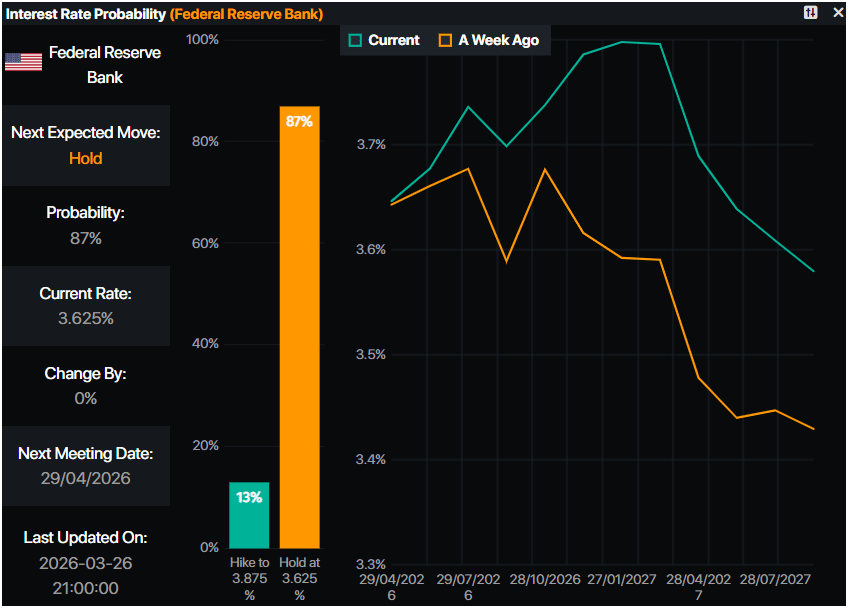
Consequently, US Treasury bond yields have risen, making Gold’s status as a haven less appealing. The US 10-year Treasury note is up eight basis points at 4.412%.
The US economic docket showed solid jobs data from the US Department of Labor. Initial Jobless Claims for the week ending March 21 came at 210K, as expected by analysts, up from the previous print of 205K.
Ahead, eyes are on speeches by a handful of Federal Reserve officials, led by Governors Lisa Cook, Stephen Miran, Philip Jefferson and Michael Barr. Along with them, Dallas Fed President Lorie Logan will cross the wires.
XAU/USD technical outlook: Gold’s downtrend resumes below $4,400
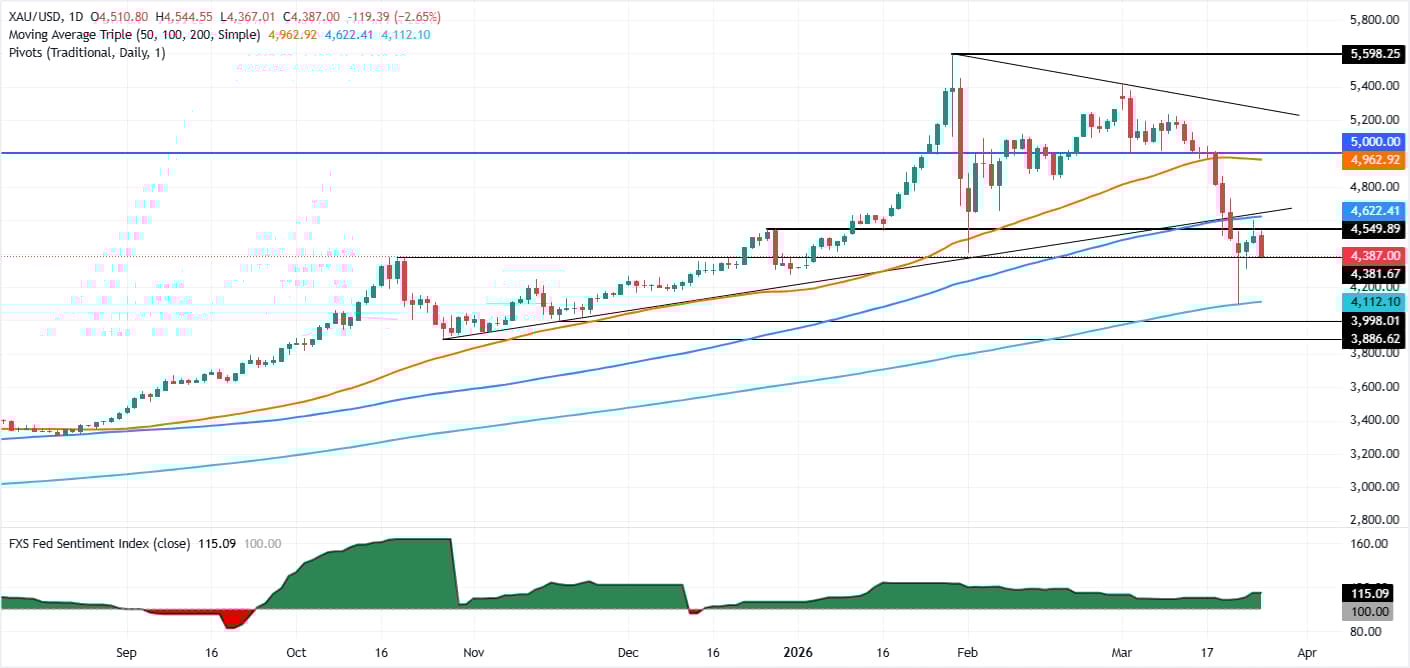
Gold price is reversing course after failing to reclaim $4,550, which exacerbated the ongoing drop below $4,400. A day ago, XAU/USD clashed with the 100-day Simple Moving Average (SMA) at $4,600, and failure to reclaim that level opened the door for further downside.
The Relative Strength Index (RSI) is trending lower, edging further deep towards oversold territory, an indication that sellers are gaining momentum.
Should Gold close daily below $4,400, the next support would be the Tuesday daily low at $4,306, followed by the Monday swing low at $4,098.
On the upside, bulls must clear the Wednesday daily low at $4,456 to reclaim $4,500.
Gold FAQs
Gold has played a key role in human’s history as it has been widely used as a store of value and medium of exchange. Currently, apart from its shine and usage for jewelry, the precious metal is widely seen as a safe-haven asset, meaning that it is considered a good investment during turbulent times. Gold is also widely seen as a hedge against inflation and against depreciating currencies as it doesn’t rely on any specific issuer or government.
Central banks are the biggest Gold holders. In their aim to support their currencies in turbulent times, central banks tend to diversify their reserves and buy Gold to improve the perceived strength of the economy and the currency. High Gold reserves can be a source of trust for a country’s solvency. Central banks added 1,136 tonnes of Gold worth around $70 billion to their reserves in 2022, according to data from the World Gold Council. This is the highest yearly purchase since records began. Central banks from emerging economies such as China, India and Turkey are quickly increasing their Gold reserves.
Gold has an inverse correlation with the US Dollar and US Treasuries, which are both major reserve and safe-haven assets. When the Dollar depreciates, Gold tends to rise, enabling investors and central banks to diversify their assets in turbulent times. Gold is also inversely correlated with risk assets. A rally in the stock market tends to weaken Gold price, while sell-offs in riskier markets tend to favor the precious metal.
The price can move due to a wide range of factors. Geopolitical instability or fears of a deep recession can quickly make Gold price escalate due to its safe-haven status. As a yield-less asset, Gold tends to rise with lower interest rates, while higher cost of money usually weighs down on the yellow metal. Still, most moves depend on how the US Dollar (USD) behaves as the asset is priced in dollars (XAU/USD). A strong Dollar tends to keep the price of Gold controlled, whereas a weaker Dollar is likely to push Gold prices up.













