




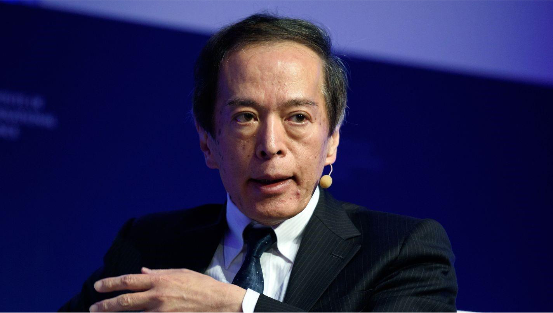
BoJ Governor Kazuo Ueda has made it clear that he will “weigh the pros and cons of a rate hike” at the December policy meeting, which markets interpret as a decisive signal that Japan is preparing to end more than a decade of ultra-loose monetary policy.
The swaps market reacted immediately: pricing for a BoJ rate hike in December surged from around 30% just ten days earlier to as high as 76% overnight. This sudden shift toward monetary tightening not only led to a simultaneous sell-off in Japanese stocks and bonds, but also acted like the first domino in a global de-risking wave, prompting capital to flee high-risk assets — with the crypto market standing at the very front of that retreat.
A Deep Dive into Ueda’s Hawkish Turn
BoJ Governor Kazuo Ueda’s December 1 comments are being viewed globally as a decisive “hawkish turn” — not because of a single aggressive remark, but because he clarified the decision-making framework, policy logic, and communication strategy in a way that fundamentally changed investors’ perception of his stance on policy normalization.
1.From Vague Guidance to a Specific Date: A Fundamental Shift in Communication
Previously, BoJ forward guidance often relied on vague phrases such as “at some point” or “at an appropriate time in the future.”
This time, however, Ueda explicitly stated that the BoJ “will consider the pros and cons of raising the policy rate at the next monetary policy meeting”, and directly placed the December 19 meeting under the policy spotlight, pledging to make the “right decision” at that time.
Such a direct link between a specific meeting date and a potential rate move is extremely rare in recent BoJ communication history, and analysts see it as the clearest pre-action signal so far.
The surge in market-implied probabilities is the most direct proof of this shift. Before Ueda spoke, the implied probability of a December hike had been hovering around 50% just a week earlier. After his remarks, overnight index swaps (OIS) quickly repriced, with traders seeing the probability of a December rate hike jump to roughly 62%–76%, and the odds of a rate hike before the January meeting rising above 90%.
Economists at Barclays wrote in a research note that what was previously a “finely balanced contest” has now flipped: a December rate hike has become the “base case.”
2.Internal Pressure and External Consensus: How the Balance Has Tipped
Ueda’s hawkish shift is not an isolated event. It reflects persistent pressure from the BoJ’s internal hawks and an evolving consensus with the government.
At the last two policy meetings, two Policy Board members (Naoki Tamura and Hajime Takata) already voted in favor of a rate hike, revealing both internal division and growing pressure for a shift. Recently, other members including Junko Nakagawa and Kazuchika Masuda have also spoken in favor of policy normalization. Nakagawa was particularly blunt, saying that given “relatively strong” price developments, the BoJ must continue to raise real interest rates.
This means that within the nine-member board, the pro-hike camp has become a force Ueda can no longer ignore, compelling the central decision-maker to address and respond to their concerns.
At the same time, the government’s stance is quietly shifting. Markets had worried that the new prime minister, Sanae Takaichi, known for favoring easy policy, might resist rate hikes. Recent developments have largely cleared that obstacle.
Japan’s Finance Minister Katsuyo Katayama has publicly stated she has “no particular objection” to the BoJ’s potential rate-hike path. After meeting with Takaichi, Ueda also hinted that the prime minister appeared comfortable with the idea of gradual rate hikes to guide inflation toward target. This political green light has given the BoJ crucial space to act independently.
3.Clarifying the Policy Logic: Three Pillars Supporting the Rate-Hike Path
- Key Variable – Spring Wage Negotiations
Ueda has repeatedly stressed that “confirming the initial momentum of wage negotiations is essential.”He has observed that corporate behavior is changing in a positive direction, with firms more willing to raise wages and prices. This implies that exchange-rate movements could have a greater impact on inflation than in the past. Analysts had long argued that if Ueda voiced optimism about next year’s Shuntō (spring wage talks), it would be viewed as the strongest possible hint of a coming hike. His latest remarks clearly reinforce that view.
- Inflation Assessment – From “Approaching” to “Achieving”
Ueda noted that inflation is projected, in the latter half of the BoJ’s three-year forecast period, to be “broadly consistent with the 2% target.” While core inflation may temporarily dip below 2% in the first half of fiscal 2026, it is expected to re-accelerate thereafter.More importantly, he highlighted that changes in corporate pricing behavior have strengthened the pass-through from exchange rates to prices. In other words, the inflationary impact of a persistently weak yen has become too significant to ignore and now requires a policy response.
- External Risks Have Eased Significantly
Ueda explicitly stated that uncertainties around the US economic outlook and high-tariff policies — previously key reasons for delaying hikes — have “eased significantly.” - This removes one of the main external justifications for the BoJ’s wait-and-see stance. While he acknowledged that the global economy is “slightly weak,” he believes it is still “growing gradually,” and that Japan’s economy has “moderately recovered.” He described the recent negative GDP print as merely “temporary.”
Crypto Takes the First Hit
In this latest liquidity shock, the crypto market suffered the most. On the evening of December 1, Bitcoin briefly plunged nearly 8%, breaking below the $84,000 level; Ether fared even worse, at one point dropping 10% intraday.
According to CoinGlass, in the past 24 hours more than 270,000 traders were liquidated, with total liquidations reaching $993 million.
The immediate trigger was a classic yen carry trade unwind. For years, investors have borrowed yen at near-zero cost, converted it into US dollars, and plowed the funds into high-risk, high-return assets such as Bitcoin.
Now, with Japanese rate-hike expectations rising, the yen has strengthened sharply (USD/JPY falling to 155.60), while Japanese government bond yields have climbed. This has pushed up both the funding and opportunity costs of borrowing yen.
Jeff Ko, Chief Analyst at CoinEx, noted that investors are reassessing the risks of unwinding yen carry trades — a process that directly weighs on the valuations of global risk assets, including cryptocurrencies.
The deeper issue is a systemic decline in risk appetite. A potential BoJ policy shift marks the end of the global “cheap money” era. With the Fed’s rate-cut path still uncertain and Europe’s economy weak, investors are increasingly adopting a “cash is king” mentality, starting by dumping highly liquid but extremely volatile assets like cryptocurrencies to reduce risk.
Technical Vulnerabilities Expose Market Fragility
The DeFi space added fuel to the fire. On the night of November 30, leading decentralized finance (DeFi) protocol Yearn Finance suffered a major hack, with macro-level fear and micro-level security failures reinforcing each other.
The attack exploited an “infinite mint” vulnerability in one of Yearn’s legacy products, yETH, a liquid staking token. The exploiter was able to mint roughly 235 trillion yETH tokens out of thin air in a single transaction. They then used this enormous stash of fake tokens to drain the associated Balancer liquidity pool, stealing about $8–9 million in crypto assets.
Security firm PeckShield reports that around 1,000 ETH (roughly $3 million) has already been routed through privacy mixer Tornado Cash, as the attacker attempts to launder the funds.

Although the Yearn team quickly clarified that its core V2/V3 vaults were unaffected and that the protocol’s total value locked (TVL) remains above $600 million, the incident nevertheless dealt a heavy blow to market confidence.
It is a stark reminder that, even amid macro headwinds, DeFi’s inherent smart-contract risks and legacy code problems remain a Sword of Damocles hanging over investors’ heads.
Combined with a recent $128 million exploit on the Balancer protocol, this latest attack has heightened concerns over the security of the DeFi ecosystem and prompted more funds to flee in panic.
According to DefiLlama, hackers have stolen more than $2.5 billion from crypto exchanges and DeFi protocols so far in 2025 alone. These incidents highlight a series of structural issues left behind by the industry’s rapid iteration:
Legacy code that has not been thoroughly tested
Layered risks arising from complex protocol composability
Logical flaws that can persist even after formal audits
In a bull market, such risks are often masked by sky-high return expectations. But when macro conditions shift and sentiment turns defensive, each new security incident becomes yet another straw on the camel’s back of market confidence.







