

USD/JPY Price Forecast: Takaichi’s trade caps Yen’s upside
โดย Sagar Dua
วันที่เผยแพร่: 15 Jan 2026 | วันที่แก้ไข: 15 Jan 2026


บทความยอดนิยม

The USD/JPY pair trades in a tight range around 158.50 during the Asian trading session on Thursday. The pair consolidates as the upbeat US Dollar (USD) has offset the decent recovery in the Japanese Yen (JPY).
- USD/JPY trades sideways around 158.50 as both the US Dollar and the Japanese Yen trade firmly.
- The Yen gains ground after Japanese officials warn of intervention against one-way excessive moves.
- The speculation for the Fed holding interest rates steady in the January policy meeting has strengthened the US Dollar.
The USD/JPY pair trades in a tight range around 158.50 during the Asian trading session on Thursday. The pair consolidates as the upbeat US Dollar (USD) has offset the decent recovery in the Japanese Yen (JPY).
Japanese Yen Price Today
The table below shows the percentage change of Japanese Yen (JPY) against listed major currencies today. Japanese Yen was the strongest against the New Zealand Dollar.
| USD | EUR | GBP | JPY | CAD | AUD | NZD | CHF | |
|---|---|---|---|---|---|---|---|---|
| USD | 0.05% | 0.05% | -0.05% | 0.10% | 0.19% | 0.23% | 0.03% | |
| EUR | -0.05% | -0.00% | -0.11% | 0.05% | 0.13% | 0.18% | -0.02% | |
| GBP | -0.05% | 0.00% | -0.11% | 0.05% | 0.14% | 0.18% | -0.02% | |
| JPY | 0.05% | 0.11% | 0.11% | 0.13% | 0.23% | 0.25% | 0.08% | |
| CAD | -0.10% | -0.05% | -0.05% | -0.13% | 0.10% | 0.13% | -0.06% | |
| AUD | -0.19% | -0.13% | -0.14% | -0.23% | -0.10% | 0.05% | -0.15% | |
| NZD | -0.23% | -0.18% | -0.18% | -0.25% | -0.13% | -0.05% | -0.20% | |
| CHF | -0.03% | 0.02% | 0.02% | -0.08% | 0.06% | 0.15% | 0.20% |
The heat map shows percentage changes of major currencies against each other. The base currency is picked from the left column, while the quote currency is picked from the top row. For example, if you pick the Japanese Yen from the left column and move along the horizontal line to the US Dollar, the percentage change displayed in the box will represent JPY (base)/USD (quote).
Japan’s currency gains ground after remaining downbeat in the past few weeks amid fears of intervention. Japan Chief Cabinet Secretary Seiji Kihara said on Wednesday that the government could intervene due to one-way excessive moves against the JPY.
However, the recovery move in the Japanese currency is expected to remain capped, with Prime Minister Sanae Takaichi’s trade remaining in traction.
Market experts are pricing in the victory of Takaichi in the early snap election, which she is expected to announce next week after dissolving the parliament’s lower house, Reuters reported. Takaichi’s win will help her get support for his budget, which is expected to be equipped with higher spending plans, an event that is favorable for Japanese equity markets and a headwind to the currency.
Meanwhile, the US Dollar Index (DXY) holds onto gains near the monthly high of 99.26 amid expectations that the Federal Reserve (Fed) will leave interest rates unchanged in the policy meeting later this month.
USD/JPY technical analysis
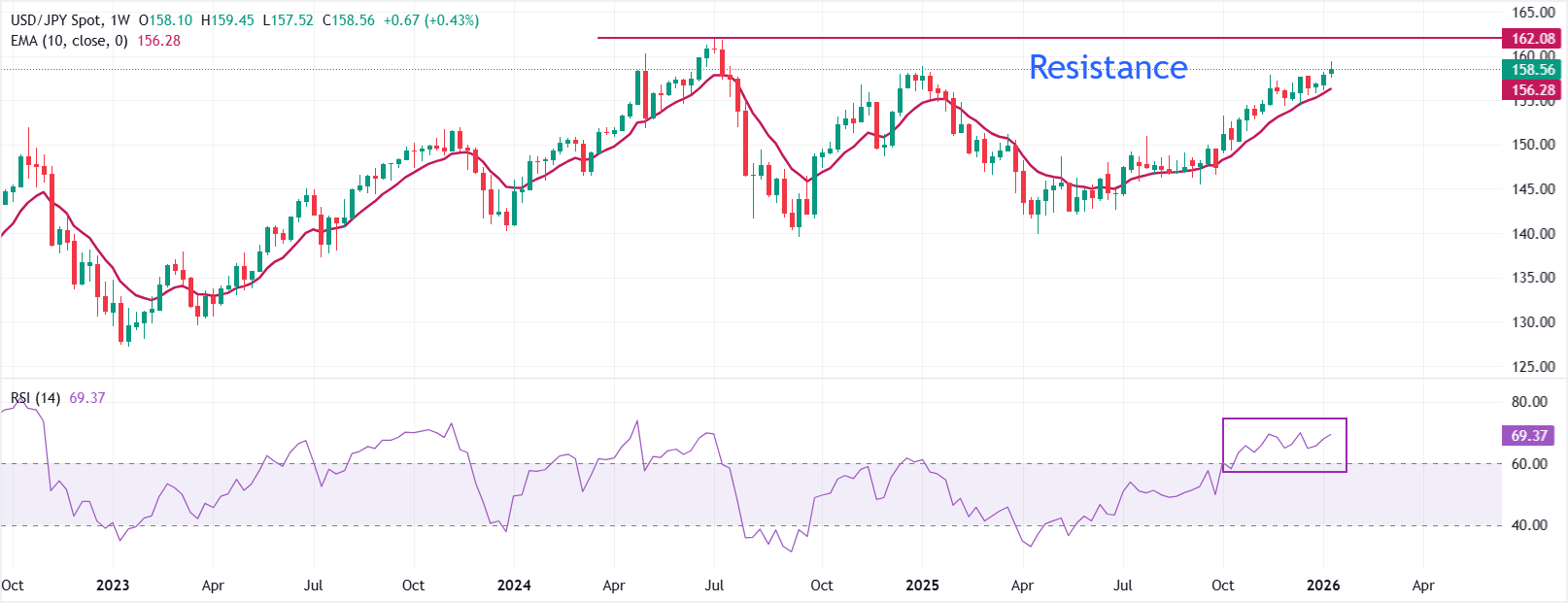
USD/JPY trades almost flat at around 158.56 during the press time. Price holds well above the rising 10-week Exponential Moving Average (EMA), reinforcing a strong uptrend. The 10-week EMA's steady climb supports dips and keeps pressure on the topside.
The 14-week Relative Strength Index (RSI) at 69.37, near overbought, confirms firm momentum but signals stretched conditions. Initial support stands at the 10-week EMA at 156.28.
While above the trend EMA, the advance could extend, with setbacks expected to be contained by dynamic support. A brief pullback would help cool RSI from near-overbought and sustain the broader move. A weekly close below 156.28 would weaken the bullish structure and open room for a deeper retracement.
(The technical analysis of this story was written with the help of an AI tool.)
Japanese Yen FAQs
The Japanese Yen (JPY) is one of the world’s most traded currencies. Its value is broadly determined by the performance of the Japanese economy, but more specifically by the Bank of Japan’s policy, the differential between Japanese and US bond yields, or risk sentiment among traders, among other factors.
One of the Bank of Japan’s mandates is currency control, so its moves are key for the Yen. The BoJ has directly intervened in currency markets sometimes, generally to lower the value of the Yen, although it refrains from doing it often due to political concerns of its main trading partners. The BoJ ultra-loose monetary policy between 2013 and 2024 caused the Yen to depreciate against its main currency peers due to an increasing policy divergence between the Bank of Japan and other main central banks. More recently, the gradually unwinding of this ultra-loose policy has given some support to the Yen.
Over the last decade, the BoJ’s stance of sticking to ultra-loose monetary policy has led to a widening policy divergence with other central banks, particularly with the US Federal Reserve. This supported a widening of the differential between the 10-year US and Japanese bonds, which favored the US Dollar against the Japanese Yen. The BoJ decision in 2024 to gradually abandon the ultra-loose policy, coupled with interest-rate cuts in other major central banks, is narrowing this differential.
The Japanese Yen is often seen as a safe-haven investment. This means that in times of market stress, investors are more likely to put their money in the Japanese currency due to its supposed reliability and stability. Turbulent times are likely to strengthen the Yen’s value against other currencies seen as more risky to invest in.

ผู้ใช้กว่าหนึ่งล้านคนพึ่งพา FXStreet สำหรับข้อมูลตลาดเรียลไทม์ เครื่องมือกราฟ การวิเคราะห์จากผู้เชี่ยวชาญ และข่าวฟอเร็กซ์ ปฏิทินเศรษฐกิจที่ครอบคลุมและเว็บบินาร์การศึกษาช่วยให้เทรดเดอร์ทันเหตุการณ์และตัดสินใจอย่างรอบคอบ FXStreet มีทีมงานประมาณ 60 คน แบ่งระหว่างสำนักงานใหญ่บาร์เซโลนาและภูมิภาคต่าง ๆ ทั่วโลก
อ่านเพิ่มเติม








