

Dogecoin Price Forecast: DOGE risks deeper pullback as US-Iran war rattles crypto assets
Ni John Isige
Petsa ng Pag-publish: 4 Mar 2026 | Petsa ng Pag-edit: 4 Mar 2026


Sikat na Artikulo

Dogecoin (DOGE) is trading around $0.090 at the time of writing on Tuesday, as risk-off sentiment grips the broader crypto market amid the ongoing war between the United States (US) and Iran.
- Dogecoin drops, holds $0.088 support as the US-Iran war spooks investors in risk assets.
- Dogecoin’s technicals remain weak, with the RSI falling and closing in on oversold territory.
- DOGE spot ETFs saw mild inflows of $779,000 on Monday, but low retail demand aligns with broader risk-off sentiment.
Dogecoin (DOGE) is trading around $0.090 at the time of writing on Tuesday, as risk-off sentiment grips the broader crypto market amid the ongoing war between the United States (US) and Iran.
Dogecoin wobbles as macro headwinds persist
Macro pressure is mounting as the US-Iran war enters its fourth day, and geopolitical tensions in the Middle East keep global markets on edge. Sustained high Oil and energy prices could keep inflation high, reducing the odds of rate cuts in 2026. Crypto and other risk assets sit on the wrong side of the conflict, as wars hardly favour such markets.
“Crypto continues to get pressured as the highest-beta growth asset in a world where risk premia on growth are rising and the Fed can’t act,” Wintermute stated in a weekly report on Monday.
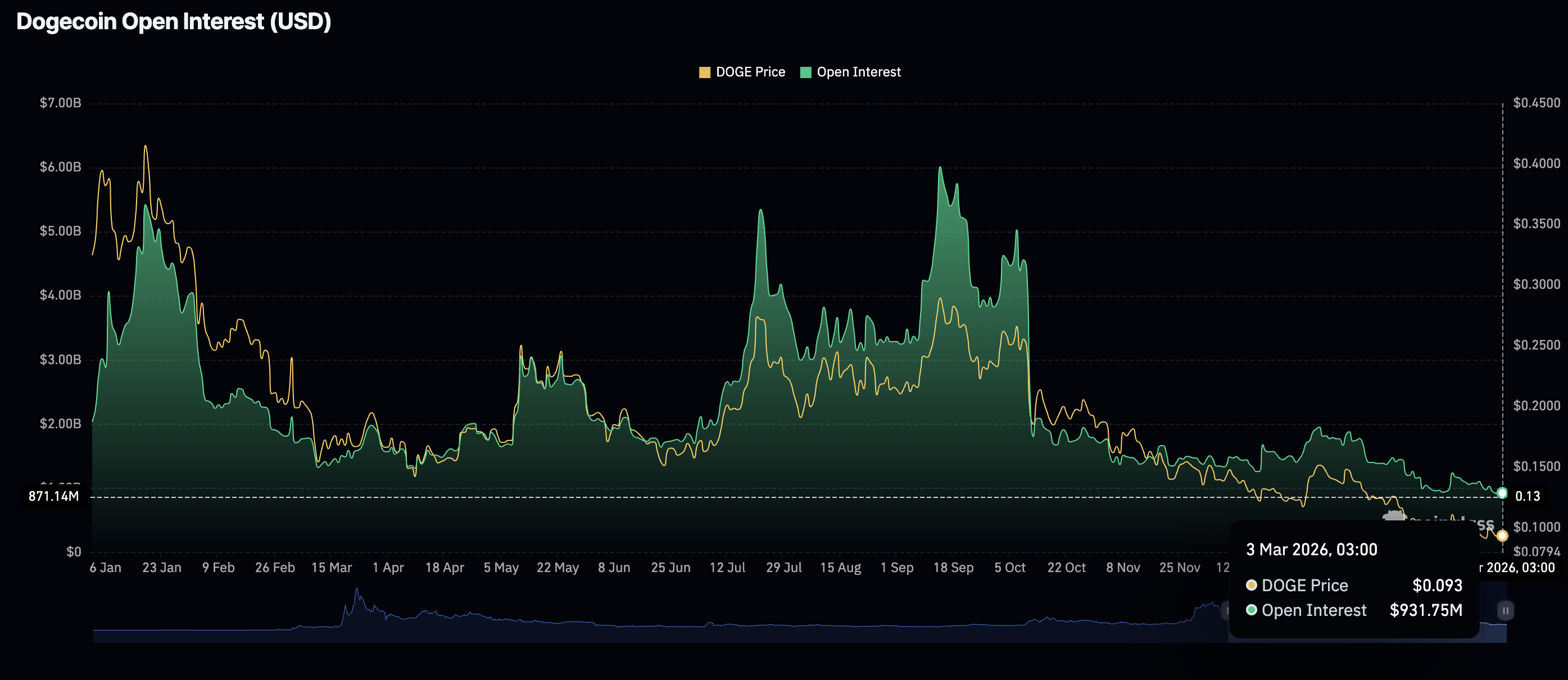
The Dogecoin derivatives market reflects risk-off sentiment amid the ongoing war, with futures Open Interest (OI) averaging $932 million on Tuesday.
In contrast, the OI, which tracks the notional value of outstanding futures contracts, hit a record $6 billion in September. The surge coincided with the meme coin’s rising to $0.31 in the same month, underscoring the importance of retail demand.
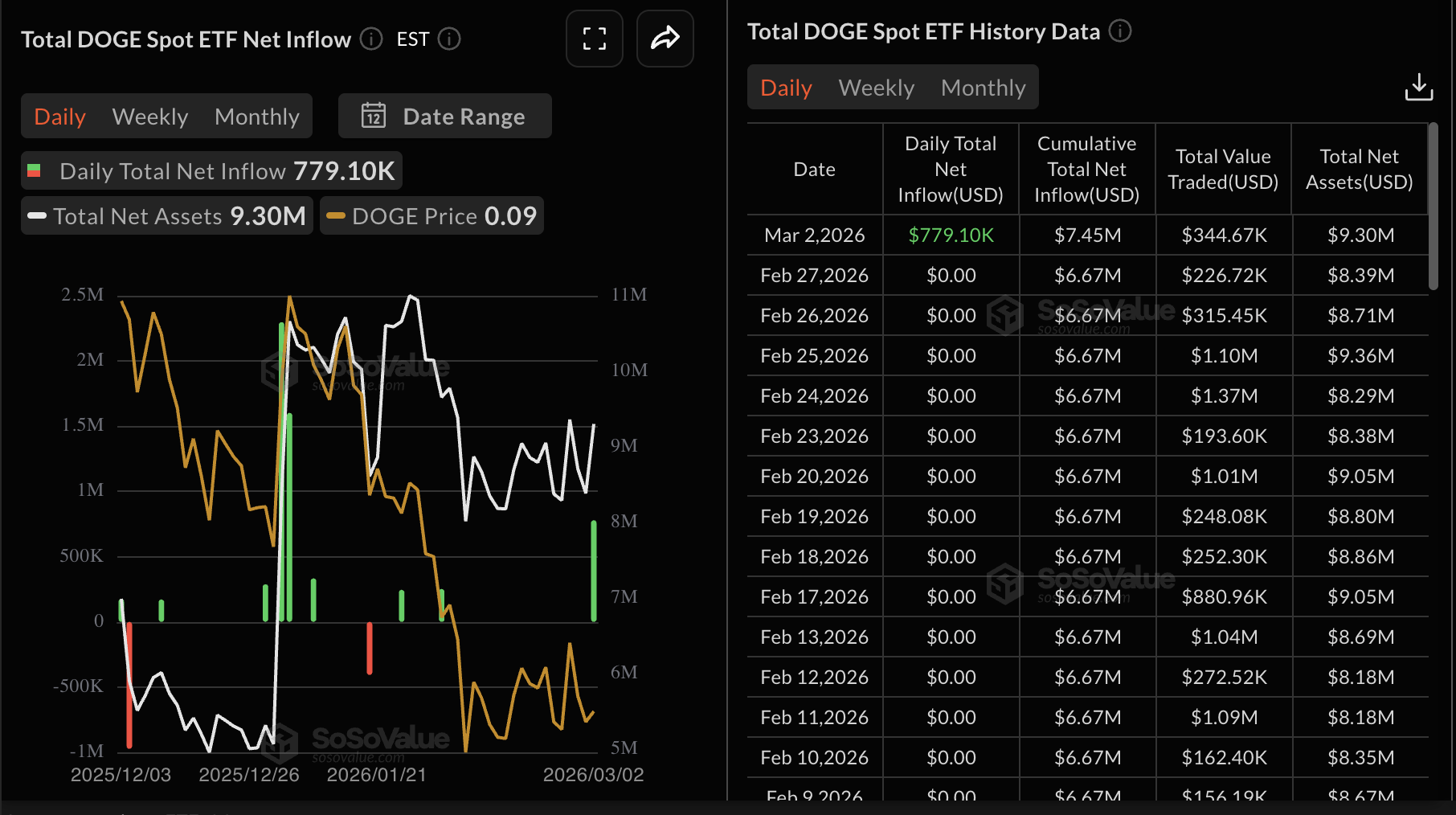
Meanwhile, inflows into Dogecoin spot Exchange-Traded Funds (ETFs) returned on Monday, averaging $779,000 after a long hiatus since February 2. The uptake of US-listed DOGE ETFs has been slow, with cumulative inflows at $7.45 million and net assets under management at $9.3 million. A steady risk appetite is required to shape positive sentiment and increase Dogecoin’s recovery potential.
Technical outlook: Dogecoin sellers tighten their grip
Dogecoin is trading around $0.090 amid bearish-leaning indicators. The meme coin remains well below the SuperTrend line at around $0.111, keeping downside pressure intact. At the same time, the 50-day, 100-day and 200-day Exponential Moving Averages (EMAs) cluster above $0.107 and slope lower, reinforcing a dominant medium-term downtrend and capping recovery attempts.
The Moving Average Convergence Divergence (MACD) indicator holds above its signal line on the daily chart, but contracting histogram bars suggest fading bullish momentum after the recent bounce. Moreover, the Relative Strength Index (RSI) has slipped into the high 30's, reflecting weak demand and aligning with a corrective-to-bearish tone.
-1772553342950-1772553342952.png)
Initial support is at Saturday's low near $0.088, where a breakdown would expose the early February pivot at $0.080. On the topside, immediate resistance stands at the daily open of $0.093. A daily close above this level is needed to ease selling pressure and open the way toward the 50-day EMA at $0.107 and later the 100-day EMA at $0.125.
Crypto ETF FAQs
An Exchange-Traded Fund (ETF) is an investment vehicle or an index that tracks the price of an underlying asset. ETFs can not only track a single asset, but a group of assets and sectors. For example, a Bitcoin ETF tracks Bitcoin’s price. ETF is a tool used by investors to gain exposure to a certain asset.
Yes. The first Bitcoin futures ETF in the US was approved by the US Securities & Exchange Commission in October 2021. A total of seven Bitcoin futures ETFs have been approved, with more than 20 still waiting for the regulator’s permission. The SEC says that the cryptocurrency industry is new and subject to manipulation, which is why it has been delaying crypto-related futures ETFs for the last few years.
Yes. The SEC approved in January 2024 the listing and trading of several Bitcoin spot Exchange-Traded Funds, opening the door to institutional capital and mainstream investors to trade the main crypto currency. The decision was hailed by the industry as a game changer.
The main advantage of crypto ETFs is the possibility of gaining exposure to a cryptocurrency without ownership, reducing the risk and cost of holding the asset. Other pros are a lower learning curve and higher security for investors since ETFs take charge of securing the underlying asset holdings. As for the main drawbacks, the main one is that as an investor you can’t have direct ownership of the asset, or, as they say in crypto, “not your keys, not your coins.” Other disadvantages are higher costs associated with holding crypto since ETFs charge fees for active management. Finally, even though investing in ETFs reduces the risk of holding an asset, price swings in the underlying cryptocurrency are likely to be reflected in the investment vehicle too.
(The technical analysis of this story was written with the help of an AI tool.)

Ang Acuity Trading ay isang fintech na nakabase sa London na itinatag noong 2013, na dalubhasa sa AI-powered na alternative data at sentiment analysis para sa trading at investments. Inirebolusyon nila ang online trading experience gamit ang visual news at sentiment tools, at patuloy na nangunguna sa merkado sa pamamagitan ng alpha-generating alternative data at highly engaging trading tools gamit ang pinakabagong AI research at technology.
Magbasa pa








