[TMGM Financial Breakfast] Mining Tycoon’s Bold Forecast: Gold Could Surge to US$17,250 Within Three Years!
A legendary mining investor has warned that today’s macroeconomic environment is even more dangerous than the stagflation era of the 1970s. With US debt approaching US$40 trillion, the Federal Reserve is effectively being forced to print money to support the system — laying the foundation for an epic long-term bull market in gold.
Mining industry legend Pierre Lassonde stated that the global financial system is undergoing a structural transformation, with gold gradually replacing the US dollar as the world’s ultimate reserve asset. He believes gold prices could eventually climb to US$17,250 per ounce.

As the co-founder of Franco-Nevada and former president of Newmont Mining, Lassonde said in a recent interview that the current macroeconomic landscape closely resembles the stagflation period of the 1970s. However, today’s global leverage levels are far higher, which could make this cycle significantly more volatile.
When Ronald Reagan first entered office in 1981, total US debt stood at just US$1 trillion. Today, annual US interest payments alone have reached that level, while total national debt is rapidly approaching US$40 trillion.
Latest data from early May 2026 shows that total US government debt has climbed close to US$39 trillion. Rising borrowing costs are further worsening the debt burden. According to projections from the Congressional Budget Office, net interest expenses this fiscal year are expected to account for nearly 14% of total federal spending.
Against a backdrop where the US budget deficit is expected to exceed 7.9% of GDP, Lassonde believes the Federal Reserve is effectively monetizing debt and printing money to backstop the system, providing strong long-term support for gold prices.
“Gold is a commodity 90% of the time, but 10% of the time it becomes the ultimate reserve currency,” Lassonde said. “When the US dollar can no longer fulfill that role, gold replaces it — and that is exactly what is happening now.”
Central banks have already become the dominant force in the gold market, steadily reducing exposure to US dollar assets while increasing gold allocations from less than 10% to more than 20% of reserves.
Recent data continues to confirm the trend of central bank gold buying. As of the end of April 2026, China’s official gold reserves reached 74.64 million ounces, marking the 18th consecutive month of accumulation.
Despite the continued purchases, gold still accounts for less than 10% of China’s foreign exchange reserves, suggesting there remains substantial room for further increases.
Meanwhile, pricing power in the gold market is gradually shifting toward the Shanghai Gold Exchange, where strong retail demand and elevated volatility are increasingly influencing physical gold pricing.
Although gold and silver prices have already reached record highs, Lassonde believes mining stocks remain significantly undervalued, with markets still failing to fully price in the sector’s unprecedented operational leverage.
Most gold mining companies currently operate with all-in sustaining costs ranging between US$1,500 and US$1,600 per ounce, while the industry average cash cost is approximately US$1,450 per ounce. Compared with current gold prices, this still leaves miners with exceptionally strong profit potential.
At a gold price of US$4,600 per ounce, miners could generate profits of roughly US$3,000 per ounce. If gold rises toward US$17,000, profit margins could expand fivefold — yet according to Lassonde, these potential gains are still not reflected in mining stock valuations.
Even if gold only rises to US$7,000 per ounce, the industry’s operating profits could still double.
Market Analysis:
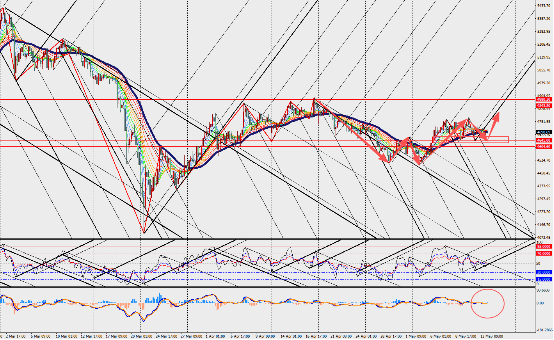
Gold remains range-bound on the 4-hour chart, while both the MACD lines and histogram continue to converge near the zero axis.
Capital allocation discipline across the mining sector has become extremely conservative. Unlike previous cycles characterized by aggressive expansion and expensive acquisitions — once the industry’s biggest weakness — mining companies are now focusing more on organic growth, dividends, and share buybacks.
According to Lassonde, the current gold rally is far more than a simple short-term price surge; it represents the beginning of a full-scale mining supercycle.