[TMGM Financial Breakfast] Rising Expectations for US-Iran Peace Deal Pressure Oil and Dollar Lower, While Gold Enjoys Strong Rebound
The core driver behind this latest rebound in gold prices stems from multiple positive developments surrounding breakthrough progress in US-Iran negotiations. US President Donald Trump publicly stated that negotiations with Iran are progressing in an orderly and constructive manner, injecting strong confidence into global markets.
At the same time, Iranian officials also released positive signals. An Iranian Foreign Ministry spokesperson stated publicly that, with mediation assistance from Pakistan, both sides had already resolved most major issues and that overall negotiations were moving steadily forward. However, he also warned markets that a final agreement has not yet been reached and that considerable uncertainty remains. Trump likewise stated there was “no need to rush” into signing a deal, indirectly confirming that substantial disagreements still exist across multiple key areas.

The two sides continue to face serious differences regarding two core issues: restrictions on Iran’s nuclear program and the scope of sanctions relief. As a result, future negotiations could still encounter major setbacks, creating lingering uncertainty for the sustainability of gold’s rebound.
Expectations for a US-Iran agreement immediately triggered chain reactions across commodity and currency markets, fundamentally reshaping short-term market dynamics. International oil prices collapsed sharply, as the geopolitical risk premium previously built into oil prices due to the Strait of Hormuz blockade and broader Middle East conflict rapidly faded. At the same time, the US Dollar Index continued weakening significantly against major global currencies. A weaker dollar directly lowers the holding cost of gold, further supporting gold prices.
Since the outbreak of Middle East conflict at the beginning of 2026, gold has remained under pressure for an extended period. The core reason was that soaring oil prices significantly boosted global inflation expectations, leading markets to increasingly fear that the Federal Reserve might be forced to resume rate hikes in order to contain inflation. Because gold itself is a non-yielding asset, its relative attractiveness declines sharply in a high-interest-rate environment, keeping gold prices under sustained pressure.
Current CME FedWatch data still shows that markets assign roughly a 40% probability to a 25-basis-point Fed rate hike at the December meeting. This expectation has continued limiting upside potential for gold. However, optimism surrounding a US-Iran agreement has now begun reversing that negative market logic. If the two sides ultimately reach a formal agreement and fully reopen the Strait of Hormuz, global oil supply tensions could ease significantly, reducing energy-driven inflation risks. In turn, the likelihood of the Federal Reserve restarting rate hikes would decline substantially, weakening gold’s disadvantage as a non-yielding asset and supporting the current rebound in gold prices.
Nevertheless, before US-Iran negotiations are finalized into a formal written agreement, gold’s upside potential will likely remain constrained by several major variables. In the short term, gold prices remain highly sensitive to US dollar strength, oil price volatility, and changing Federal Reserve rate expectations.
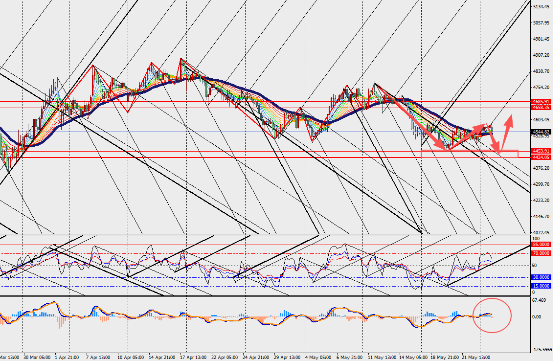
Market Analysis:
Gold encountered resistance and pulled back on the 4-hour chart timeframe, while both the MACD lines and histogram continued contracting above the zero axis. Although short-term volatility has intensified and bullish-bearish market battles are becoming increasingly aggressive, gold’s longer-term fundamental support remains solid. The global de-dollarization trend continues advancing steadily, while central banks around the world continue aggressively increasing gold reserves in order to optimize foreign exchange reserve structures. At the same time, retail and institutional investment demand for gold remains resilient globally, while overall gold ETF holdings continue holding at elevated levels. These dual supportive forces may effectively limit the risk of a deep correction in gold prices.