US-Iran Conflict “Hanging by a Thread” as CPI Data Looms — Gold Reclaims 4,700, Eyes 5,000 by Year-End!
Spot gold rebounded after an early dip on Monday. Amid continued volatility across global markets, gold prices are now at a critical intersection of geopolitical risk and macroeconomic data, leaving investor sentiment increasingly mixed and sensitive.
Market participants generally believe that the current volatile upward trend is mainly driven by persistent concerns surrounding the US-Iran conflict.
US President Donald Trump stated clearly on Monday that the ceasefire agreement with Iran is now “hanging by a thread.” He swiftly rejected Iran’s response to the US peace proposal, arguing that Tehran’s conditions were completely unacceptable. The conflict, which has now lasted for 10 weeks, has caused thousands of casualties and severely disrupted global energy supplies, with shipping through the Strait of Hormuz nearly grinding to a halt.

As a result, international oil prices rebounded sharply. The surge in oil prices has directly lifted global inflation expectations, reinforcing market expectations that interest rates may remain elevated for longer. Although a high-interest-rate environment typically weighs on gold prices, the safe-haven demand triggered by geopolitical tensions and the risk of prolonged inflation have instead provided strong support for gold.
The stalemate in peace negotiations has heightened short-term uncertainty, but investors continue to maintain optimistic expectations that gold prices could rise toward US$5,000 by the end of the year.
This week, markets will face a major test from key US inflation data releases. The Consumer Price Index (CPI) will be published on Tuesday, followed by the Producer Price Index (PPI) on Wednesday.
April headline CPI is expected to rise by 0.6% month-on-month, with annual inflation projected at 3.7%. Core CPI is forecast to increase by 2.7% year-on-year. PPI data is also expected to face upward pressure, with investors closely watching the transmission effect from rising oil prices.
US Treasury yields moved higher on Monday, with the 10-year yield climbing to 4.404%, while the 2-year yield also rose notably. This reflects growing market concerns that elevated oil prices may reignite inflation pressures.
Meanwhile, stronger-than-expected April nonfarm payroll data has further reduced the likelihood of near-term Federal Reserve rate cuts. Institutions including Goldman Sachs have already pushed their expectations for the first rate cut back to late 2026.
At present, the market is seeing clear dip-buying activity, while investors are simultaneously adjusting positions ahead of this week’s inflation data releases. This repositioning itself has provided short-term support for gold prices.
The prolonged nature of the US-Iran conflict and continued uncertainty surrounding the Strait of Hormuz have established a solid safe-haven floor for gold. At the same time, the direction of US inflation data and the future policy path of the Federal Reserve will determine whether gold prices can extend their upside momentum further.
Market Analysis:
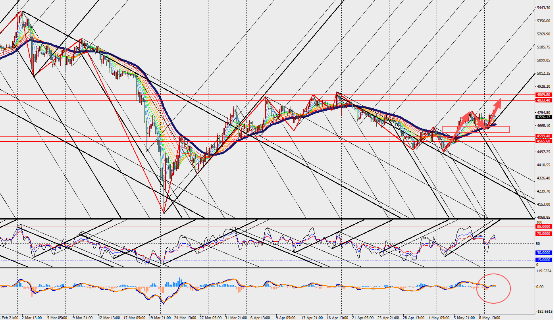
Gold rebounded again on the 4-hour chart timeframe, while both the MACD lines and histogram remain near the zero axis with weakening momentum.
As a traditional safe-haven and inflation-hedging asset, gold is once again demonstrating its unique value amid today’s increasingly complex global environment.
Investors should closely monitor this week’s US inflation data as well as developments surrounding Trump’s visit to Beijing, while remaining flexible in adjusting trading strategies accordingly.