

British Pound rebounds as USD bulls fade despite hot Core PCE
- Core PCE rises to 3.4%, keeping Fed pressure alive.
- GDP and jobless claims beat forecasts, but Dollar slips.
- UK political uncertainty lingers as Burnham succession questions grow.
The Pound Sterling advances by 0.22% even though the US economy grew faster than previously reported in Q1 of 2026, while inflation readings suggest that the Federal Reserve needs to tighten policy. The GBP/USD trades at 1.3194, after bouncing off daily lows of 1.31511.
GBP/USD gains as Dollar profit-taking offsets strong US data

The US Dollar treads water even though the Fed’s preferred inflation gauge, the Core Personal Consumption Expenditures (PCE) Price Index, expanded by 3.4% YoY as expected, up from 3.3% in April, implying that further tightening is needed. The US Dollar Index (DXY), which tracks the buck’s value against six currencies, is down 0.17% at 101.41.
US Treasury yields are also down, with the 10-year T-note yield down 2 basis points to 4.378%. US Gross Domestic Product (GDP) figures for Q1 2026 rose by 2.1% QoQ, exceeding estimates and the previous 1.6% print. Initial Jobless claims for the week ending June 20 dipped from 226K to 215K below estimates, while Durable Goods Orders contracted -4.5% as expected, down from 8% gain in the previous month.
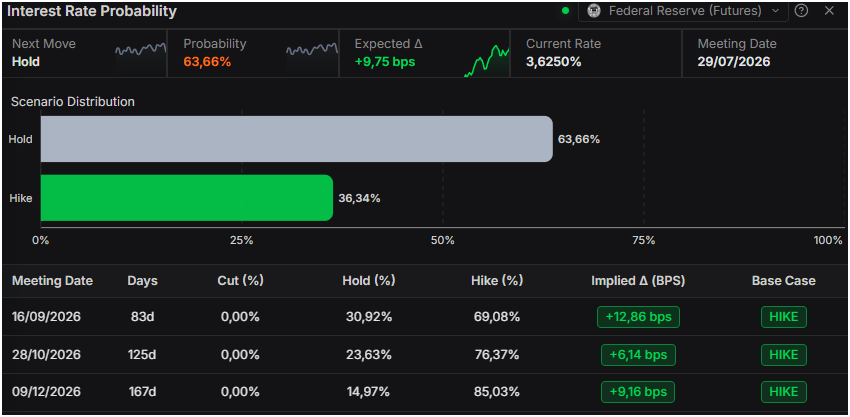
Given the backdrop, the Greenback was expected to extend its rally, but traders seem to be booking profits as money markets trimmed Fed hawkish bets for 2026.
Prime Terminal data shows that traders expect at least 30 basis points of easing towards the end of the year, down from nearly 40 on June 22.
In the UK, the docket remained absent, but the resignation of UK Prime Minister Keir Starmer opened the door for Andy Burnham. Burnham, who is seen as Starmer’s successor, is said not to retain the Chancellor Rachel Reeves, and there’s speculation of whom he would choose to succeed her.
Last year, Burnham called for an end to the UK’s dependence on foreign lenders, which triggered worries about him becoming the Prime Minister.
Mark Dowding, chief investment officer at the hedge fund RBC BlueBay, said that “He is boxed in by the fact that government finances are in a weak position, and if he chooses to ignore this reality, then he could find himself under pressure very quickly.”
Aside from this, the deal between the US and Iran pushed Oil prices lower, easing inflationary pressures. Meanwhile, the Bank of England is expected to hold rates unchanged at the July meeting, yet traders had priced in a rate hike by December.
GBP/]USD Price Forecast: Technical outlook
In the daily chart, GBP/USD trades at 1.3207. The pair remains under pressure as it holds well below the clustered 50-, 100- and 200-day simple moving averages (SMAs) grouped around 1.3437, keeping the broader tone bearish after losing the prior uptrend support line that was broken near 1.3451. The Relative Strength Index (14) at roughly 36 drifts in bearish territory but above oversold conditions, hinting that sellers retain control while still leaving room for additional downside before stretched conditions emerge.
On the topside, the SMA cluster around 1.3437 is the first significant resistance, followed by the descending resistance trend line that was last violated around 1.3537, where prior reactions suggest renewed supply. On the downside, initial demand is expected around the former rising trend-line origin close to 1.3159 and the nearby recent low area around 1.3167; a decisive break beneath this band would expose deeper losses, while holding above it would merely signal consolidation within a still bearish daily backdrop.
(The technical analysis of this story was written with the help of an AI tool.)
Pound Sterling FAQs
The Pound Sterling (GBP) is the oldest currency in the world (886 AD) and the official currency of the United Kingdom. It is the fourth most traded unit for foreign exchange (FX) in the world, accounting for 12% of all transactions, averaging $630 billion a day, according to 2022 data. Its key trading pairs are GBP/USD, also known as ‘Cable’, which accounts for 11% of FX, GBP/JPY, or the ‘Dragon’ as it is known by traders (3%), and EUR/GBP (2%). The Pound Sterling is issued by the Bank of England (BoE).
The single most important factor influencing the value of the Pound Sterling is monetary policy decided by the Bank of England. The BoE bases its decisions on whether it has achieved its primary goal of “price stability” – a steady inflation rate of around 2%. Its primary tool for achieving this is the adjustment of interest rates. When inflation is too high, the BoE will try to rein it in by raising interest rates, making it more expensive for people and businesses to access credit. This is generally positive for GBP, as higher interest rates make the UK a more attractive place for global investors to park their money. When inflation falls too low it is a sign economic growth is slowing. In this scenario, the BoE will consider lowering interest rates to cheapen credit so businesses will borrow more to invest in growth-generating projects.
Data releases gauge the health of the economy and can impact the value of the Pound Sterling. Indicators such as GDP, Manufacturing and Services PMIs, and employment can all influence the direction of the GBP. A strong economy is good for Sterling. Not only does it attract more foreign investment but it may encourage the BoE to put up interest rates, which will directly strengthen GBP. Otherwise, if economic data is weak, the Pound Sterling is likely to fall.
Another significant data release for the Pound Sterling is the Trade Balance. This indicator measures the difference between what a country earns from its exports and what it spends on imports over a given period. If a country produces highly sought-after exports, its currency will benefit purely from the extra demand created from foreign buyers seeking to purchase these goods. Therefore, a positive net Trade Balance strengthens a currency and vice versa for a negative balance.














