

British Pound Sterling leans on hikes its economy can't justify
- Markets still price BoE hikes even as UK growth signals deteriorate.
- That hawkish premium rests on an energy shock, not domestic strength.
- Friday's NFP and back-to-back Bailey speeches are the near-term tests.
Sterling is standing on a bet that gets harder to justify by the week. Markets still lean toward Bank of England (BoE) rate hikes this year, even as the economy beneath the Pound flashes contraction rather than the overheating that would normally warrant tighter policy. The Pound is holding up, but it is holding up on borrowed conviction, and the lender is the energy market.
Hiking into a contraction signal
The data is not subtle. May's construction Purchasing Managers Index (PMI) printed near 38, deep in contraction territory, the labour market shed roughly 100K jobs in the latest read, the worst since 2020, and yet the Bank Rate sits at 3.75% with the curve still leaning toward more tightening. Wage growth running close to 4.1% gives the hawks something to point at, but raising rates into a shrinking economy is a narrow path, and one the BoE would clearly rather not be walking.
A hawkish premium on loan from Crude Oil
The reason the BoE cannot simply cut is sitting in the energy market. April's Consumer Price Index (CPI) near 2.8% would, in calmer times, have cleared the way for easing. Instead, the Middle East conflict and the threat to Crude Oil supply through the Strait of Hormuz have kept energy costs elevated and headline inflation sticky. Sterling's hawkish premium is effectively borrowed from Crude Oil, and if those supply fears ease, the prop under the Pound goes with them. It is the same imported inflation shock forcing the same awkward hawkishness onto Japan and Australia, which is what ties this Pound story to the broader tape.
The Fed setting the floor under the Dollar
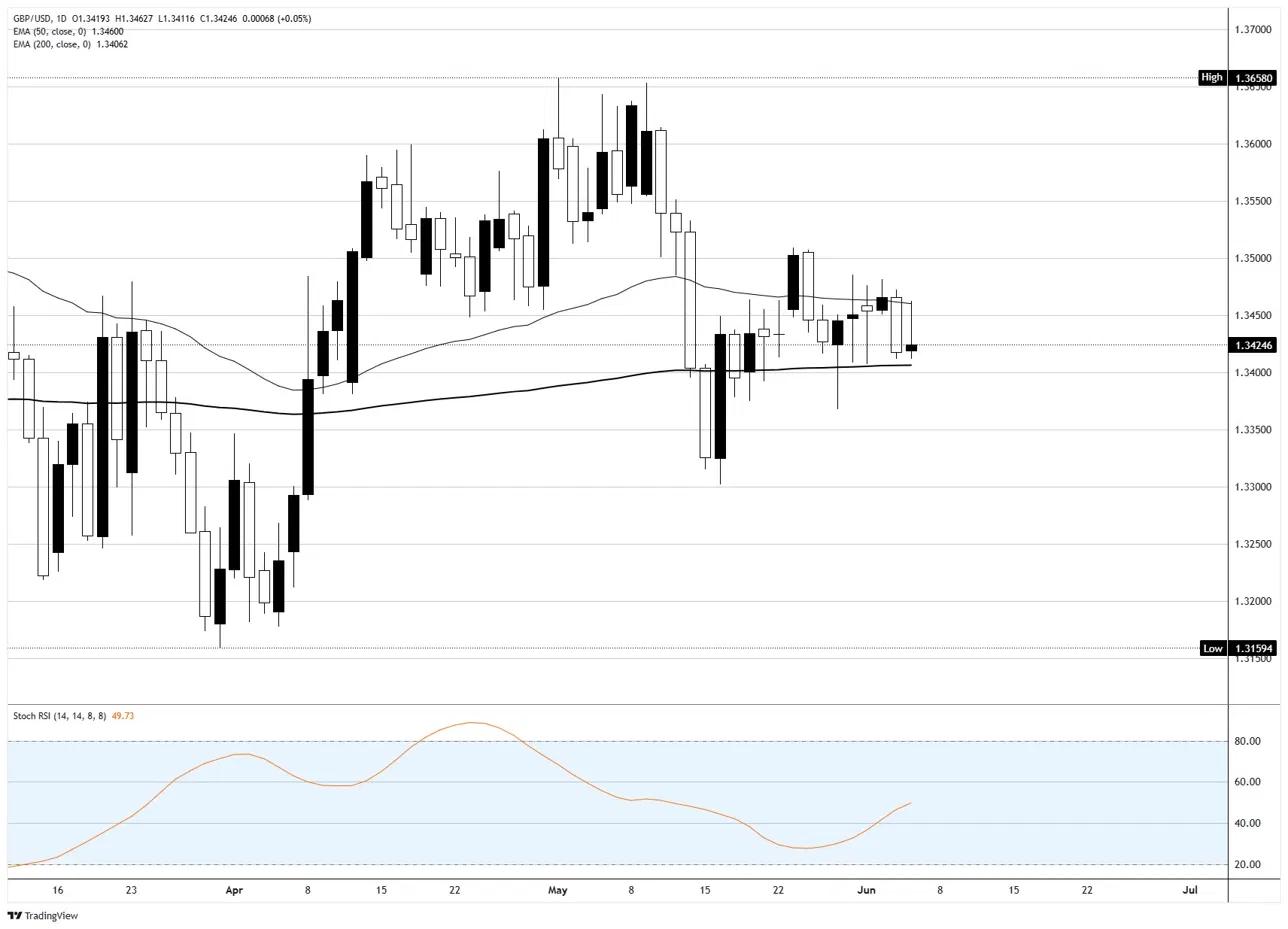
On the other side of the trade, the Federal Reserve (Fed) offers the Pound no help. Thursday's speakers, Schmid, Barkin and Daly among them, all warned that rates may rise if inflation does not ease, and markets now lean toward a hike by year-end rather than a cut. The chart offers no rescue either: GBP/USD is pinned between its 50-day and 200-day Exponential Moving Averages (EMA), with the Stochastic Relative Strength Index (Stoch RSI) sitting near the midpoint. That is a non-committal setup, and a non-committal chart leaves the macro story firmly in charge.
Bailey, then payrolls
Governor Bailey speaks twice into the weekend, late Thursday and again Friday, and any lean toward the growth risks rather than inflation stickiness would knock the hawkish bet straight away. Then comes the main event: Nonfarm Payrolls (NFP) Friday at 12:30 GMT, consensus near 85K after 115K, with unemployment seen at 4.3%. A firm print keeps the Dollar bid and caps the Pound, while a soft one offers some relief. Next week brings UK retail sales early on, then a Friday cluster of Gross Domestic Product (GDP) and production figures that will test the growth picture again.
How to trade the trap
Resistance: the 50-day EMA around 1.3450, then 1.3650 on a sustained Dollar pullback.
Support: the 200-day EMA close to 1.3400, with a loss of that level pointing toward 1.3150.
Bias: rangebound with a soft underside. The Pound holds only as long as its hike premium does, and that premium hangs on elevated Crude Oil and a Fed that stays hawkish. A soft NFP, a dovish lean from Bailey, or easing energy prices would each chip away at it, and two of the three arrive inside 24 hours.
GBP/USD 5-minute chart
Pound Sterling FAQs
The Pound Sterling (GBP) is the oldest currency in the world (886 AD) and the official currency of the United Kingdom. It is the fourth most traded unit for foreign exchange (FX) in the world, accounting for 12% of all transactions, averaging $630 billion a day, according to 2022 data. Its key trading pairs are GBP/USD, also known as ‘Cable’, which accounts for 11% of FX, GBP/JPY, or the ‘Dragon’ as it is known by traders (3%), and EUR/GBP (2%). The Pound Sterling is issued by the Bank of England (BoE).
The single most important factor influencing the value of the Pound Sterling is monetary policy decided by the Bank of England. The BoE bases its decisions on whether it has achieved its primary goal of “price stability” – a steady inflation rate of around 2%. Its primary tool for achieving this is the adjustment of interest rates. When inflation is too high, the BoE will try to rein it in by raising interest rates, making it more expensive for people and businesses to access credit. This is generally positive for GBP, as higher interest rates make the UK a more attractive place for global investors to park their money. When inflation falls too low it is a sign economic growth is slowing. In this scenario, the BoE will consider lowering interest rates to cheapen credit so businesses will borrow more to invest in growth-generating projects.
Data releases gauge the health of the economy and can impact the value of the Pound Sterling. Indicators such as GDP, Manufacturing and Services PMIs, and employment can all influence the direction of the GBP. A strong economy is good for Sterling. Not only does it attract more foreign investment but it may encourage the BoE to put up interest rates, which will directly strengthen GBP. Otherwise, if economic data is weak, the Pound Sterling is likely to fall.
Another significant data release for the Pound Sterling is the Trade Balance. This indicator measures the difference between what a country earns from its exports and what it spends on imports over a given period. If a country produces highly sought-after exports, its currency will benefit purely from the extra demand created from foreign buyers seeking to purchase these goods. Therefore, a positive net Trade Balance strengthens a currency and vice versa for a negative balance.














