

Euro routed as Warsh's Fed turns the dot plot upside down
- EUR/USD fell to its lowest level of the session after the June Federal Reserve decision.
- New projections flipped the 2026 rate path from a cut to a hike.
- Rate traders now price a possible Fed hike as soon as September.
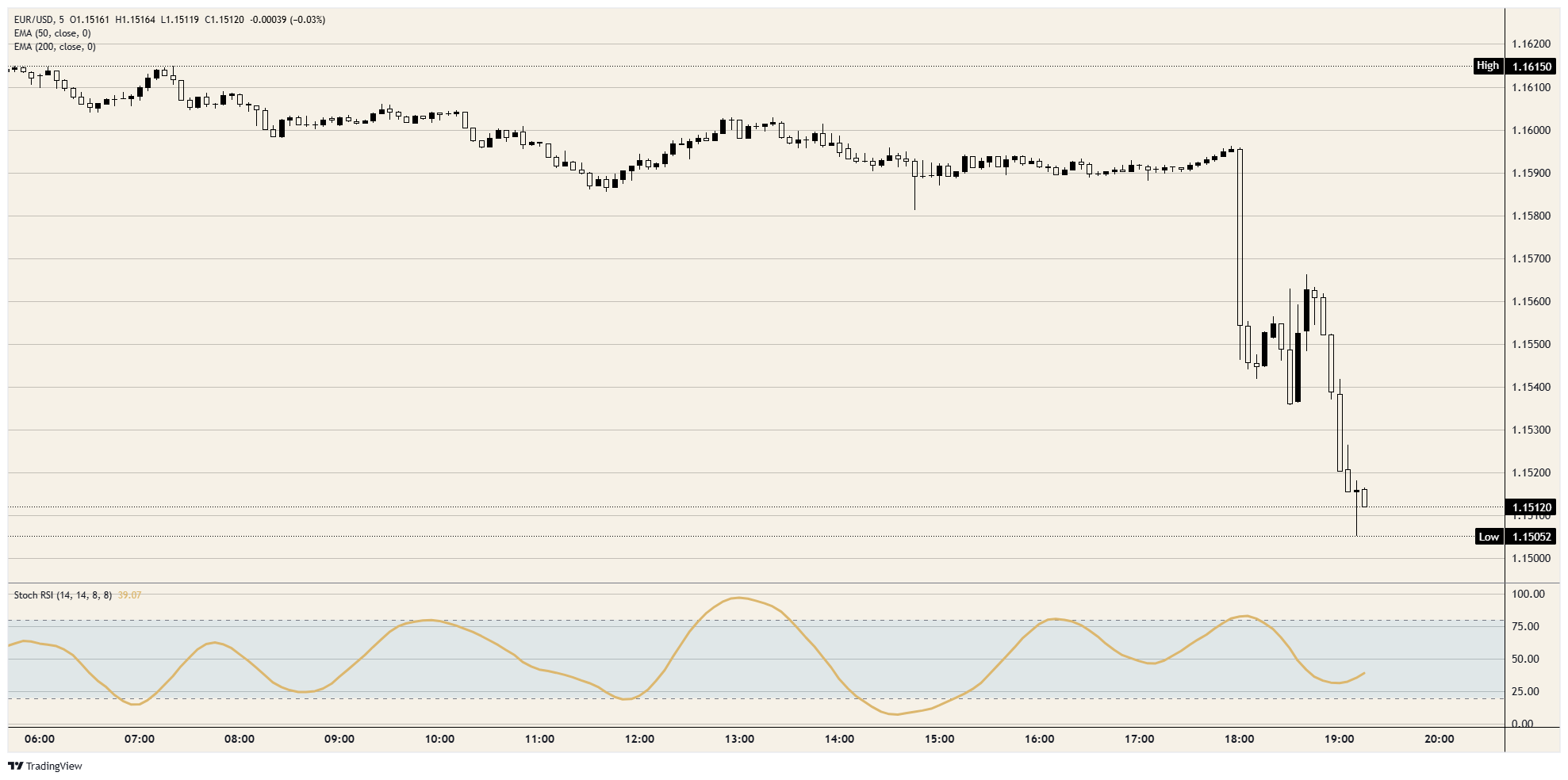
Kevin Warsh's first meeting as Federal Reserve (Fed) Chair was billed as a quiet hold, and on the headline rate it delivered exactly that. Everything wrapped around that hold, however, was a hawkish blow to the Euro. EUR/USD had been sitting just below 1.1600 into the announcement and fell close to 60 pips within minutes, slicing through 1.1550 and pressing toward 1.1500 as the scale of the shift registered.

A statement stripped of comfort
The Federal Open Market Committee (FOMC) held the target range at 3.50% to 3.75% on a unanimous 12 to 0 vote, a sharp turn from April's fractured 8 to 4 split that carried dissents on both sides. The easing bias has been removed; the old language on the timing of future adjustments was deleted and replaced with a blunt commitment to deliver price stability. Job gains were upgraded to keeping pace with the workforce, and policymakers added that productivity and capital investment are strong.
Dots that point up, not down
The Summary of Economic Projections (SEP) carried the real venom. The median 2026 federal funds projection jumped to roughly 3.8% from 3.4% in March, which turns the next expected move from a cut into a hike and sets the median a quarter point above the current rate. The trigger was an inflation forecast that blew out, with the median 2026 Personal Consumption Expenditures (PCE) projection leaping to 3.6% from 2.7% and the core reading lifted to 3.3%. The forecast climbed even as oil eased on the new Iran deal, a sign the Committee no longer treats its inflation problem as purely an energy story, and nearly half the Committee now pencils in a hike this year.
Warsh swings the gavel
At his first press conference Warsh leaned into the institutional overhaul he has long telegraphed, launching five task forces to review how the Fed runs its operations, including the balance sheet. He went further on communication, signaling he would not be surprised to see a new communications framework and changes to the SEP itself by year-end, a blunt restatement of his belief that the central bank should lean far less on forward guidance. He also appears to have withheld his own dot, leaving the awkward irony that the very projections which just whipsawed markets may be the next thing he overhauls.
September is suddenly live
The market took the cue immediately. According to the CME FedWatch tool, a rate increase by September is now close to a coin flip, the odds build toward 60% by October, and roughly three quarters of traders see higher rates by December. The nearest meetings remain near-certain holds, so the live debate is no longer whether the Fed eases but how soon it tightens. That is a hostile backdrop for a Euro now staring at a widening Dollar yield advantage.
Resistance: The 1.1550 level the pair knifed through now caps rebounds, with 1.1600 the heavier barrier and the line whose recovery would suggest the selloff is being faded.
Support: With price pinned below 1.1550, the 1.1500 handle is the obvious magnet, and a decisive break there opens the door toward 1.1450.
Bias: Bearish. The fundamental picture has shifted hard in the Dollar's favor, and rallies into the 1.1550 to 1.1600 band look like selling opportunities unless incoming data undercut the Fed's revived inflation fears.
EUR/USD 5-minute chart
Euro FAQs
The Euro is the currency for the 20 European Union countries that belong to the Eurozone. It is the second most heavily traded currency in the world behind the US Dollar. In 2022, it accounted for 31% of all foreign exchange transactions, with an average daily turnover of over $2.2 trillion a day. EUR/USD is the most heavily traded currency pair in the world, accounting for an estimated 30% off all transactions, followed by EUR/JPY (4%), EUR/GBP (3%) and EUR/AUD (2%).
The European Central Bank (ECB) in Frankfurt, Germany, is the reserve bank for the Eurozone. The ECB sets interest rates and manages monetary policy. The ECB’s primary mandate is to maintain price stability, which means either controlling inflation or stimulating growth. Its primary tool is the raising or lowering of interest rates. Relatively high interest rates – or the expectation of higher rates – will usually benefit the Euro and vice versa. The ECB Governing Council makes monetary policy decisions at meetings held eight times a year. Decisions are made by heads of the Eurozone national banks and six permanent members, including the President of the ECB, Christine Lagarde.
Eurozone inflation data, measured by the Harmonized Index of Consumer Prices (HICP), is an important econometric for the Euro. If inflation rises more than expected, especially if above the ECB’s 2% target, it obliges the ECB to raise interest rates to bring it back under control. Relatively high interest rates compared to its counterparts will usually benefit the Euro, as it makes the region more attractive as a place for global investors to park their money.
Data releases gauge the health of the economy and can impact on the Euro. Indicators such as GDP, Manufacturing and Services PMIs, employment, and consumer sentiment surveys can all influence the direction of the single currency. A strong economy is good for the Euro. Not only does it attract more foreign investment but it may encourage the ECB to put up interest rates, which will directly strengthen the Euro. Otherwise, if economic data is weak, the Euro is likely to fall. Economic data for the four largest economies in the euro area (Germany, France, Italy and Spain) are especially significant, as they account for 75% of the Eurozone’s economy.
Another significant data release for the Euro is the Trade Balance. This indicator measures the difference between what a country earns from its exports and what it spends on imports over a given period. If a country produces highly sought after exports then its currency will gain in value purely from the extra demand created from foreign buyers seeking to purchase these goods. Therefore, a positive net Trade Balance strengthens a currency and vice versa for a negative balance.













