

Gold Price Forecast: XAU/USD recovers further to near $4,530 amid falling Oil prices
- Gold price jumps to near $4,530 on renewed US-Iran deal optimism.
- US-Iran deal hopes have weighed heavily on the Oil price.
- Gulf oil infrastructure damage and the need to rebuild energy inventory could keep oil prices higher.
Gold price (XAU/USD) is up 0.7% to near $4,530 during the European trading session on Friday. The precious metal extends its Thursday’s recovery move, as Oil prices decline due to renewed hopes of a permanent peace deal between the United States (US) and Iran.

As of writing, the WTI Oil price trades 1.6% lower, hitting a fresh five-week low near $86.30.
On Thursday, a report from Axios showed that the US and Iran had reached an agreement over a 60-day Memorandum of Understanding (MoU), which includes “unrestricted” energy flow through the Strait of Hormuz, a critical passage to almost 20% of global energy supply, and the removal of the US blockade on Iranian sea ports. However, the agreement still needs approval from US President Donald Trump.
Gold price has been underperforming in the past few months as higher Oil prices due to Middle East conflicts fueled US inflation, which forced traders to price out the possibility of interest rate cuts by the Federal Reserve (Fed) this year, with markets even beginning to price in potential rate hikes by December. Higher-for-longer interest rate expectations reduce the appeal of non-yielding assets like Gold.
However, falling Oil prices this week have reduced expectations for additional Fed tightening, with markets now pricing in a 44% chance of higher rates by December, down from nearly 62% a week earlier.
Meanwhile, market experts are of the view that damage to Gulf energy infrastructure and the need to rebuild oil inventory would keep Oil prices higher even as Middle East conflicts get resolved.
Analysts at Goldman Sachs expect Brent and WTI to hold stable around $80 and $75 per barrel, respectively, through 2027. They note that global inventory rebuilding and structural supply responses will offset downward pressure even if shipping chokepoints like the Strait of Hormuz reopen.
The projected Oil price will still be almost 30% higher than what was seen before the onset of the war.
Also, US President Trump’s refusal to approve the latest US-Iran framework could lead to fresh concerns over the Gold price.
Gold technical analysis
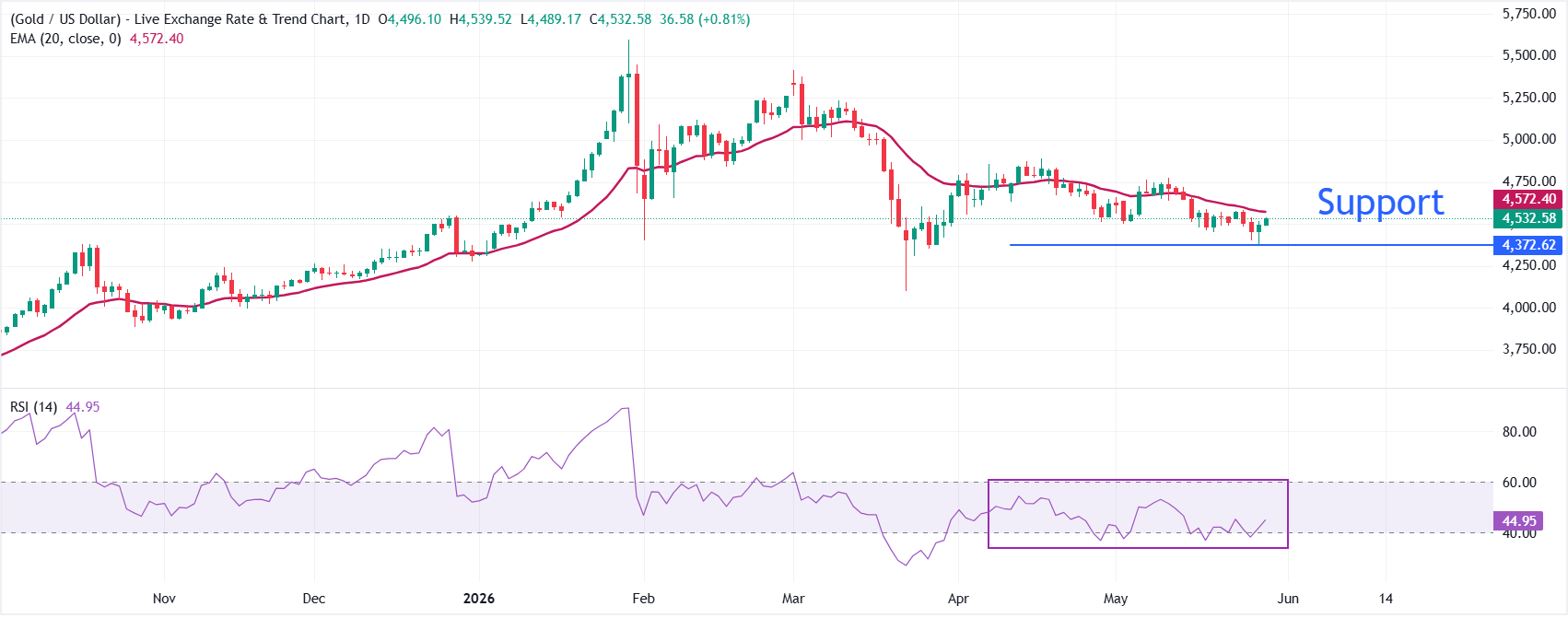
XAU/USD trades higher at around $4,530 as of writing. However, the near-term tone of the precious metal remains bearish as it holds beneath the 20-day Exponential Moving Average (EMA) at around $4,572.
The proximity of price to this EMA suggests the metal remains capped by short-term trend resistance, while the 14-day Relative Strength Index (RSI) near 45 hints at subdued, mildly bearish momentum rather than outright oversold conditions.
On the topside, the 20-day EMA at $4,572 is the first barrier bulls must reclaim to ease immediate downside pressure and open the way for a more sustained recovery towards the May 15 high at $4,665. Looking down, the yellow metal could slide to $4,300 if it falls back below the May 28 low at $4,366.
(The technical analysis of this story was written with the help of an AI tool.)
Gold FAQs
Gold has played a key role in human’s history as it has been widely used as a store of value and medium of exchange. Currently, apart from its shine and usage for jewelry, the precious metal is widely seen as a safe-haven asset, meaning that it is considered a good investment during turbulent times. Gold is also widely seen as a hedge against inflation and against depreciating currencies as it doesn’t rely on any specific issuer or government.
Central banks are the biggest Gold holders. In their aim to support their currencies in turbulent times, central banks tend to diversify their reserves and buy Gold to improve the perceived strength of the economy and the currency. High Gold reserves can be a source of trust for a country’s solvency. Central banks added 1,136 tonnes of Gold worth around $70 billion to their reserves in 2022, according to data from the World Gold Council. This is the highest yearly purchase since records began. Central banks from emerging economies such as China, India and Turkey are quickly increasing their Gold reserves.
Gold has an inverse correlation with the US Dollar and US Treasuries, which are both major reserve and safe-haven assets. When the Dollar depreciates, Gold tends to rise, enabling investors and central banks to diversify their assets in turbulent times. Gold is also inversely correlated with risk assets. A rally in the stock market tends to weaken Gold price, while sell-offs in riskier markets tend to favor the precious metal.
The price can move due to a wide range of factors. Geopolitical instability or fears of a deep recession can quickly make Gold price escalate due to its safe-haven status. As a yield-less asset, Gold tends to rise with lower interest rates, while higher cost of money usually weighs down on the yellow metal. Still, most moves depend on how the US Dollar (USD) behaves as the asset is priced in dollars (XAU/USD). A strong Dollar tends to keep the price of Gold controlled, whereas a weaker Dollar is likely to push Gold prices up.













