

Trading
Tuklasin ang malawak na hanay ng mga merkado na may competitive na presyo, malalim na liquidity, at advanced na trading tools.
Matuto Pa 
Platform
Mag-trade nang walang sagabal gamit ang malakas na platform ng TMGM, na ginawa para sa bilis, katumpakan, at superior na trading experience.
Matuto Pa Trading Platform
Mga Trading Tools
Academy
Matuto ng mga pangunahing kaalaman sa trading gamit ang mga beginner-friendly na resources, kasama ang mga gabay, webinars, at market insights.
Matuto Pa TMGM Academy
Balita at Analysis
Makakuha ng real-time na mga update sa merkado at expert analysis upang manatiling nangunguna sa mga trading opportunities
Matuto Pa Balita at Analysis
Tungkol
Alamin kung ano ang nagpapangiiba sa TMGM — ang aming global presence, regulatory strength, at commitment sa innovation sa trading.
Matuto Pa Bakit Piliin ang TMGM
Sponsorship
Ondo Price Forecast: ONDO holds key support as network’s tokenized stocks launch on Uniswap
- ONDO clings to critical support above $0.30, trading within a broader bearish trend from June highs of $0.43.
- Ondo Finance lists over 430 tokenized stocks and ETFs on decentralized exchange Uniswap, expanding access to global markets.
- ONDO technical outlook remains largely bearish, with the major moving averages capping the upside amid weak momentum indicators.
Ondo Finance (ONDO) is facing a pivotal moment as it attempts to hold above the $0.30 short-term support level on Tuesday. Since early June, ONDO has declined by more than 30%, putting significant pressure on the technical setup and reducing the probability of a sustained bullish reversal.
Uniswap lists Ondo Finance tokenized stocks and ETFs
Ondo Finance announced on Tuesday that more than 430 tokenized stocks and Exchange-Traded Funds (ETFs) are now available for trading on the decentralized exchange (DEX) Uniswap.
Qualified participants on Ethereum (ETH) and BNB Chain can now gain exposure to leading equities such as SpaceX (SPCX), Tesla (TSLA), Nvidia (NVDA), and Apple (AAPL), along with major ETFs like QQQ and SPY, all seamlessly via the Uniswap platform.
Ondo Finance stated in the press release that protocols, wallets, or applications that have integrated UniswapX can link their users to Ondo tokenized stocks and ETFs without additional integration work.
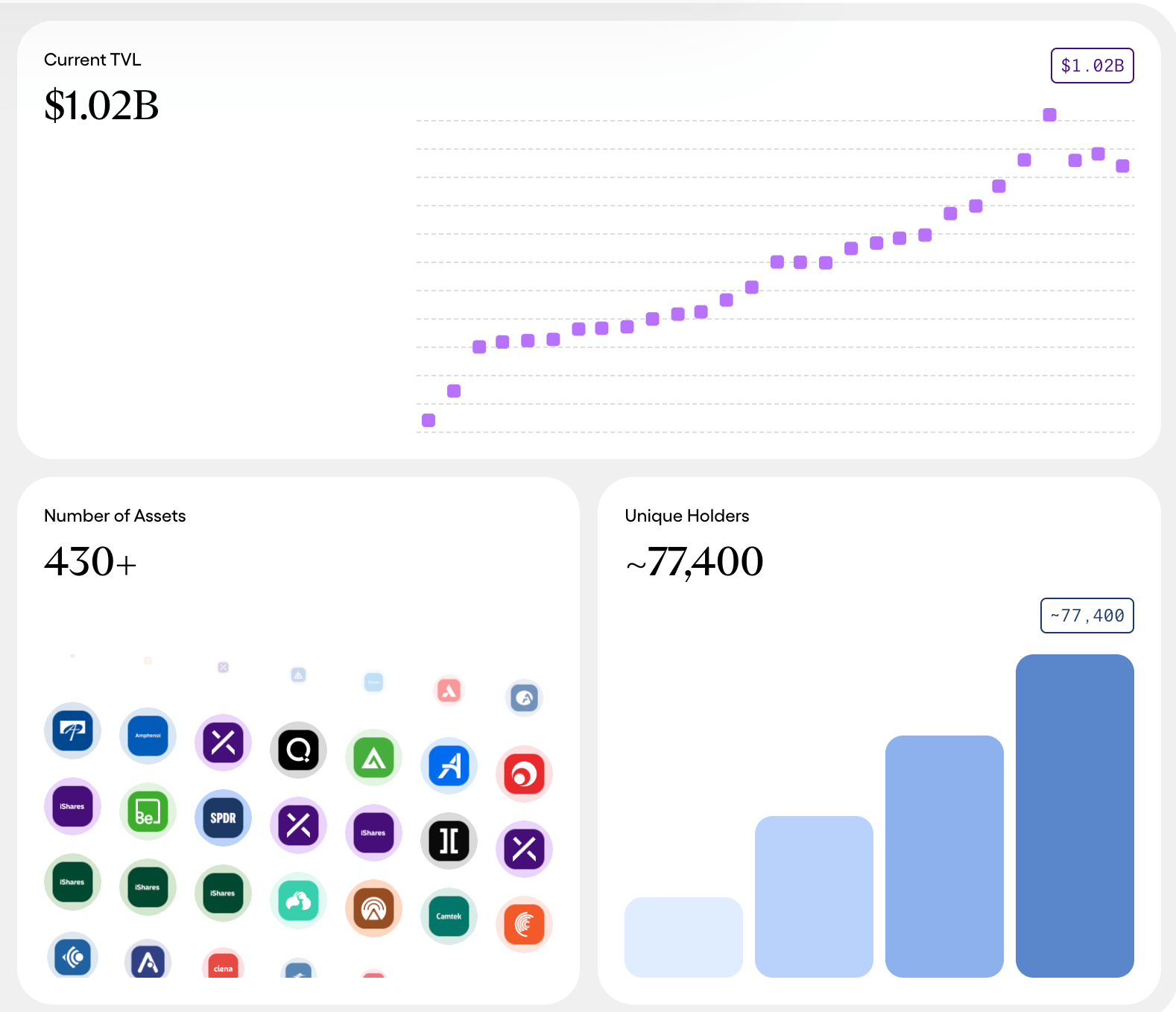
Ondo Finance is a leading real-world asset (RWA) tokenization platform, with a self-reported Total Value Locked (TVL) of $1.02 billion. The protocol boasts over 77,000 unique holders spread across over 430 assets.
Price analysis: Ondo under pressure as bearish signals persist
ONDO trades around $0.31 as bulls aggressively defend the psychological $0.30 support level. Meanwhile, the token upholds a bearish bias, sitting decisively below the short and long-term Exponential Moving Averages (EMAs).
Momentum conditions reinforce the cautious tone, with the Relative Strength Index (RSI) hovering near 39 in weak territory on the daily chart and the Moving Average Convergence Divergence (MACD) histogram still negative, hinting at persistent downside pressure despite mild stabilization.
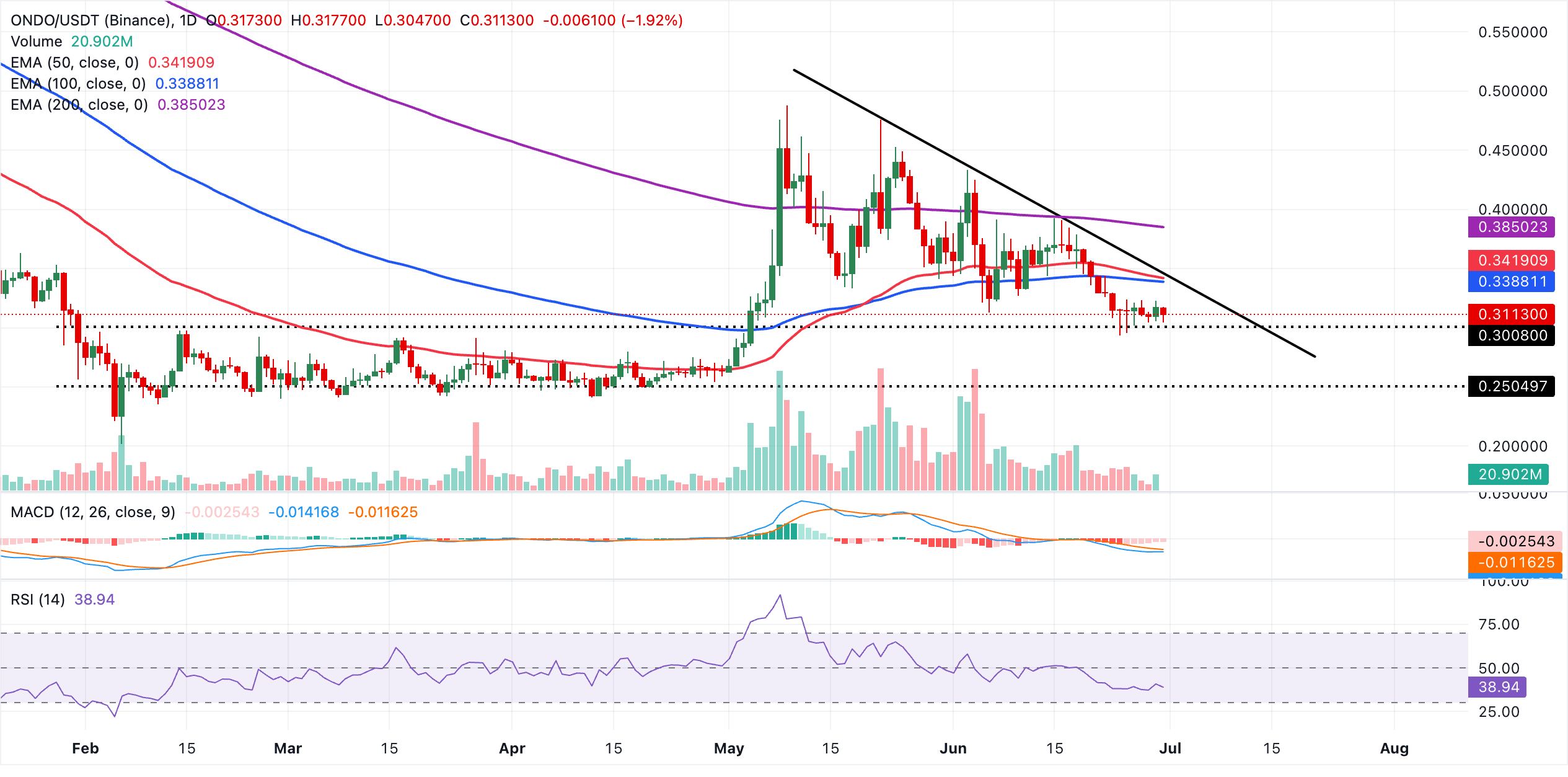
Initial resistance aligns with the 100-day EMA at $0.34, followed closely by the 50-day EMA at $0.34, forming a compact supply zone that bulls would need to reclaim to ease the current bearish structure. Above these barriers, the 200-day EMA at $0.39 marks a more significant hurdle within the broader downtrend, while the longer-term descending trendline, referenced around $0.52, defines the upper boundary. Looking down, ONDO bulls hold firmly to the immediate support at $0.30, where a deeper sell-off will likely open the door to losses targeting the demand area at $0.25.
(The technical analysis of this story was written with the help of an AI tool.)
Bitcoin, altcoins, stablecoins FAQs
Bitcoin is the largest cryptocurrency by market capitalization, a virtual currency designed to serve as money. This form of payment cannot be controlled by any one person, group, or entity, which eliminates the need for third-party participation during financial transactions.
Altcoins are any cryptocurrency apart from Bitcoin, but some also regard Ethereum as a non-altcoin because it is from these two cryptocurrencies that forking happens. If this is true, then Litecoin is the first altcoin, forked from the Bitcoin protocol and, therefore, an “improved” version of it.
Stablecoins are cryptocurrencies designed to have a stable price, with their value backed by a reserve of the asset it represents. To achieve this, the value of any one stablecoin is pegged to a commodity or financial instrument, such as the US Dollar (USD), with its supply regulated by an algorithm or demand. The main goal of stablecoins is to provide an on/off-ramp for investors willing to trade and invest in cryptocurrencies. Stablecoins also allow investors to store value since cryptocurrencies, in general, are subject to volatility.
Bitcoin dominance is the ratio of Bitcoin's market capitalization to the total market capitalization of all cryptocurrencies combined. It provides a clear picture of Bitcoin’s interest among investors. A high BTC dominance typically happens before and during a bull run, in which investors resort to investing in relatively stable and high market capitalization cryptocurrency like Bitcoin. A drop in BTC dominance usually means that investors are moving their capital and/or profits to altcoins in a quest for higher returns, which usually triggers an explosion of altcoin rallies.
Sikat na Artikulo
1Mexican Peso builds winning streak as USD/MXN drifts toward 18.002Corporate Bitcoin buying accelerates as Strategy, Strive and Metaplanet expand BTC treasuries3Singapore Dollar: MAS seen very slightly tightening – Standard Chartered4Silver Price Forecast: XAG/USD builds base above $60, eyes $645Chinese Yuan: Sideways with firmer bias against US Dollar - UOB6Gold stalls below $4,150 as rising US yields offset Fed relief7Markets just priced out rate hikes on financial stress. This chart shows why 2022-23 says they’ll be wrong8Japanese Yen weakens as wide yield gap supports US Dollar9Forex Today: PMIs in Europe and Fedspeak will do the rounds
LIVE QUOTES

LAHAT TUNGKOL SA TECHNICAL
Ano ang Dark Cloud Cover Pattern at Paano Ito I-trade?
Ano ang Piercing Line Candlestick Pattern at Paano Ito Ipinagte-trade?
Ano ang mga candlestick pattern na Tweezer Top at Bottom?
Inside Bar na Pattern ng Candlestick: Ano Ito, Paano Ito Matutukoy, at Paano Ito I-trade
Hanging Man Candlestick Pattern: Paano Ito Matukoy at I-trade
Paano Gumuhit ng Fibonacci Retracement: Pagsasanay sa Golden Ratio sa Trading
Ano ang MACD at Paano Maghanap ng Entry at Exit Points
Ano ang RSI, ang Relative Strength Index
Ano ang Scalping sa Trading at Paano Ito Gumagana
Magsimula!
Mag-sign up at ma-access ang Global Markets sa loob ng 3 minuto

Makipag-ugnayan sa Amin









Mga Kontak
Telepono: +61 2 8036 8388
Fax: +61 2 8036 8388
Email: support@tmgm.com
Web: https://www.tmgm.com



Ang impormasyong ibinigay sa website na ito ay pangkalahatang impormasyon lamang at hindi bumubuo ng personal na payong pinansyal. Bago kumilos batay sa anumang impormasyon sa website na ito, dapat mong isaalang-alang ang pagiging angkop ng impormasyon kaugnay ng iyong mga layunin, kalagayang pinansyal, at mga pangangailangan. Ang pag-iinvest sa CFDs at FX Margin Contracts ay may kaakibat na malalaking panganib at hindi angkop para sa lahat ng mamumuhunan. Maaari kang mawalan ng higit pa sa iyong paunang deposito. Wala kang pagmamay-ari o anumang interes sa pinagbabatayang asset. Inirerekomenda namin na humingi ka ng independiyenteng payo at tiyaking lubos mong nauunawaan ang mga panganib na kasangkot bago makipagkalakalan. Mahalaga na basahin at isaalang-alang mo ang dokumento ng pagsisiwalat bago ka kumuha ng anumang produktong nakalista sa website. Ang impormasyon at mga patalastas na inaalok sa website na ito ay hindi nilalayong gamitin ng sinumang tao sa alinmang bansa o hurisdiksyon kung saan ang ganitong paggamit ay labag sa mga lokal na batas at regulasyon. Ang mga Produkto at Serbisyong inaalok sa website na ito ay hindi nilalayong para sa mga residente ng United States, Malaysia, at Thailand.
Ang TMGM ay awtorisado at pinangangasiwaan sa iba't ibang hurisdiksyon.
Ang Trademax Australia Limited, na nag-trading bilang TMGM, ay pinangangasiwaan ng Australian Securities and Investments Commission (ASIC), AFSL no. 436416 at matatagpuan sa Level 28, One International Tower, 100 Barangaroo Avenue, 2000 Sydney, NSW Australia.
Email: support@tmgm.com.au
Ang Trademax Global Limited, na nag-trading bilang TMGM, ay awtorisado at pinangangasiwaan ng Vanuatu Financial Services Commission (VFSC), registration number 40356 at nakarehistro sa 1276, Kumul Highway, Port Vila, Vanuatu, Republic of Vanuatu.
Email: support@tmgm.com
Ang Trademax Global Markets (SE) Limited, na kilala bilang TMGM, ay awtorisado at nire-regulahan ng Financial Services Authority (FSA) ng Seychelles, na may lisensya bilang SD224. Ang kumpanya ay nakarehistro sa Office Blg. 13, Providence Estate ABIS Centre, Mahe, Seychelles.
Email: support@tmgm.com
Ang Trademax Global Markets (International) Pty Ltd, na nag-trading bilang TMGM, ay awtorisado at pinangangasiwaan ng Financial Services Commission, Mauritius (FSC) na may license no. GB22201012, at nakarehistro sa 33, Edith Cavell Street C/o IQ EQ Fund Services (Mauritius) Ltd Port Louis, 11324 Mauritius.
Email: support@tmgm.com
Copyright © TMGM. Lahat ng karapatan ay nakalaan