

Ripple Price Forecast: XRP losses extend amid risk-averse sentiment, muted ETF activity
- XRP corrects for the fourth consecutive day on Friday, trading well below the weekly open of $1.38.
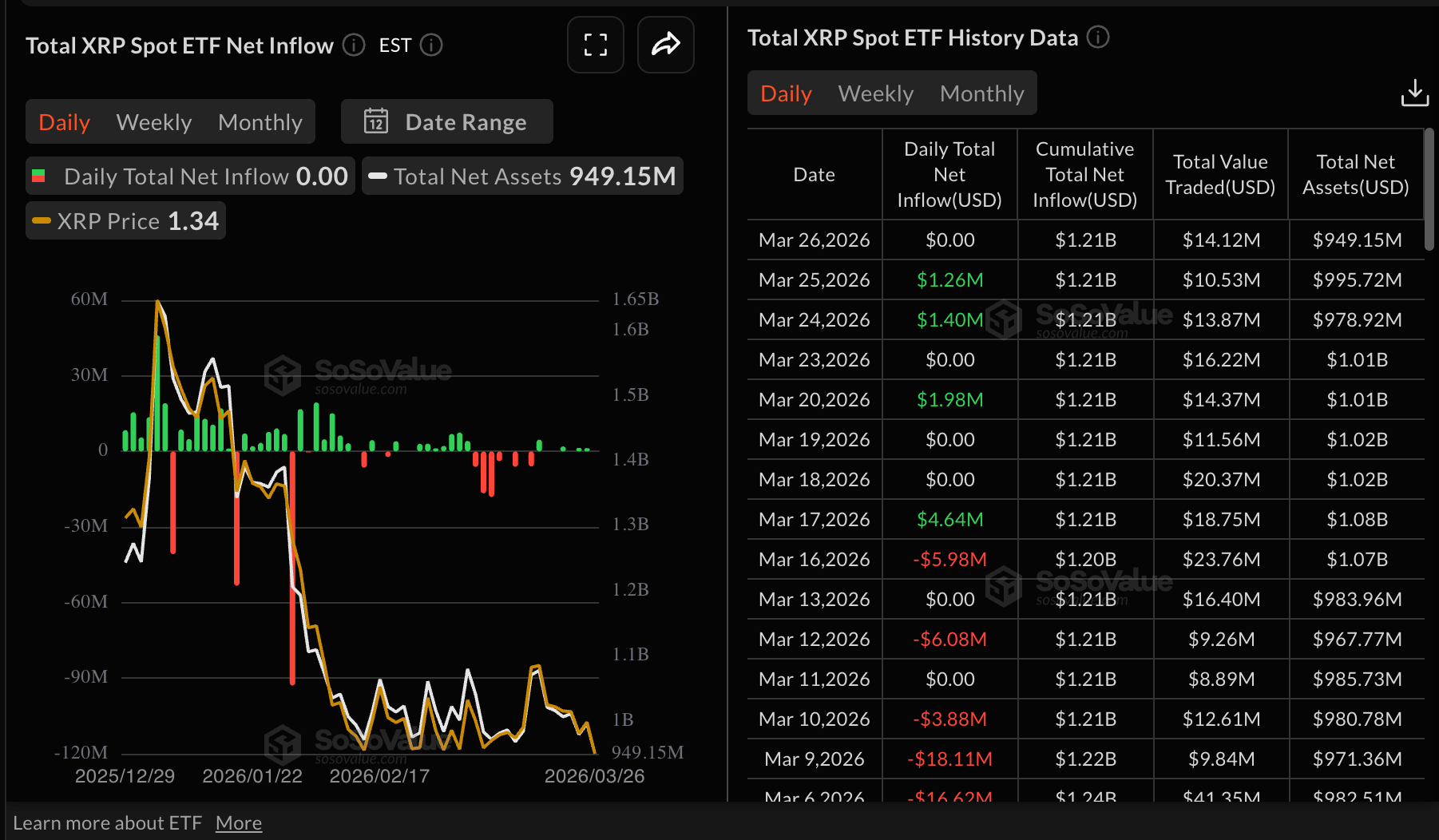
- XRP cumulative inflows into ETFs hold at $1.21 billion following muted activity on Thursday.
- The remittance token’s mild increase in futures Open Interest fails to absorb the selling pressure, as bearish pressure persists.
Ripple (XRP) is trading in a largely bearish environment, extending its correction to $1.34, notably below its weekly open at $1.38. Sellers have remained in control since the failed attempt at $1.61, aligning with the March peak.

The potential retest of the pivotal $1.30 support level could determine the next direction XRP takes. For now, retail investors appear keen to buy the dip amid a strengthening derivatives market. However, risk-off sentiment is persistent among institutional investors, which could limit XRP’s upside.
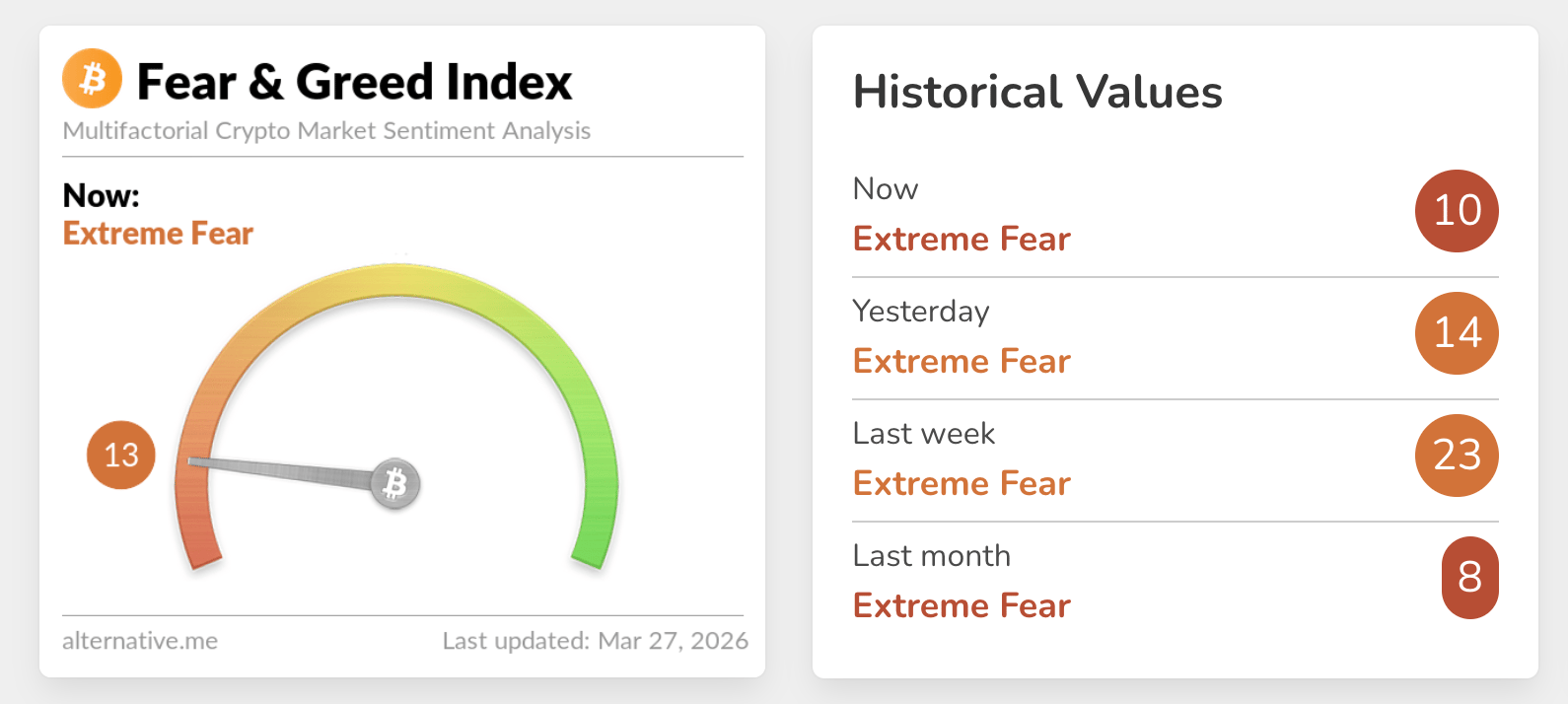
Sentiment in the cryptocurrency market remains weak as a risk-off mood triggers capital flight. The Crypto Fear & Greed Index holds at 13 on Friday in the extreme fear territory, down from 14 the previous day.
XRP falters amid cooling institutional interest
Interest in XRP spot Exchange-Traded Funds (ETFs) continues to wobble, reflecting broader crypto market risk-off sentiment. Institutional investors who primarily seek exposure to XRP via ETFs are increasingly withdrawing funds or retreating to the sidelines, which is negatively impacting sentiment.
The XRP ETF market remained quiet, with all five products posting zero flows on Thursday. According to SoSoValue data, cumulative inflows average $1.21 billion, with net assets under management approximately at $949 million. The net assets’ downtrend extends from $1.65 billion on January 1.
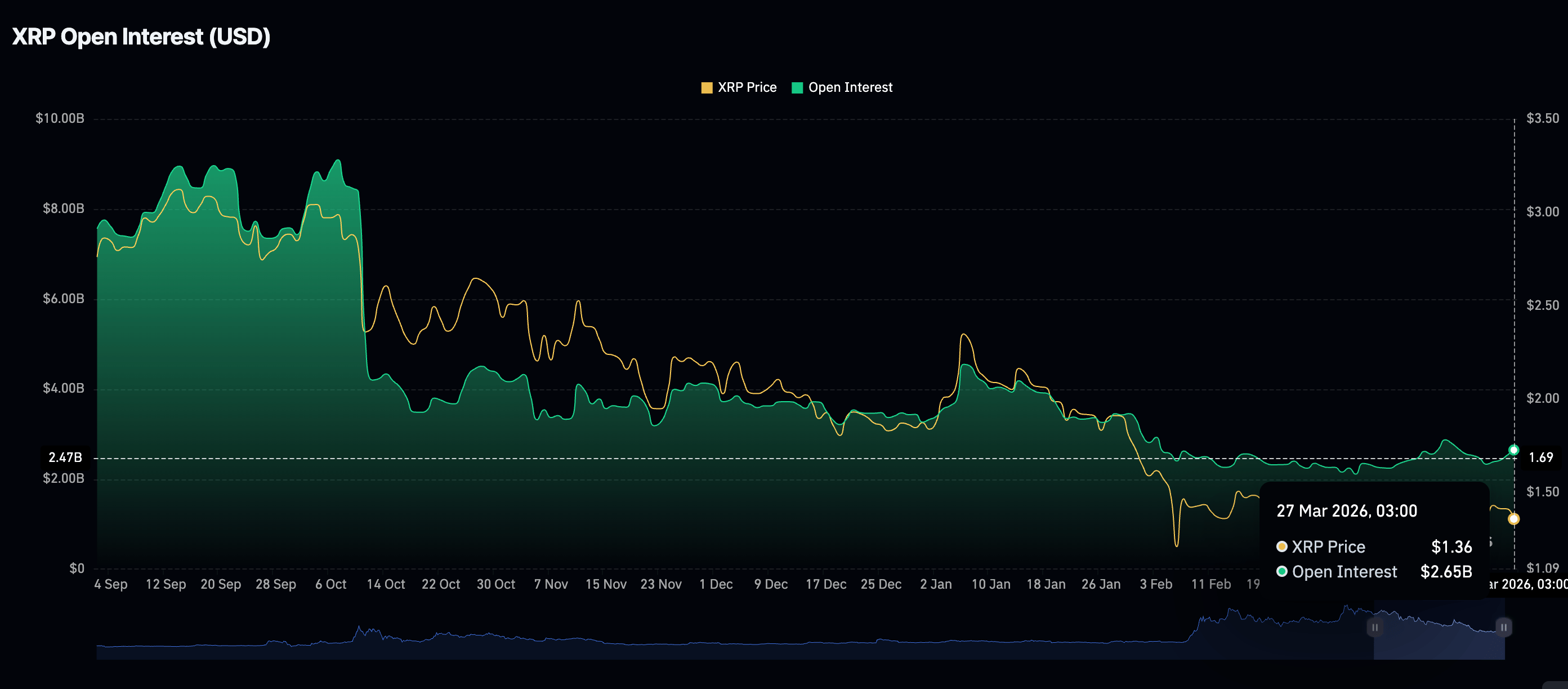
The XRP derivatives market paints a slightly positive outlook, with futures Open Interest (OI) increasing to $2.65 billion on Friday, up from $2.53 billion the previous day. CoinGlass data shows that the OI has steadily grown from $2.33 billion on Monday, affirming that risk appetite is improving in the retail market. A steady increase in OI would support XRP’s recovery potential.
Technical outlook: XRP falls as near-term bias turns bearish
XRP is edging lower below its weekly high of $1.38 and trading around $1.35 amid a broader bearish trend. The price slipped below the upward-sloping support trendline that had been underpinning the advance from around $1.12 in early February. Daily closes remain well below the 50-day, 100-day and 200-day Exponential Moving Averages (EMAs), clustered between roughly $1.48 and $1.90, reinforcing a downside tilt as those averages cap rebounds.
Momentum has weakened, with the Moving Average Convergence Divergence (MACD) indicator slipping below its signal line on the daily chart, and the red histogram bars expanding below the zero line. Moreover, the Relative Strength Index (RSI) is around 41 on the same chart, remaining below the 50 midline. Both momentum indicators suggest sellers retain the initiative in the short term.
-1774611957858-1774611957893.png)
XRP's initial resistance lies at the broken trendline area around $1.39, where prior support and the recent breakdown level converge, followed by the 50-day EMA at $1.48. A recovery through these barriers would be needed to ease immediate downside pressure and open the way toward the 100-day EMA at 1.65. On the downside, immediate support aligns with the daily low around $1.33, and a clear break below this floor would expose the next bearish target near $1.30, where prior consolidation appeared, with scope for an extension toward $1.25 if downside momentum extends.
Ripple FAQs
Ripple is a payments company that specializes in cross-border remittance. The company does this by leveraging blockchain technology. RippleNet is a network used for payments transfer created by Ripple Labs Inc. and is open to financial institutions worldwide. The company also leverages the XRP token.
XRP is the native token of the decentralized blockchain XRPLedger. The token is used by Ripple Labs to facilitate transactions on the XRPLedger, helping financial institutions transfer value in a borderless manner. XRP therefore facilitates trustless and instant payments on the XRPLedger chain, helping financial firms save on the cost of transacting worldwide.
XRPLedger is based on a distributed ledger technology and the blockchain using XRP to power transactions. The ledger is different from other blockchains as it has a built-in inflammatory protocol that helps fight spam and distributed denial-of-service (DDOS) attacks. The XRPL is maintained by a peer-to-peer network known as the global XRP Ledger community.
XRP uses the interledger standard. This is a blockchain protocol that aids payments across different networks. For instance, XRP’s blockchain can connect the ledgers of two or more banks. This effectively removes intermediaries and the need for centralization in the system. XRP acts as the native token of the XRPLedger blockchain engineered by Jed McCaleb, Arthur Britto and David Schwartz.
(The technical analysis of this story was written with the help of an AI tool.)














