

Trading
Tuklasin ang malawak na hanay ng mga merkado na may competitive na presyo, malalim na liquidity, at advanced na trading tools.
Matuto Pa 
Platform
Mag-trade nang walang sagabal gamit ang malakas na platform ng TMGM, na ginawa para sa bilis, katumpakan, at superior na trading experience.
Matuto Pa Trading Platform
Mga Trading Tools
Academy
Matuto ng mga pangunahing kaalaman sa trading gamit ang mga beginner-friendly na resources, kasama ang mga gabay, webinars, at market insights.
Matuto Pa TMGM Academy
Balita at Analysis
Makakuha ng real-time na mga update sa merkado at expert analysis upang manatiling nangunguna sa mga trading opportunities
Matuto Pa Balita at Analysis
Tungkol
Alamin kung ano ang nagpapangiiba sa TMGM — ang aming global presence, regulatory strength, at commitment sa innovation sa trading.
Matuto Pa Bakit Piliin ang TMGM
Sponsorship
Top 3 Price Prediction: Bitcoin, Ethereum, Ripple – BTC recovers from support, ETH and XRP eyes bullish breakout
- Bitcoin price extends its recovery on Friday after finding support around the key level earlier this week.
- Ethereum nears the 23.6% Fibonacci retracement level at $2,138, a close above would suggest an upside move.
- XRP approaches the upper boundary of its falling channel, signaling a potential bullish breakout.
Bitcoin (BTC), Ethereum (ETH), and Ripple (XRP) extend their recovery on Friday after recent corrective moves. BTC is trading above $77,700 after finding support around major levels, and ETH is near the key resistance zone, where a breakout could trigger further rebounds. Meanwhile, XRP approaches its upper boundary of the falling channel; a close above signals a bullish move.

Bitcoin's major support holds strong
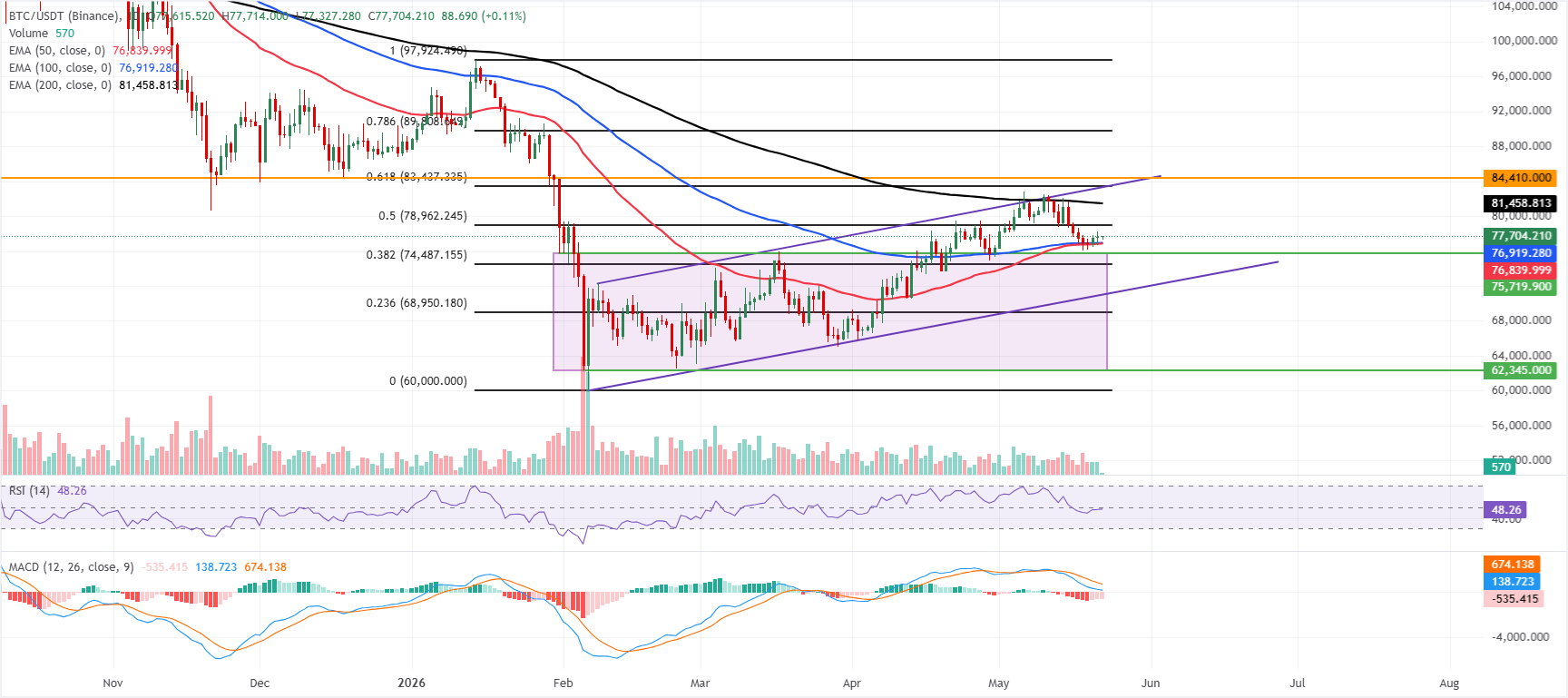
Bitcoin price extends its recovery, trading above $77,704 and holding above the 50- and 100-day Exponential Moving Averages (EMAs) near $76,840–$76,920, suggesting underlying dip-buying interest despite a dense topside cap.
The Crypto King is still pinned below the 200-day EMA at $81,458 and the 50% Fibonacci retracement of the latest swing at $78,962, leaving the broader structure in consolidation rather than in a clear breakout phase. The Relative Strength Index (RSI) hovers just below the 50 mark, while the Moving Average Convergence Divergence (MACD) remains in negative territory, suggesting that momentum is subdued and rallies could face selling pressure into overhead levels.
On the topside, initial resistance is located at the 50% Fibonacci retracement at $78,962, followed by the 200-day EMA at $81,458; a sustained move above these would open the way toward the 61.8% retracement at $83,437 and the horizontal barrier around $84,410.
On the downside, immediate support comes from the cluster of the 100-day EMA at $76,919 and the 50-day EMA at $76,840, with the 38.2% Fibonacci retracement at $74,487 next in line if those levels give way. A deeper slide would expose the former trendline break area around $70,995 and the 23.6% retracement near $68,950, where stronger medium-term demand would be expected to emerge.
Ethereum tests key resistance
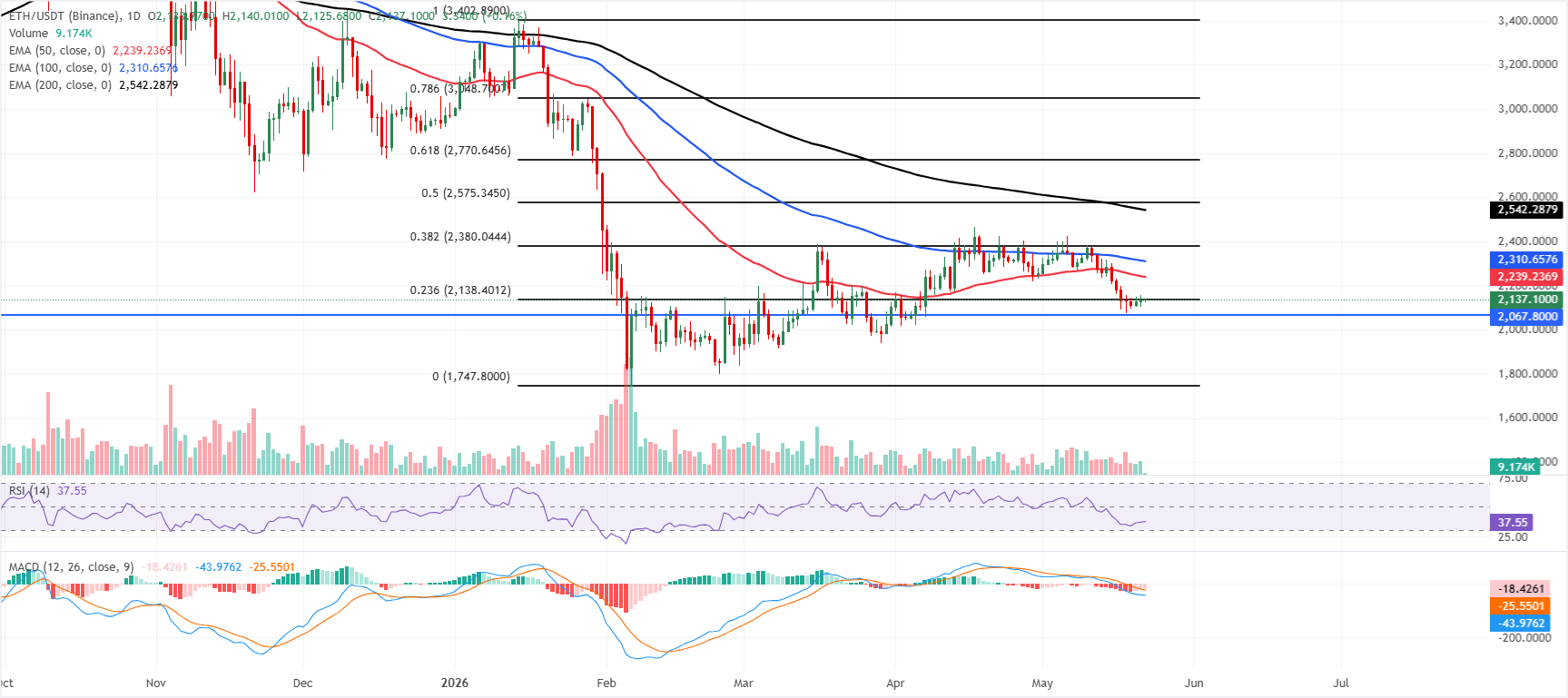
Ethereum trades at $2,137. Price remains below the 50-, 100-, and 200-day EMAs, which fan out well above the market and reinforce an overarching downtrend.
ETH is also capped almost immediately by the 23.6% Fibonacci retracement at roughly $2,138, underscoring the lack of topside traction after the recent slide. The RSI hovers just above 37, suggesting weak but not extreme downside pressure, while the negative MACD still hints at prevailing bearish momentum, though it has moderated from prior extremes.
On the upside, initial resistance is at the 23.6% Fibonacci retracement near $2,138, with further hurdles at the 50-day EMA near $2,239 and the 100-day EMA near $2,310. Above these, the 38.2% retracement near $2,380 and the distant 200-day EMA near the $2,542 mark are progressively stronger supply zones within the broader corrective structure.
On the downside, immediate support is seen at the horizontal level around $2,067, ahead of the more distant cycle low anchor near $1,748; a clear break under the former would likely expose the latter and extend the current bearish phase.
XRP could extend gains if it breaks above the channel pattern
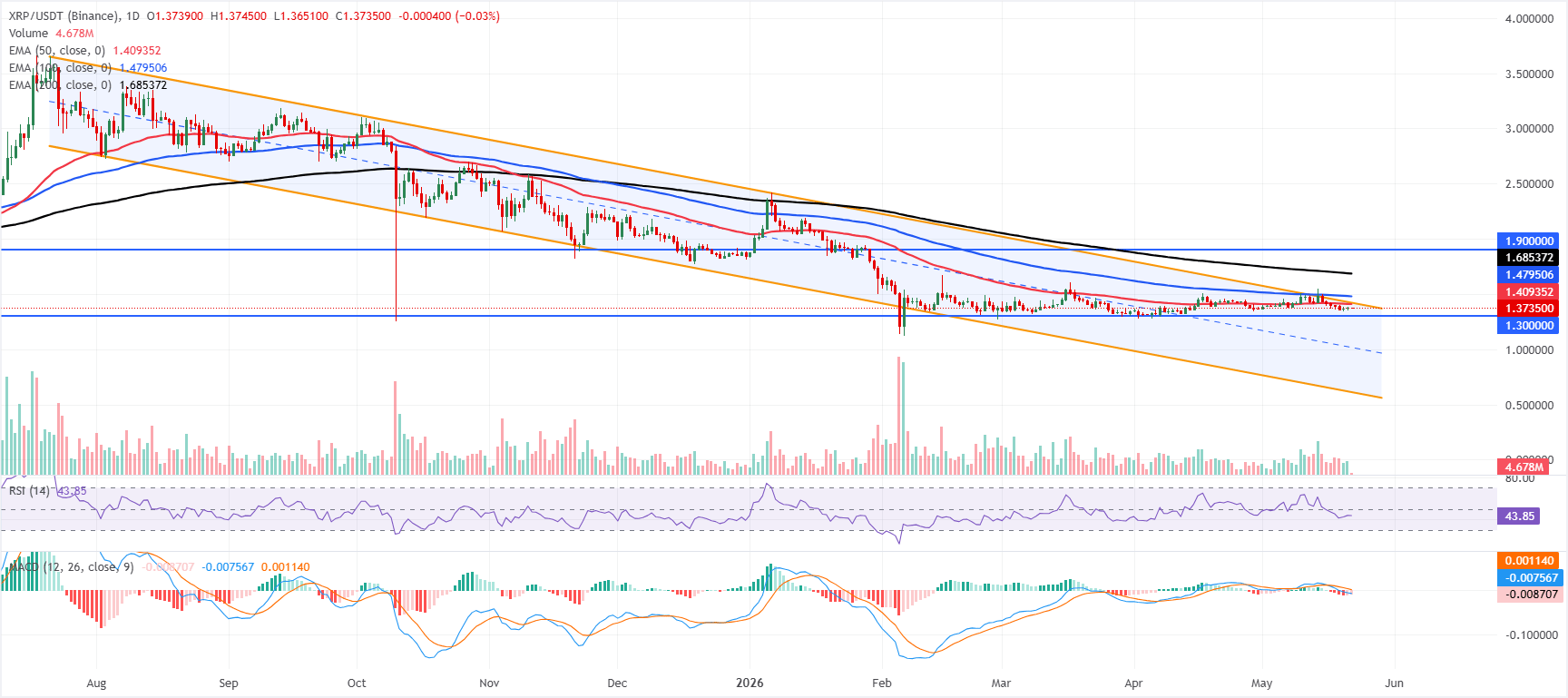
XRP price trades at $1.373, maintaining a bearish near-term bias as it holds below a stack of EMAs. The 50-day EMA at $1.409 is the first cap, reinforced by the upper boundary of the prevailing downward channel near $1.420, while the 100-day and 200-day EMAs at $1.479 and $1.685 sit higher and underscore a broader corrective phase.
Momentum backs this downward tone, with the RSI hovering around 43 in negative territory and the MACD below zero, hinting that rallies are likely to face selling pressure.
On the topside, immediate resistance is located at the 50-day EMA around $1.409, followed by the channel boundary near $1.420; a daily close above this area would be needed to ease the current pressure and expose the 100-day EMA at $1.479, ahead of the more distant 200-day EMA near $1.685 and the horizontal barrier at $1.900.
On the downside, initial support is seen at the horizontal level of $1.300, where a break lower would signal a continuation of the decline and open the door to deeper losses within the broader downtrend channel.
(The technical analysis of this story was written with the help of an AI tool.)
Cryptocurrency metrics FAQs
The developer or creator of each cryptocurrency decides on the total number of tokens that can be minted or issued. Only a certain number of these assets can be minted by mining, staking or other mechanisms. This is defined by the algorithm of the underlying blockchain technology. On the other hand, circulating supply can also be decreased via actions such as burning tokens, or mistakenly sending assets to addresses of other incompatible blockchains.
Market capitalization is the result of multiplying the circulating supply of a certain asset by the asset’s current market value.
Trading volume refers to the total number of tokens for a specific asset that has been transacted or exchanged between buyers and sellers within set trading hours, for example, 24 hours. It is used to gauge market sentiment, this metric combines all volumes on centralized exchanges and decentralized exchanges. Increasing trading volume often denotes the demand for a certain asset as more people are buying and selling the cryptocurrency.
Funding rates are a concept designed to encourage traders to take positions and ensure perpetual contract prices match spot markets. It defines a mechanism by exchanges to ensure that future prices and index prices periodic payments regularly converge. When the funding rate is positive, the price of the perpetual contract is higher than the mark price. This means traders who are bullish and have opened long positions pay traders who are in short positions. On the other hand, a negative funding rate means perpetual prices are below the mark price, and hence traders with short positions pay traders who have opened long positions.
Sikat na Artikulo
1BoJ’s Ueda: Long term interest rates are determined in markets, reflecting various factors2India Gold price today: Gold rises, according to FXStreet data3Ripple and Stellar outlook: Rebound from key technical supports as derivatives turn mildly bullish4GBP/USD Price Forecast: Defends 1.3200 as bears await two-week-old range breakdown5EUR/JPY Price Forecast: Remains below 177.00 as bearish bias prevails6Dogecoin Price Forecast: DOGE tests $0.0800 support level amid ETF outflows7Gold bounces off $4,150 amid modest USD pullback but stays in two-week-old range8Ripple-backed Evernorth goes live on Nasdaq with 473 million XRP treasury9Asian stock markets plunge, KOSPI faces bloodbath amid chip competition from China
LIVE QUOTES


LAHAT TUNGKOL SA TECHNICAL
Ano ang Dark Cloud Cover Pattern at Paano Ito I-trade?
Ano ang Piercing Line Candlestick Pattern at Paano Ito Ipinagte-trade?
Ano ang mga candlestick pattern na Tweezer Top at Bottom?
Inside Bar na Pattern ng Candlestick: Ano Ito, Paano Ito Matutukoy, at Paano Ito I-trade
Hanging Man Candlestick Pattern: Paano Ito Matukoy at I-trade
Paano Gumuhit ng Fibonacci Retracement: Pagsasanay sa Golden Ratio sa Trading
Ano ang MACD at Paano Maghanap ng Entry at Exit Points
Ano ang RSI, ang Relative Strength Index
Ano ang Scalping sa Trading at Paano Ito Gumagana
Magsimula!
Mag-sign up at ma-access ang Global Markets sa loob ng 3 minuto

Makipag-ugnayan sa Amin









Mga Kontak
Telepono: +61 2 8036 8388
Fax: +61 2 8036 8388
Email: support@tmgm.com
Web: https://www.tmgm.com



Ang impormasyong ibinigay sa website na ito ay pangkalahatang impormasyon lamang at hindi bumubuo ng personal na payong pinansyal. Bago kumilos batay sa anumang impormasyon sa website na ito, dapat mong isaalang-alang ang pagiging angkop ng impormasyon kaugnay ng iyong mga layunin, kalagayang pinansyal, at mga pangangailangan. Ang pag-iinvest sa CFDs at FX Margin Contracts ay may kaakibat na malalaking panganib at hindi angkop para sa lahat ng mamumuhunan. Maaari kang mawalan ng higit pa sa iyong paunang deposito. Wala kang pagmamay-ari o anumang interes sa pinagbabatayang asset. Inirerekomenda namin na humingi ka ng independiyenteng payo at tiyaking lubos mong nauunawaan ang mga panganib na kasangkot bago makipagkalakalan. Mahalaga na basahin at isaalang-alang mo ang dokumento ng pagsisiwalat bago ka kumuha ng anumang produktong nakalista sa website. Ang impormasyon at mga patalastas na inaalok sa website na ito ay hindi nilalayong gamitin ng sinumang tao sa alinmang bansa o hurisdiksyon kung saan ang ganitong paggamit ay labag sa mga lokal na batas at regulasyon. Ang mga Produkto at Serbisyong inaalok sa website na ito ay hindi nilalayong para sa mga residente ng United States, Malaysia, at Thailand.
Ang TMGM ay awtorisado at pinangangasiwaan sa iba't ibang hurisdiksyon.
Ang Trademax Australia Limited, na nag-trading bilang TMGM, ay pinangangasiwaan ng Australian Securities and Investments Commission (ASIC), AFSL no. 436416 at matatagpuan sa Level 28, One International Tower, 100 Barangaroo Avenue, 2000 Sydney, NSW Australia.
Email: support@tmgm.com.au
Ang Trademax Global Limited, na nag-trading bilang TMGM, ay awtorisado at pinangangasiwaan ng Vanuatu Financial Services Commission (VFSC), registration number 40356 at nakarehistro sa 1276, Kumul Highway, Port Vila, Vanuatu, Republic of Vanuatu.
Email: support@tmgm.com
Ang Trademax Global Markets (SE) Limited, na kilala bilang TMGM, ay awtorisado at nire-regulahan ng Financial Services Authority (FSA) ng Seychelles, na may lisensya bilang SD224. Ang kumpanya ay nakarehistro sa Office Blg. 13, Providence Estate ABIS Centre, Mahe, Seychelles.
Email: support@tmgm.com
Ang Trademax Global Markets (International) Pty Ltd, na nag-trading bilang TMGM, ay awtorisado at pinangangasiwaan ng Financial Services Commission, Mauritius (FSC) na may license no. GB22201012, at nakarehistro sa 33, Edith Cavell Street C/o IQ EQ Fund Services (Mauritius) Ltd Port Louis, 11324 Mauritius.
Email: support@tmgm.com
Copyright © TMGM. Lahat ng karapatan ay nakalaan