

Trade The World
BoJ’s Ueda: Underlying inflation accelerating toward 2% moderately
Ni Lallalit Srijandorn
Petsa ng Pag-publish: 13 Nov 2025 | Petsa ng Pag-edit: 13 Nov 2025


POPULAR ARTICLES
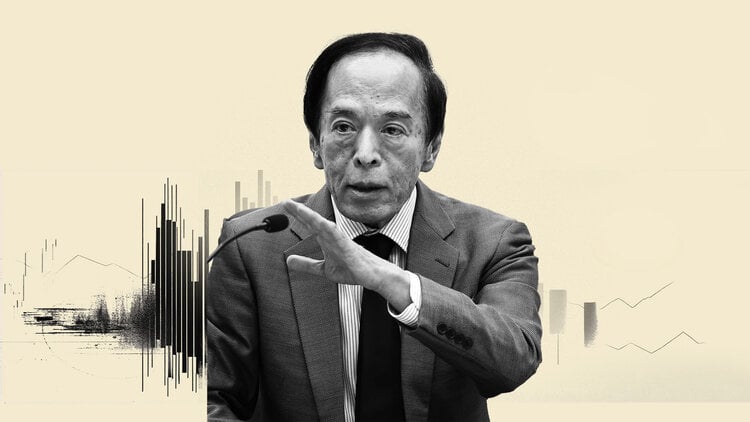
Bank of Japan (BoJ) Governor Kazuo Ueda said on Thursday that the Japanese central bank will strive to create strong economy so that tax revenues rise without tax hikes.
Bank of Japan (BoJ) Governor Kazuo Ueda said on Thursday that the Japanese central bank will strive to create strong economy so that tax revenues rise without tax hikes.
Key quotes
BoJ striving to achieve moderate inflation backed by wage growth by helping improve economy.
BoJ aims to achieve sustained economic growth benefiting public.
Consumption resilient due to improvement in household income, job conditions.
Underlying inflation accelerating toward 2% moderately.
Hard to break down inflation to driven by cost-push factors and driven by demand.
Recent food price increases likely caused by elevated raw material expenses, with other goods' prices also increasing as companies pass on higher wages.
Job market tightens, wages rising, creating moderate cycle of rising wages and inflation.
Market reaction
As of writing, the USD/JPY pair is up 0.01% on the day at 154.76.
Bank of Japan FAQs
The Bank of Japan (BoJ) is the Japanese central bank, which sets monetary policy in the country. Its mandate is to issue banknotes and carry out currency and monetary control to ensure price stability, which means an inflation target of around 2%.
The Bank of Japan embarked in an ultra-loose monetary policy in 2013 in order to stimulate the economy and fuel inflation amid a low-inflationary environment. The bank’s policy is based on Quantitative and Qualitative Easing (QQE), or printing notes to buy assets such as government or corporate bonds to provide liquidity. In 2016, the bank doubled down on its strategy and further loosened policy by first introducing negative interest rates and then directly controlling the yield of its 10-year government bonds. In March 2024, the BoJ lifted interest rates, effectively retreating from the ultra-loose monetary policy stance.
The Bank’s massive stimulus caused the Yen to depreciate against its main currency peers. This process exacerbated in 2022 and 2023 due to an increasing policy divergence between the Bank of Japan and other main central banks, which opted to increase interest rates sharply to fight decades-high levels of inflation. The BoJ’s policy led to a widening differential with other currencies, dragging down the value of the Yen. This trend partly reversed in 2024, when the BoJ decided to abandon its ultra-loose policy stance.
A weaker Yen and the spike in global energy prices led to an increase in Japanese inflation, which exceeded the BoJ’s 2% target. The prospect of rising salaries in the country – a key element fuelling inflation – also contributed to the move.

FXStreet
Higit sa isang milyong user ang umaasa sa FXStreet para sa real-time market data, charting tools, expert insights, at Forex news. Ang komprehensibong economic calendar at educational webinars nito ay tumutulong sa mga trader na manatiling may alam at gumawa ng kalkuladong mga desisyon. Sinusuportahan ang FXStreet ng humigit-kumulang 60 propesyonal sa pagitan ng Barcelona HQ at iba’t ibang rehiyon sa buong mundo.
Read More








