

Savdo
Raqobatbardosh narxlar, chuqur likvidlik va ilg‘or savdo vositalari bilan keng turdagi bozorlarni kashf eting.
Batafsil ma’lumot 
Platforma
TMGM’ning tezlik, aniqlik va yuqori savdo tajribasi uchun yaratilgan kuchli platformasi bilan uzluksiz savdo qiling.
Batafsil ma’lumot Savdo platformasi
Savdo vositalari
Akademiya
Boshlovchilar uchun qulay resurslar, jumladan qo‘llanmalar, vebinarlar va bozor tahlillari orqali savdoning asoslarini o‘rganing.
Batafsil ma’lumot Yangiliklar va tahlil
Savdo imkoniyatlaridan oldinda bo‘lish uchun bozor yangilanishlari va ekspert tahlillarini real vaqt rejimida oling
Batafsil ma’lumot Yangiliklar va tahlil
Haqida
TMGMni boshqalardan ajratib turadigan jihatlarni bilib oling — bizning global mavjudligimiz, tartibga solishdagi mustahkamligimiz va savdoda innovatsiyalarga sodiqligimiz.
Batafsil ma’lumot Nega TMGMni tanlash kerak
USD/CAD Price Forecast: Debate over size of Fed’s next rate hike backs further upside
- USD/CAD jumps to near 1.4213 as the Canadian Dollar faces pressure from lower oil prices.
- The US Dollar strengthens amid fears of aggressive Fed policy tightening.
- The US CPI data remained hotter-than-expected in October.
The Canadian Dollar (CAD) continues to under perform the US Dollar (USD) due to multiple headwinds. Lower oil prices due to United States (US)-Iran deal hopes and fresh fears of aggressive Federal Reserve (Fed) monetary tightening have strengthened the USD/CAD pair.
As of writing, the USD/CAD pair is up 0.17% to near 1.4213, the highest level seen in over three weeks. The US Dollar Index (DXY), which gauges the Greenback’s value against six major currencies, trades 0.15% higher to near 102.37.
The appeal of currencies from economies, such as Canada, which are net energy exporter, diminishes when oil prices decline. The WTI Oil price has fallen almost 18% to near $85.35 from its recent highs of 104.03.
Fed December hike seen as sealed as debate shifts to size of move
According to TD Securities, the “strong upside surprise in the US CPI makes a December hike all but certain,” with the bank reiterating that “today's data certainly seals a Dec rate hike by the Fed.” Strategists note that “after Waller's speech, the debate has now shifted to whether the FOMC will go 25 or 50bps,” as Governor Waller’s pre-CPI remarks have sharpened the focus on the need for a potential “catch-up” move. TD Securities writes that the discussion will now center on whether the Fed should implement a “catch-up 50bps rate hike in December, or whether to maintain course with a 25bps rate increase and provide strong guidance toward a potential January follow-through.” For now, they emphasize that “we still favor a 25bp hike with a rising risk of another hike in January.”
USD/CAD Technical Analysis
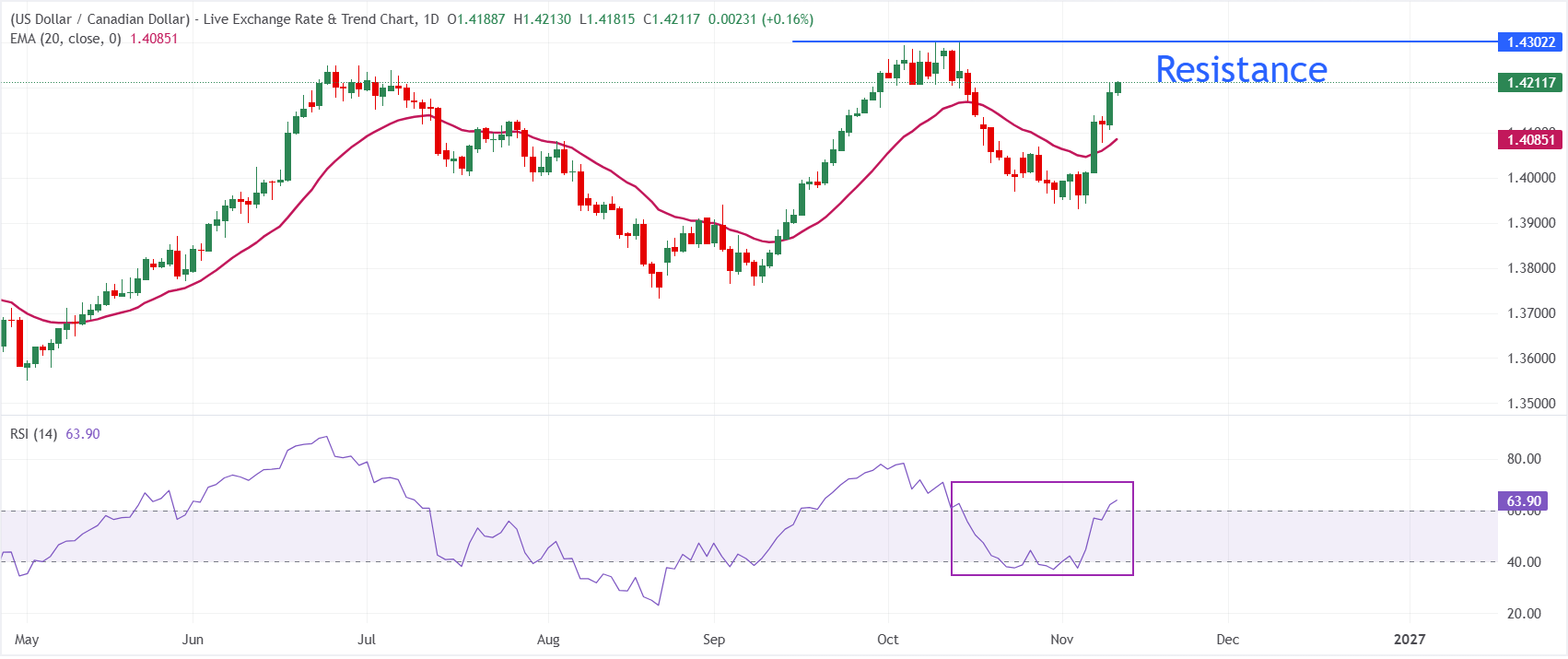
In the daily chart, USD/CAD trades at 1.4212. The pair holds a bullish near-term bias, with price advancing above the 20-day Exponential Moving Average (EMA) at 1.4085, which now underpins the move. The Relative Strength Index (RSI) at 63.9 stays in positive territory without yet signaling overbought conditions, suggesting buyers retain control but with scope for consolidation after the recent recovery.
On the downside, immediate support is seen at the 1.4210 area as a nearby pivot, followed by the 20-day EMA at 1.4085, where dip-buying interest could re-emerge if a pullback develops. With no significant technical resistance immediately overhead in this dataset, the focus remains on whether bulls can defend these underlying supports to extend the broader uptrend.
(The technical analysis of this story was written with the help of an AI tool. Know more.)
US Dollar FAQs
The US Dollar (USD) is the official currency of the United States of America, and the ‘de facto’ currency of a significant number of other countries where it is found in circulation alongside local notes. It is the most heavily traded currency in the world, accounting for over 88% of all global foreign exchange turnover, or an average of $6.6 trillion in transactions per day, according to data from 2022. Following the second world war, the USD took over from the British Pound as the world’s reserve currency. For most of its history, the US Dollar was backed by Gold, until the Bretton Woods Agreement in 1971 when the Gold Standard went away.
The most important single factor impacting on the value of the US Dollar is monetary policy, which is shaped by the Federal Reserve (Fed). The Fed has two mandates: to achieve price stability (control inflation) and foster full employment. Its primary tool to achieve these two goals is by adjusting interest rates. When prices are rising too quickly and inflation is above the Fed’s 2% target, the Fed will raise rates, which helps the USD value. When inflation falls below 2% or the Unemployment Rate is too high, the Fed may lower interest rates, which weighs on the Greenback.
In extreme situations, the Federal Reserve can also print more Dollars and enact quantitative easing (QE). QE is the process by which the Fed substantially increases the flow of credit in a stuck financial system. It is a non-standard policy measure used when credit has dried up because banks will not lend to each other (out of the fear of counterparty default). It is a last resort when simply lowering interest rates is unlikely to achieve the necessary result. It was the Fed’s weapon of choice to combat the credit crunch that occurred during the Great Financial Crisis in 2008. It involves the Fed printing more Dollars and using them to buy US government bonds predominantly from financial institutions. QE usually leads to a weaker US Dollar.
Quantitative tightening (QT) is the reverse process whereby the Federal Reserve stops buying bonds from financial institutions and does not reinvest the principal from the bonds it holds maturing in new purchases. It is usually positive for the US Dollar.
Eng yaxshi maqolalar
1AUD/JPY narx prognozi: pasayish signallari pastga yo‘nalgan kayfiyatni kuchaytirishi fonida 109,50 dan pastladi2Oktyabrda Xitoy savdo profitsiti qisqargani fonida Avstraliya dollari sustligicha qolmoqda3Xitoyning savdo profitsiti oktyabrda kutilganidan ko‘proq qisqarib, 712,72 mlrd CNYni tashkil etdi.4AQSh dollari indeksi (DXY) 101,70 atrofida barqaror, Eron borasidagi noaniqlik fonida AQSh CPI hisobotini kutmoqda5Xitoy eksporti yillik hisobda oktyabrda 35,2%ni tashkil etib, 33,5%lik prognozdan yuqori boʻldi.6Xitoy importi (yillik hisobda) oktyabrda kutilganidan yuqori: prognoz 32%, amaldagi ko‘rsatkich 41,6%7Xitoyning AQSh dollaridagi savdo balansi oktabrda $105,28 mlrdni tashkil etdi, bu kutilgan $125,8 mlrd ko‘rsatkichidan past.8Xitoyning savdo balansi (CNY) oktabrda 712,78 mlrdni tashkil etib, kutilgan 859 mlrdlik ko‘rsatkichdan past bo‘ldi.9Xitoy eksporti (yillik, CNY) oktyabrda avvalgi 29,6% dan 28,7% gacha pasaydi.


Boshlang!
Ro‘yxatdan o‘ting va 3 daqiqadan kamroq vaqt ichida Global bozorlariga kirish imkoniga ega bo‘ling

Biz bilan bog‘laning









Kontaktlar
Telefon: +61 2 8036 8388
Faks: +61 2 8036 8388
Email: support@tmgm.com
Veb: https://www.tmgm.com



Ushbu veb-saytda taqdim etilgan ma’lumotlar faqat umumiy xususiyatga ega bo‘lib, shaxsiy moliyaviy maslahat hisoblanmaydi. Ushbu veb-saytdagi har qanday ma’lumot asosida harakat qilishdan oldin, ma’lumotning sizning maqsadlaringiz, moliyaviy ahvolingiz va ehtiyojlaringizga mosligini ko‘rib chiqishingiz kerak. CFD va FX Margin shartnomalariga sarmoya kiritish sezilarli xavflarni o‘z ichiga oladi va barcha investorlar uchun mos emas. Siz boshlang‘ich depozitingizdan ko‘proq yo‘qotishingiz mumkin. Siz asosiy aktivga egalik qilmaysiz va unda hech qanday manfaatga ega emassiz. Savdo qilishdan oldin mustaqil maslahat olishni va ishtirok etuvchi xavflarni to‘liq tushunishingizni tavsiya qilamiz. Veb-saytda keltirilgan har qanday mahsulotni xarid qilishdan oldin oshkor qilish hujjatini o‘qib chiqishingiz va ko‘rib chiqishingiz muhimdir. Ushbu veb-saytda taklif etilgan ma’lumotlar va reklama materiallari bunday foydalanish mahalliy qonunlar va qoidalarga zid bo‘ladigan har qanday mamlakat yoki yurisdiksiyadagi shaxslar tomonidan foydalanish uchun mo‘ljallanmagan. Ushbu veb-saytda taklif etilgan Mahsulotlar va Xizmatlar AQSh, Malayziya va Tailand rezidentlari uchun mo‘ljallanmagan.
TMGM turli yurisdiksiyalarda vakolatli va tartibga solinadi.
Trademax Australia Limited, TMGM nomi ostida faoliyat yuritadi, Avstraliya Qimmatli qog‘ozlar va investitsiyalar komissiyasi (ASIC) tomonidan tartibga solinadi, AFSL raqami 436416 va manzili: Level 28, One International Tower, 100 Barangaroo Avenue, 2000 Sydney, NSW Australia.
Email: support@tmgm.com.au
Trademax Global Limited, TMGM nomi ostida faoliyat yuritadi, Vanuatu Moliyaviy Xizmatlar Komissiyasi (VFSC) tomonidan vakolatli va tartibga solinadi, ro‘yxatga olish raqami 40356 va ro‘yxatdan o‘tgan manzili: 1276, Kumul Highway, Port Vila, Vanuatu, Vanuatu Respublikasi.
Email: support@tmgm.com
Trademax Global Markets (SE) Limited, TMGM nomi ostida faoliyat yuritadi, Seyshel orollari Moliyaviy Xizmatlar Boshqarmasi (FSA) tomonidan 224-sonli SD litsenziyasi bilan vakolatli va tartibga solinadi. Kompaniya Office No 13, Providence Estate ABIS Centre, Mahe, Seychelles manzilida ro‘yxatdan o‘tgan.
Email: support@tmgm.com
Trademax Global Markets (International) Pty Ltd, TMGM nomi ostida faoliyat yuritadi, Mauritius Moliyaviy Xizmatlar Komissiyasi (FSC) tomonidan GB22201012 litsenziya raqami bilan vakolatli va tartibga solinadi hamda 33, Edith Cavell Street C/o IQ EQ Fund Services (Mauritius) Ltd Port Louis, 11324 Mauritius manzilida ro‘yxatdan o‘tgan.
Email: support@tmgm.com
Mualliflik huquqi © TMGM. Barcha huquqlar himoyalangan