

Trade The World
EUR/USD tumbles after Fed minutes obliterate December easing bets
作者 Christian Borjon Valencia
發布日期: 20 Nov 2025 | 修改日期: 20 Nov 2025


POPULAR ARTICLES

EUR/USD drops over 0.49% on Wednesday as the minutes of the Federal Reserve hinted the central bank could skip an interest rate cut at the December meeting, according to October’s meeting minutes. The pair trades at 1.1524, after hitting a daily low shy of 1.1600.
- EUR/USD drops as December Fed cut odds fall from 42% to 33% after hawkish FOMC minutes.
- Minutes reveal deep Fed division, with majority resisting more easing despite labor-market softness.
- Eurozone HICP dips to 2.1% near ECB target as focus shifts to US jobs and confidence data.
EUR/USD drops over 0.49% on Wednesday as the minutes of the Federal Reserve hinted the central bank could skip an interest rate cut at the December meeting, according to October’s meeting minutes. The pair trades at 1.1524, after hitting a daily low shy of 1.1600.
Euro tumbles nearly 0.5% after FOMC minutes reveal most Fed officials oppose easing at next month’s meeting
The minutes showed the Fed is split, with most of the members opposing a December rate cut, at the October 28-29 meeting. The chances of a rate cut fell from around 42% to 33%, revealed the FedWatch Tool.
Across the Atlantic, the Eurozone Harmonized Index of Consumer Prices (HICP) dipped from 2.2% to 2.1% in September, close to the European Central Bank (ECB) 2% inflation target. Core HICP was 2.4% YoY for the same period.
Ahead the US economic docket will feature US jobs data, led by Nonfarm Payroll figures, Initial Jobless Claims and Fed speakers. In Europe, the schedule is light, with traders eyeing Eurozone Consumer Confidence.
Daily market movers: Fed minutes weigh on the Euro
- Federal Reserve minutes revealed that “Many participants were in favor of lowering the target range for the federal funds rate,” but some would have been satisfied with keeping rates unchanged. The minutes showed that the Committee is concerned about inflation and that further easing “could add to the risk of higher inflation becoming entrenched.”
- The minutes showed that policymakers "Several" support a December reduction as likely appropriate, several others saw lower rates as eventually appropriate though not necessarily as of December, while "many participants" had already ruled out a December cut.
- US Nonfarm Payroll figures for September would be revealed on Thursday. Economists expect that the economy would likely add 50K people to the workforce exceeding August’s 22K print.
- The Euro is also pressured by the Dollar’s strength. The US Dollar Index (DXY) which tracks the performance of American currency against other six is up 0.54% at 100.13.
EUR/USD technical outlook: Slides towards 1.1500 on hawkish Fed minutes
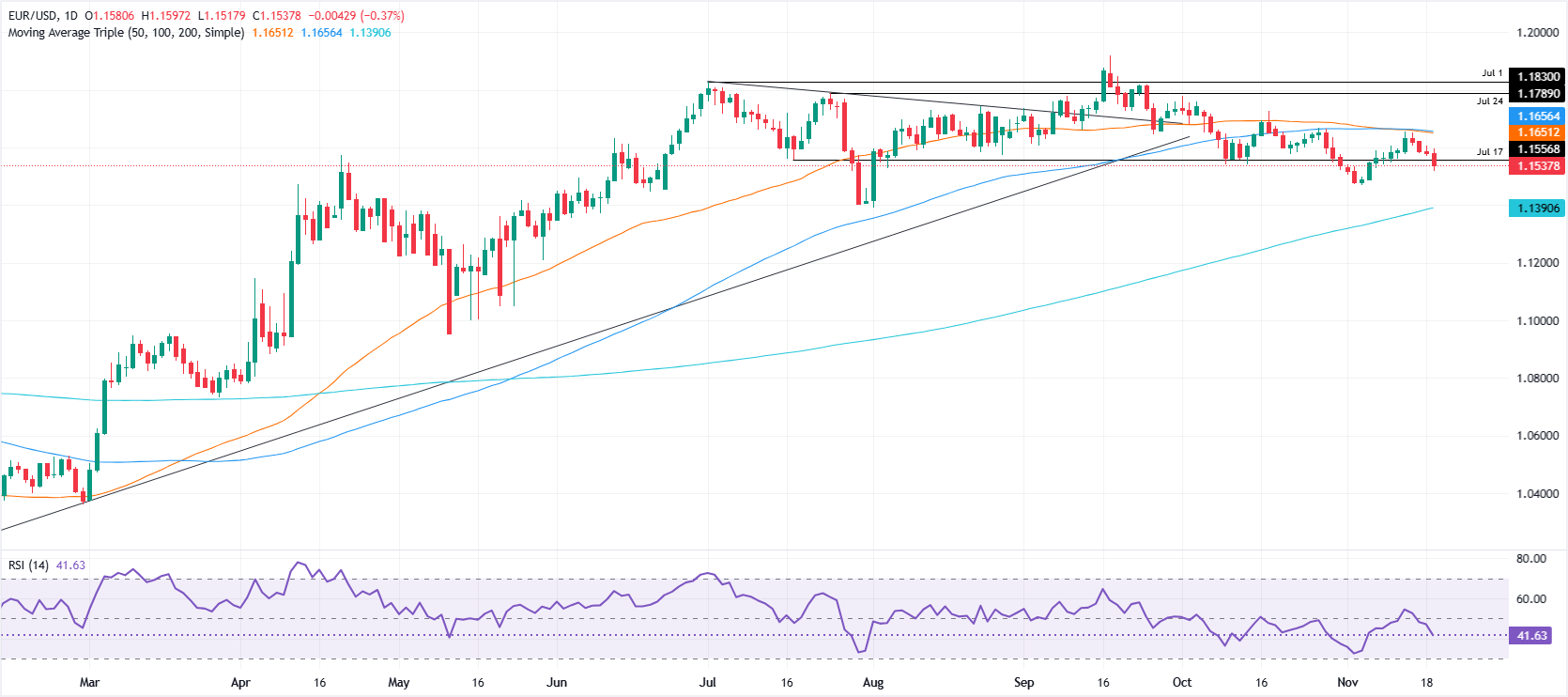
The EUR/USD has fallen to a two-week low of 1.1517, before hovering around current exchange rates. Buyers failed to reclaim 1.1600 as the Fed hints that it could hold rates unchanged at the December meeting.
A drop below 1.1500 could open the path to test the November 5 swing low of 1.1468, followed by 1.1450. Once breached, the 200-day Simple Moving Average (SMA) could be reached at 1.1393.
For a bullish continuation, the EUR/USD needs to rise above the 100-day SMA at 1.1574, followed by the 20-day SMA at 1.1578 and 1.1600. This clears the path to challenge the key resistance level at 1.1650, the 50-day SMA.
Euro FAQs
The Euro is the currency for the 20 European Union countries that belong to the Eurozone. It is the second most heavily traded currency in the world behind the US Dollar. In 2022, it accounted for 31% of all foreign exchange transactions, with an average daily turnover of over $2.2 trillion a day. EUR/USD is the most heavily traded currency pair in the world, accounting for an estimated 30% off all transactions, followed by EUR/JPY (4%), EUR/GBP (3%) and EUR/AUD (2%).
The European Central Bank (ECB) in Frankfurt, Germany, is the reserve bank for the Eurozone. The ECB sets interest rates and manages monetary policy. The ECB’s primary mandate is to maintain price stability, which means either controlling inflation or stimulating growth. Its primary tool is the raising or lowering of interest rates. Relatively high interest rates – or the expectation of higher rates – will usually benefit the Euro and vice versa. The ECB Governing Council makes monetary policy decisions at meetings held eight times a year. Decisions are made by heads of the Eurozone national banks and six permanent members, including the President of the ECB, Christine Lagarde.
Eurozone inflation data, measured by the Harmonized Index of Consumer Prices (HICP), is an important econometric for the Euro. If inflation rises more than expected, especially if above the ECB’s 2% target, it obliges the ECB to raise interest rates to bring it back under control. Relatively high interest rates compared to its counterparts will usually benefit the Euro, as it makes the region more attractive as a place for global investors to park their money.
Data releases gauge the health of the economy and can impact on the Euro. Indicators such as GDP, Manufacturing and Services PMIs, employment, and consumer sentiment surveys can all influence the direction of the single currency. A strong economy is good for the Euro. Not only does it attract more foreign investment but it may encourage the ECB to put up interest rates, which will directly strengthen the Euro. Otherwise, if economic data is weak, the Euro is likely to fall. Economic data for the four largest economies in the euro area (Germany, France, Italy and Spain) are especially significant, as they account for 75% of the Eurozone’s economy.
Another significant data release for the Euro is the Trade Balance. This indicator measures the difference between what a country earns from its exports and what it spends on imports over a given period. If a country produces highly sought after exports then its currency will gain in value purely from the extra demand created from foreign buyers seeking to purchase these goods. Therefore, a positive net Trade Balance strengthens a currency and vice versa for a negative balance.

Acuity Trading
Acuity Trading 是一家成立於 2013 年、總部位於倫敦的金融科技公司,專注於 AI 驅動的另類數據與情緒分析,用於交易與投資。他們以可視化新聞與情緒工具革新線上交易體驗,並持續以最新 AI 研究與技術提供可產生阿爾法的另類數據與高度互動的交易工具。
Read More








