

Banxico reduced rates from 7.25% to 7% as widely expected
作者 Christian Borjon Valencia
發布日期: 19 Dec 2025 | 修改日期: 19 Dec 2025


熱門文章
The Bank of Mexico, known as Banxico, reduced rates by 25 basis points as expected on Thursday at its December policy meeting with a 4-1 vote split, as Deputy Governor Jonathan Heat continues to dissent on the board, as he wanted to keep the main reference rate unchanged.
The Bank of Mexico, known as Banxico, reduced rates by 25 basis points as expected on Thursday at its December policy meeting with a 4-1 vote split, as Deputy Governor Jonathan Heat continues to dissent on the board, as he wanted to keep the main reference rate unchanged.
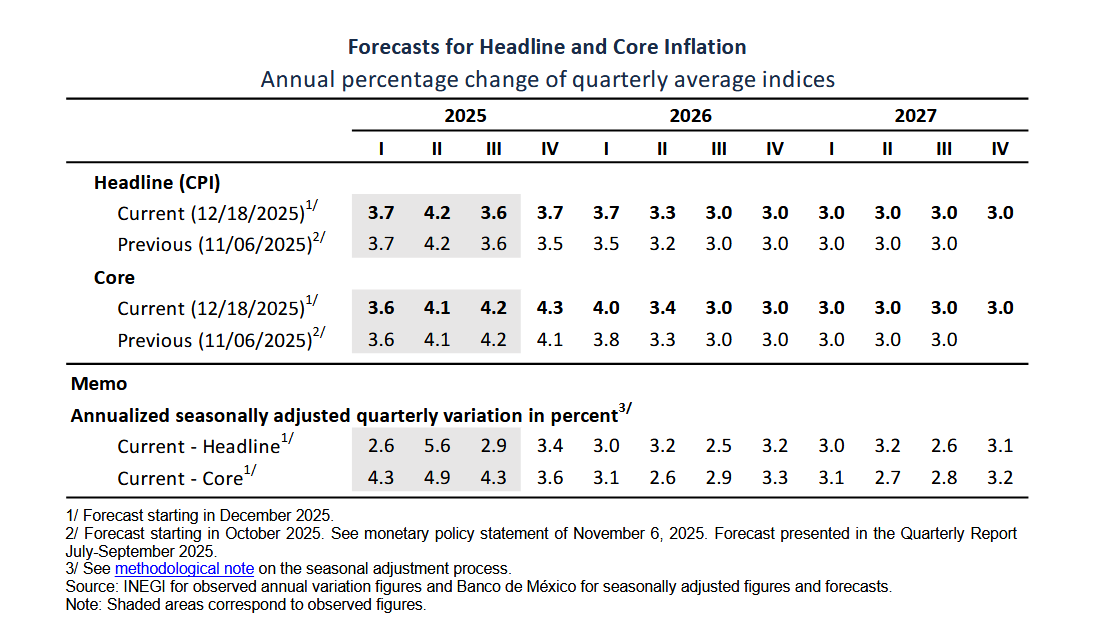
Banxico's monetary policy statement revealed that the board will evaluate the timing for additional reference rate adjustments. Officials repeat that the balance for the trajectory of inflation within the forecast horizon remains biased to the upside, as the board expects inflation to reach the inflation target in Q3 of 2026.
Banxico economic projections
USD/MXN reaction
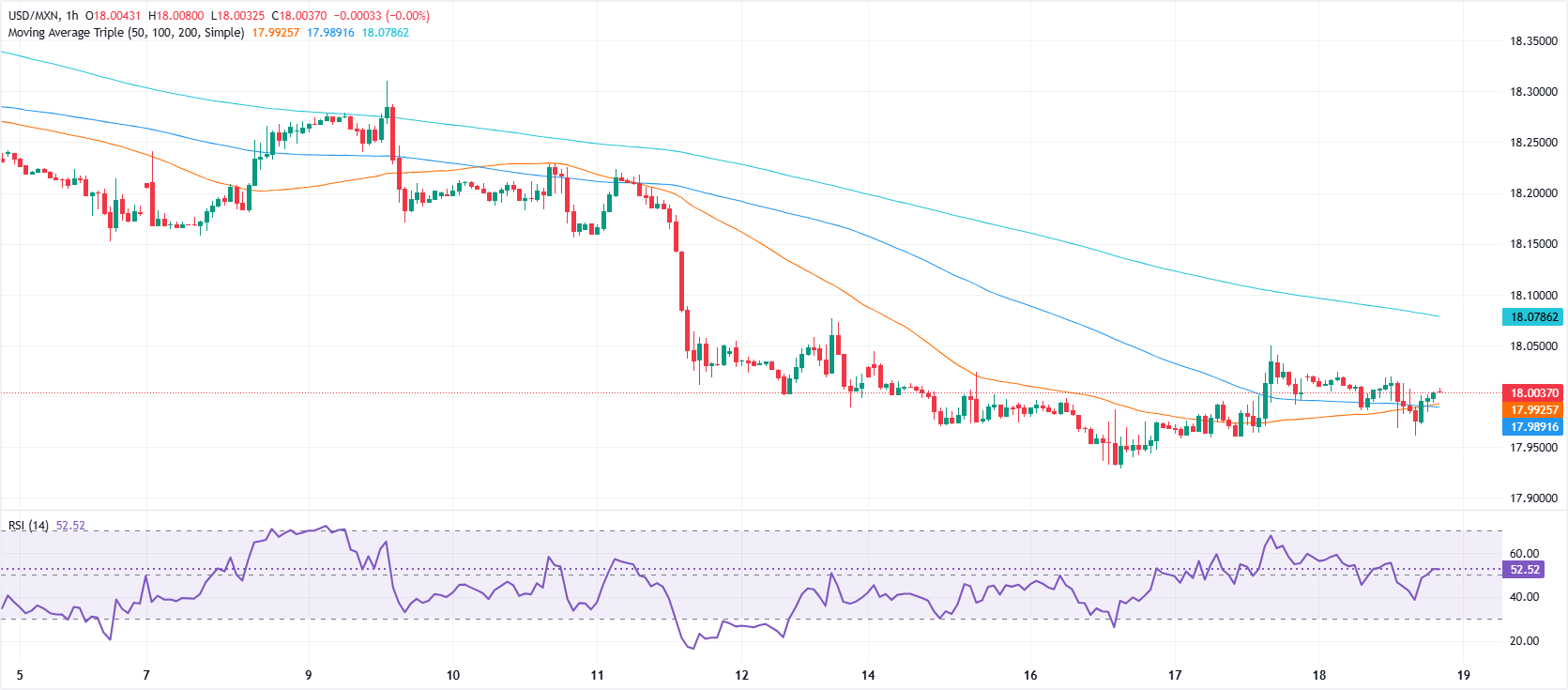
The USD/MXN barely reacted, remaining at around 18.00, virtually unchanged. During the year, the exotic pair has tumbled over 12%, mirroring last year’s price action. As long as it remains below 18.07, further downside is seen, with investors eyeing the YTD low of 17.92 hit on December 16.
Banxico FAQs
The Bank of Mexico, also known as Banxico, is the country’s central bank. Its mission is to preserve the value of Mexico’s currency, the Mexican Peso (MXN), and to set the monetary policy. To this end, its main objective is to maintain low and stable inflation within target levels – at or close to its target of 3%, the midpoint in a tolerance band of between 2% and 4%.
The main tool of the Banxico to guide monetary policy is by setting interest rates. When inflation is above target, the bank will attempt to tame it by raising rates, making it more expensive for households and businesses to borrow money and thus cooling the economy. Higher interest rates are generally positive for the Mexican Peso (MXN) as they lead to higher yields, making the country a more attractive place for investors. On the contrary, lower interest rates tend to weaken MXN. The rate differential with the USD, or how the Banxico is expected to set interest rates compared with the US Federal Reserve (Fed), is a key factor.
Banxico meets eight times a year, and its monetary policy is greatly influenced by decisions of the US Federal Reserve (Fed). Therefore, the central bank’s decision-making committee usually gathers a week after the Fed. In doing so, Banxico reacts and sometimes anticipates monetary policy measures set by the Federal Reserve. For example, after the Covid-19 pandemic, before the Fed raised rates, Banxico did it first in an attempt to diminish the chances of a substantial depreciation of the Mexican Peso (MXN) and to prevent capital outflows that could destabilize the country.

超過一百萬用戶依賴 FXStreet 獲取即時市場數據、圖表工具、專家洞見與外匯新聞。其全面的經濟日曆與教育網路研討會協助交易者保持資訊領先、做出審慎決策。FXStreet 擁有約 60 人的團隊,分布於巴塞隆納總部及全球各地。
閱讀更多








