

GBP/JPY breaks below 50-day EMA as UK data and BoJ hike bets weigh
作者 Joshua Gibson
發布日期: 20 Feb 2026 | 修改日期: 20 Feb 2026


熱門文章

The Bank of England (BoE) held rates at 3.75% at its February meeting in a tight 5-4 vote, with four members pushing for a cut.
- Pound Sterling slides toward 208.00 as soft UK labor and inflation data meet rising Bank of Japan rate expectations.
- UK headline CPI dropped to 3% in January and unemployment rose to 5.2%, strengthening the case for a Bank of England rate cut from 3.75% as early as March.
- The Bank of Japan held at 0.75% in January but board members continue to signal further normalization is needed, with markets pricing roughly 80% probability of an April hike.
The Bank of England (BoE) held rates at 3.75% at its February meeting in a tight 5-4 vote, with four members pushing for a cut. This week's UK data has reinforced the dovish case: Tuesday's labor report showed unemployment climbing to 5.2% with payrolls falling by 30K, while Wednesday's Consumer Price Index (CPI) confirmed headline inflation dropped to 3%. Friday's UK retail sales and preliminary Purchasing Managers Index (PMI) data will test whether the softening trend is broadening.
On the Japanese Yen side, the BoJ held at 0.75% in January but board member Masu stated this month that further hikes are needed to complete policy normalization. Markets assign roughly 80% probability to an April move, and the Yen has found support from that expectation alongside Prime Minister Takaichi's fiscal discipline messaging. The combination of a dovish BoE outlook and a gradually tightening BoJ is creating a structural headwind for the cross.
Sharp sell-off through 50-day EMA as Stochastic plunges into oversold
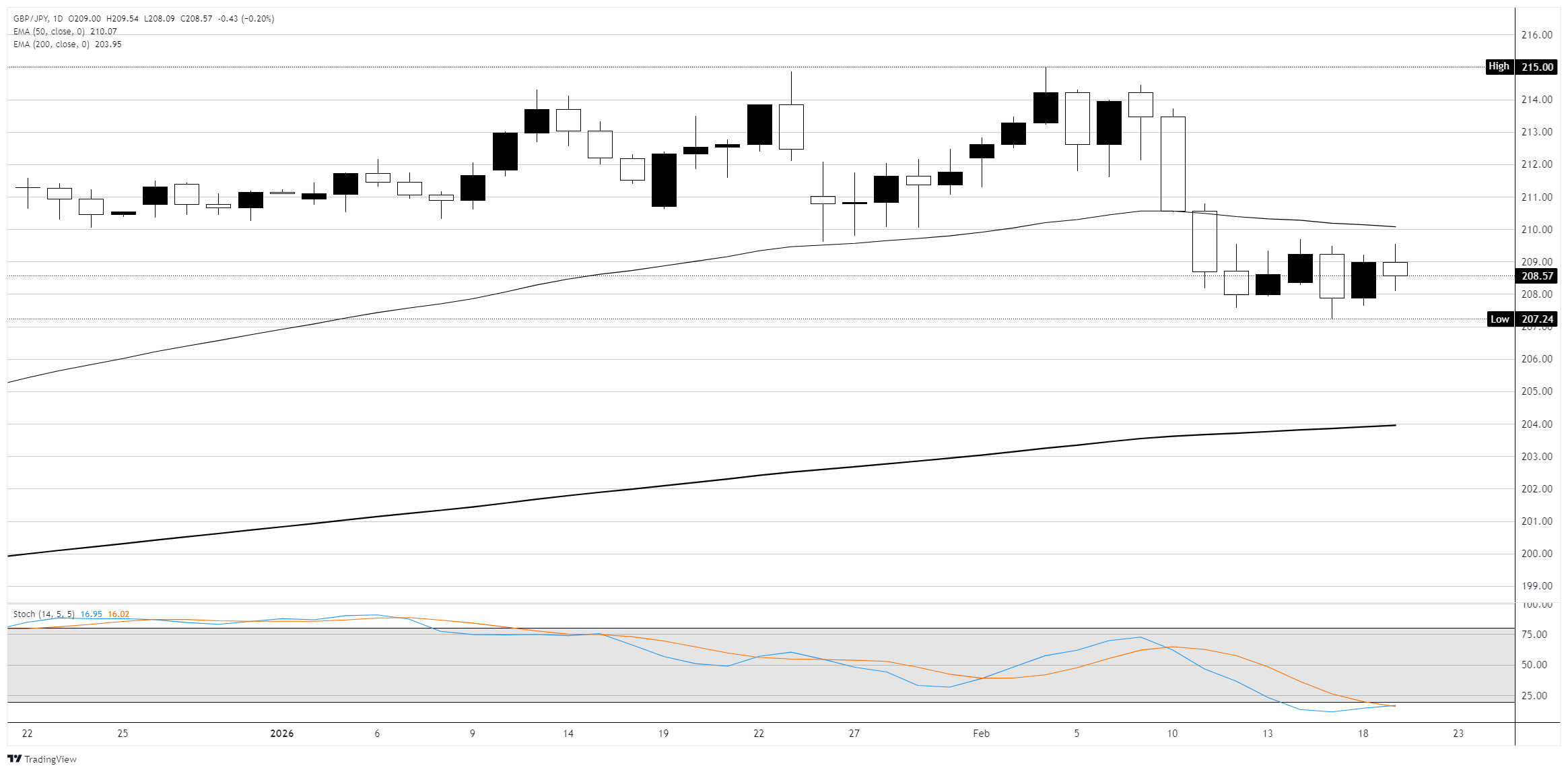
On the daily chart, GBP/JPY has sold off sharply over the past week, falling from the 214.00 area to trade near 208.55 on Thursday. The pair has broken decisively below the 50-day Exponential Moving Average (EMA) at 210.05, the first sustained break below that level since the rally from the late December lows near 211.00. The 200-day EMA at 204.00 continues to trend higher well below, so the longer-term structure is still bullish, but the near-term picture has deteriorated.
The Stochastic Oscillator has plunged deep into the oversold zone, suggesting selling momentum is strong but a relief bounce could develop if the pair holds the 208.00 area. Recent sessions show a sequence of bearish candles with expanding bodies, pointing to growing selling conviction following the weak UK data. Immediate support sits at the year-to-date low near 207.24, with 206.00 and the round 205.00 level below. Resistance rests at the 50-day EMA near 210.00; a reclaim of that level would be needed to stabilize the technical picture.
GBP/JPY daily chart
Pound Sterling FAQs
The Pound Sterling (GBP) is the oldest currency in the world (886 AD) and the official currency of the United Kingdom. It is the fourth most traded unit for foreign exchange (FX) in the world, accounting for 12% of all transactions, averaging $630 billion a day, according to 2022 data. Its key trading pairs are GBP/USD, also known as ‘Cable’, which accounts for 11% of FX, GBP/JPY, or the ‘Dragon’ as it is known by traders (3%), and EUR/GBP (2%). The Pound Sterling is issued by the Bank of England (BoE).
The single most important factor influencing the value of the Pound Sterling is monetary policy decided by the Bank of England. The BoE bases its decisions on whether it has achieved its primary goal of “price stability” – a steady inflation rate of around 2%. Its primary tool for achieving this is the adjustment of interest rates. When inflation is too high, the BoE will try to rein it in by raising interest rates, making it more expensive for people and businesses to access credit. This is generally positive for GBP, as higher interest rates make the UK a more attractive place for global investors to park their money. When inflation falls too low it is a sign economic growth is slowing. In this scenario, the BoE will consider lowering interest rates to cheapen credit so businesses will borrow more to invest in growth-generating projects.
Data releases gauge the health of the economy and can impact the value of the Pound Sterling. Indicators such as GDP, Manufacturing and Services PMIs, and employment can all influence the direction of the GBP. A strong economy is good for Sterling. Not only does it attract more foreign investment but it may encourage the BoE to put up interest rates, which will directly strengthen GBP. Otherwise, if economic data is weak, the Pound Sterling is likely to fall.
Another significant data release for the Pound Sterling is the Trade Balance. This indicator measures the difference between what a country earns from its exports and what it spends on imports over a given period. If a country produces highly sought-after exports, its currency will benefit purely from the extra demand created from foreign buyers seeking to purchase these goods. Therefore, a positive net Trade Balance strengthens a currency and vice versa for a negative balance.

超過一百萬用戶依賴 FXStreet 獲取即時市場數據、圖表工具、專家洞見與外匯新聞。其全面的經濟日曆與教育網路研討會協助交易者保持資訊領先、做出審慎決策。FXStreet 擁有約 60 人的團隊,分布於巴塞隆納總部及全球各地。
閱讀更多








