

Gold approaches $5,000 after US CPI misses expectations
作者 Vishal Chaturvedi
發布日期: 13 Feb 2026 | 修改日期: 13 Feb 2026


熱門文章

Gold (XAU/USD) edges higher on Friday as soft US CPI data bolstered expectations for interest-rate cuts by the Federal Reserve (Fed). At the time of writing, XAU/USD is trading around $5,000, rebounding after sliding to a near one-week low on the previous day near $ 4,880.
- Gold recovers on Friday after a steep drop below the $5,000 handle.
- Soft US CPI data reinforces expectations for Fed rate cuts later this year.
- Technically, XAU/USD holds above the 20-day SMA, with $4,800 acting as initial support.
Gold (XAU/USD) edges higher on Friday as soft US CPI data bolstered expectations for interest-rate cuts by the Federal Reserve (Fed). At the time of writing, XAU/USD is trading around $5,000, rebounding after sliding to a near one-week low on the previous day near $ 4,880.
US CPI puts Fed rate-cut timing in focus
Elevated volatility in the precious metals space is keeping bulls from adding aggressive long positions after the recent correction in Gold's price from record highs around $5,600. Gold fell around 3.5% on Thursday, while Silver (XAG/USD) slumped nearly 11.5%, as broad-based outflows hit risk assets alongside equities and cryptocurrencies.
US inflation came in softer than expected in January. Headline CPI rose 0.2% on the month, below market expectations and easing from December’s 0.3% increase. On a yearly basis, CPI slowed to 2.4% from 2.7%, undershooting forecasts of 2.5%.
CPI excluding food and energy rose 0.3% MoM, in line with expectations and up from 0.2% previously, while the annual core rate eased slightly to 2.5% from 2.6%, matching market forecasts.
In reaction to the data, the US Dollar (USD) gave up its earlier gains and US Treasury yields extended their decline, as traders priced in more than 50 basis points (bps) of easing this year, lending additional support to the non-yielding metal.
At the same time, the broader macro backdrop remains supportive, with persistent geopolitical tensions and continued central-bank buying underpinning demand.
Technical analysis: XAU/USD consolidates near the $5,000 handle
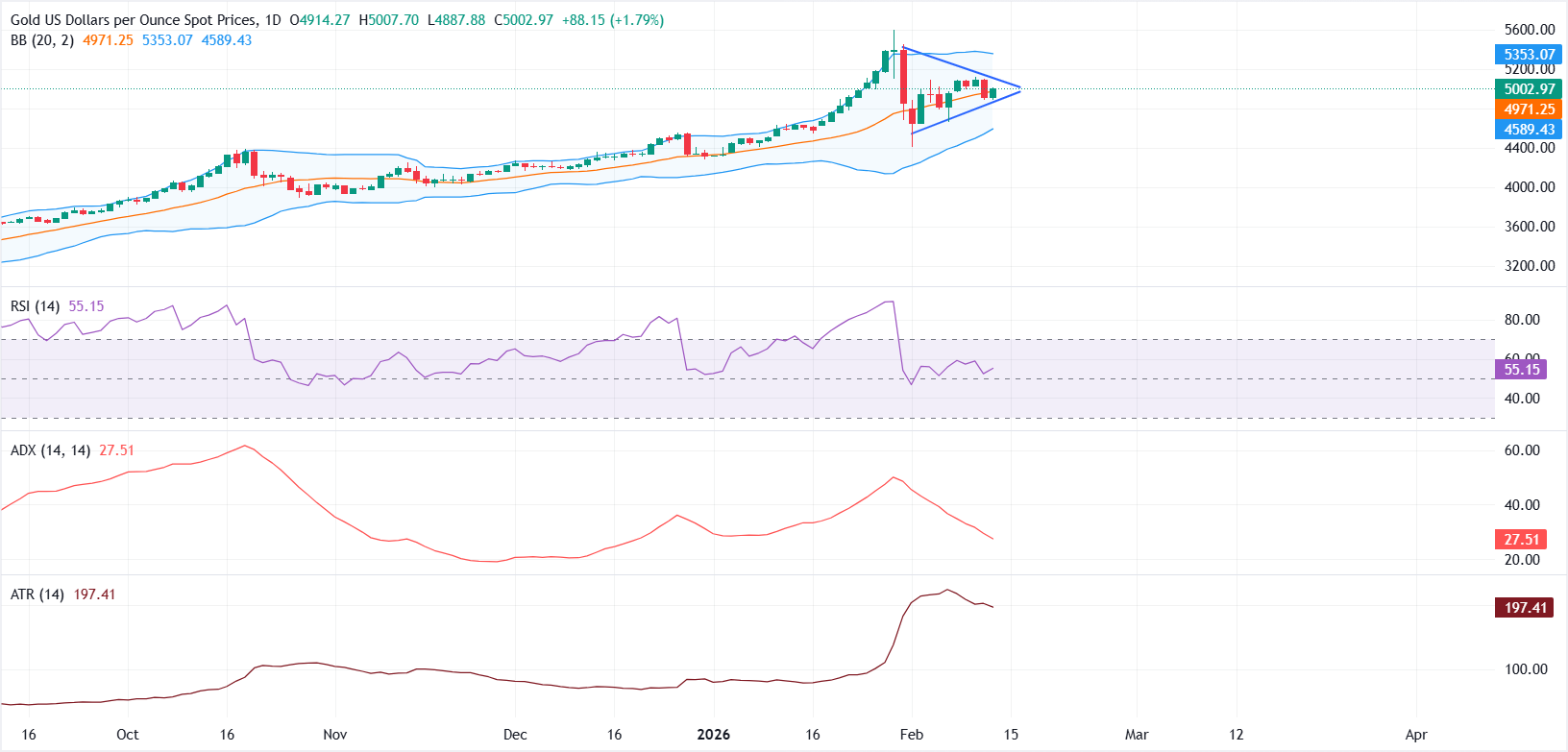
XAU/USD remains in consolidation on the daily chart after the sharp pullback from record highs. Prices are hovering above the 20-day simple moving average (SMA), which also aligns with the middle Bollinger Band at $4,969.20.
Bollinger Bands continue to widen, with the upper band at $5,350.76 and the lower band at $4,587.64, indicating elevated volatility as price gravitates toward the middle line. The Relative Strength Index (RSI) at 53.92 is neutral, signalling balanced momentum.
A failure to sustain gains above the 20-day SMA would keep downside pressure in place, with initial support seen around the $4,800 zone, followed by the lower Bollinger Band near $4,588.
On the upside, bulls would need a clear break above the $5,000-$5,100 area to revive bullish momentum.
(The technical analysis of this story was written with the help of an AI tool.)
Fed FAQs
Monetary policy in the US is shaped by the Federal Reserve (Fed). The Fed has two mandates: to achieve price stability and foster full employment. Its primary tool to achieve these goals is by adjusting interest rates. When prices are rising too quickly and inflation is above the Fed’s 2% target, it raises interest rates, increasing borrowing costs throughout the economy. This results in a stronger US Dollar (USD) as it makes the US a more attractive place for international investors to park their money. When inflation falls below 2% or the Unemployment Rate is too high, the Fed may lower interest rates to encourage borrowing, which weighs on the Greenback.
The Federal Reserve (Fed) holds eight policy meetings a year, where the Federal Open Market Committee (FOMC) assesses economic conditions and makes monetary policy decisions. The FOMC is attended by twelve Fed officials – the seven members of the Board of Governors, the president of the Federal Reserve Bank of New York, and four of the remaining eleven regional Reserve Bank presidents, who serve one-year terms on a rotating basis.
In extreme situations, the Federal Reserve may resort to a policy named Quantitative Easing (QE). QE is the process by which the Fed substantially increases the flow of credit in a stuck financial system. It is a non-standard policy measure used during crises or when inflation is extremely low. It was the Fed’s weapon of choice during the Great Financial Crisis in 2008. It involves the Fed printing more Dollars and using them to buy high grade bonds from financial institutions. QE usually weakens the US Dollar.
Quantitative tightening (QT) is the reverse process of QE, whereby the Federal Reserve stops buying bonds from financial institutions and does not reinvest the principal from the bonds it holds maturing, to purchase new bonds. It is usually positive for the value of the US Dollar.

超過一百萬用戶依賴 FXStreet 獲取即時市場數據、圖表工具、專家洞見與外匯新聞。其全面的經濟日曆與教育網路研討會協助交易者保持資訊領先、做出審慎決策。FXStreet 擁有約 60 人的團隊,分布於巴塞隆納總部及全球各地。
閱讀更多








