

USD/INR clings to gains as receding Greenland disputes boost US Dollar
作者 Sagar Dua
發布日期: 22 Jan 2026 | 修改日期: 22 Jan 2026


熱門文章

The Indian Rupee (INR) holds onto losses near its all-time low against the US Dollar (USD) on Thursday.
- The Indian Rupee remains on the back foot against the US Dollar due to multiple headwinds.
- The US Dollar gains on receding geopolitical and trade tensions between the US and the EU.
- FIIs continue to offload their stakes in the Indian stock market.
The Indian Rupee (INR) holds onto losses near its all-time low against the US Dollar (USD) on Thursday. The USD/INR pair trades marginally below the lifetime high of 92.00 posted on Wednesday as continuous selling pressure in the Indian stock market from overseas investors keeps battering the Indian currency.
Foreign Institutional Investors (FIIs) continue to pare their stakes in the Indian equity market due to the United States (US)- India trade deal stalemate.
So far in January, FIIs have remained net sellers in 13 of 14 trading days, offloading stakes worth Rs. 34,041.21 crore.
On the domestic front, investors await the preliminary HSBC Composite Purchasing Managers’ Index (PMI) data for January, which will be released on Friday. Investors will closely monitor the data to get fresh cues about the economy’s overall demand ahead of the Financial Year (FY) 2026-2027 fiscal budget announcement on February 1.
The table below shows the percentage change of Indian Rupee (INR) against listed major currencies today. Indian Rupee was the weakest against the Australian Dollar.
| USD | EUR | GBP | JPY | CAD | AUD | INR | CHF | |
|---|---|---|---|---|---|---|---|---|
| USD | -0.02% | -0.02% | 0.25% | -0.07% | -0.59% | 0.07% | -0.08% | |
| EUR | 0.02% | -0.00% | 0.28% | -0.05% | -0.58% | 0.07% | -0.06% | |
| GBP | 0.02% | 0.00% | 0.28% | -0.05% | -0.57% | 0.10% | -0.06% | |
| JPY | -0.25% | -0.28% | -0.28% | -0.32% | -0.82% | -0.21% | -0.32% | |
| CAD | 0.07% | 0.05% | 0.05% | 0.32% | -0.51% | 0.11% | -0.01% | |
| AUD | 0.59% | 0.58% | 0.57% | 0.82% | 0.51% | 0.62% | 0.51% | |
| INR | -0.07% | -0.07% | -0.10% | 0.21% | -0.11% | -0.62% | -0.14% | |
| CHF | 0.08% | 0.06% | 0.06% | 0.32% | 0.01% | -0.51% | 0.14% |
The heat map shows percentage changes of major currencies against each other. The base currency is picked from the left column, while the quote currency is picked from the top row. For example, if you pick the Indian Rupee from the left column and move along the horizontal line to the US Dollar, the percentage change displayed in the box will represent INR (base)/USD (quote).
Daily Digest Market Movers: Trump drops tariff threats, plans of US military action
- A strong recovery move in the US Dollar due to easing geopolitical and trade tensions between the US and the European Union (EU) is also strengthening USD/INR. As of writing, the US Dollar Index (DXY), which tracks the Greenback’s value against six major currencies, clings to gains near Wednesday’s high around 98.80.
- The US Dollar attracted significant bids on Wednesday after US President Donald Trump dropped his plans of military action and tariff threats on EU members for Greenland’s acquisition.
- Speaking at the World Economic Forum (WEF) in Davos on Wednesday, Trump said that “I won't use force” to purchase Greenland, but is “seeking immediate negotiations” to discuss its acquisition.
- US President Trump also confirmed his plans of dropping Greenland’s forceful acquisition through a post on Truth.Social, after meeting with the Secretary General of NATO, Mark Rutte. Trump added that Washington and NATO have formed the framework of a “future deal with respect to Greenland, and in fact, the entire Arctic Region”.
- Last weekend, US President Trump announced 10% tariffs on several EU nations and the United Kingdom (UK) for opposing Washington’s plans to possess Greenland, and warned that import duties could be increased further unless a deal is reached. The event led to a sharp decline in the demand for riskier assets and the US Dollar, while heightening concerns of a trade war between the world’s largest economies.
- Meanwhile, investors await the US Personal Consumption Expenditure Prices Index (PCE) data for October and November, which will be published at 15:00 GMT. The impact of the Federal Reserve’s (Fed) preferred inflation gauge on expectations for the monetary policy outlook will be limited, as it doesn't cover price changes of latest months.
Technical Analysis: USD/INR stays close to all-time highs near 92.00
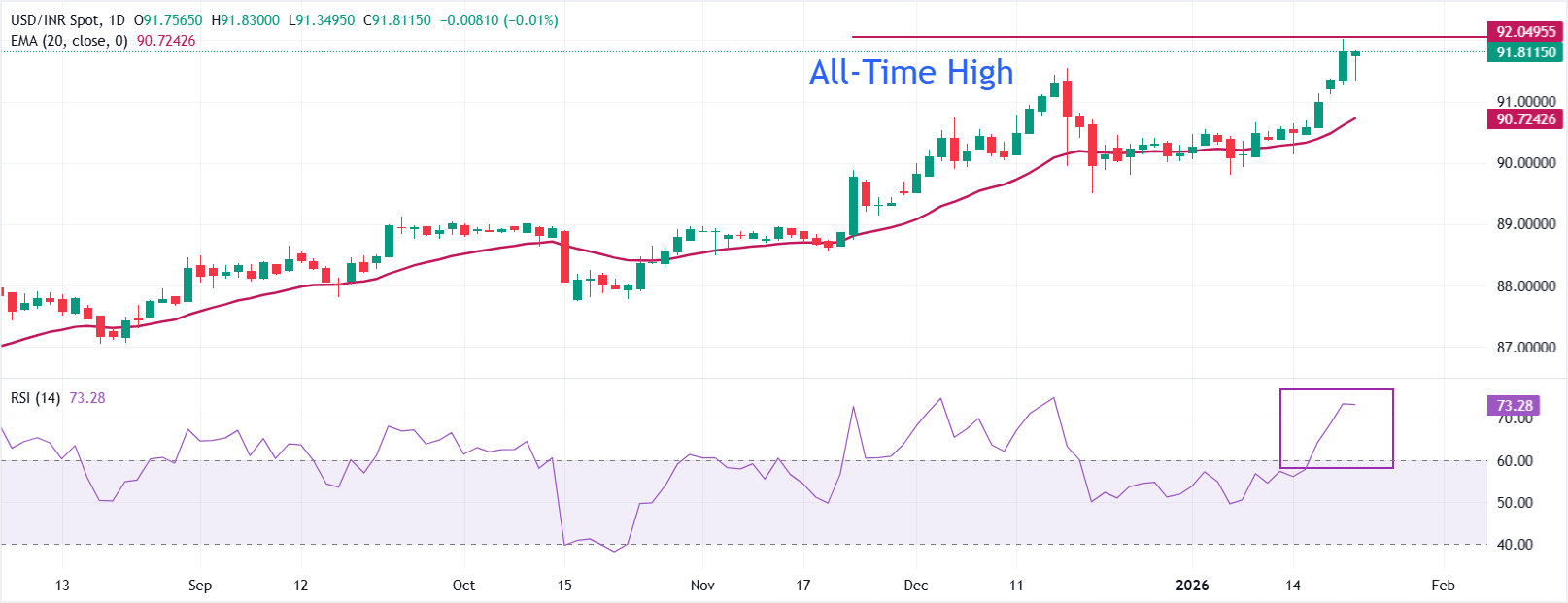
USD/INR trades firmly near 91.81 as of writing. The pair holds above a rising 20-day Exponential Moving Average (EMA), preserving a firm bullish bias. The 20-day EMA continues to slope higher, confirming trend strength.
The 14-day Relative Strength Index (RSI) at 73.28 (overbought) highlights stretched momentum after the latest advance. Initial support sits at the 20-day EMA at 90.72, and while above this gauge, the path of least resistance would remain higher.
Should buyers defend the 20-day EMA at 90.72, the advance would extend, though the overbought oscillator could cap momentum until it cools. A daily close below that average would warn of a loss of trend control, with RSI slipping under 70, flagging a broader pullback.
(The technical analysis of this story was written with the help of an AI tool.)
Indian economy FAQs
The Indian economy has averaged a growth rate of 6.13% between 2006 and 2023, which makes it one of the fastest growing in the world. India’s high growth has attracted a lot of foreign investment. This includes Foreign Direct Investment (FDI) into physical projects and Foreign Indirect Investment (FII) by foreign funds into Indian financial markets. The greater the level of investment, the higher the demand for the Rupee (INR). Fluctuations in Dollar-demand from Indian importers also impact INR.
India has to import a great deal of its Oil and gasoline so the price of Oil can have a direct impact on the Rupee. Oil is mostly traded in US Dollars (USD) on international markets so if the price of Oil rises, aggregate demand for USD increases and Indian importers have to sell more Rupees to meet that demand, which is depreciative for the Rupee.
Inflation has a complex effect on the Rupee. Ultimately it indicates an increase in money supply which reduces the Rupee’s overall value. Yet if it rises above the Reserve Bank of India’s (RBI) 4% target, the RBI will raise interest rates to bring it down by reducing credit. Higher interest rates, especially real rates (the difference between interest rates and inflation) strengthen the Rupee. They make India a more profitable place for international investors to park their money. A fall in inflation can be supportive of the Rupee. At the same time lower interest rates can have a depreciatory effect on the Rupee.
India has run a trade deficit for most of its recent history, indicating its imports outweigh its exports. Since the majority of international trade takes place in US Dollars, there are times – due to seasonal demand or order glut – where the high volume of imports leads to significant US Dollar- demand. During these periods the Rupee can weaken as it is heavily sold to meet the demand for Dollars. When markets experience increased volatility, the demand for US Dollars can also shoot up with a similarly negative effect on the Rupee.

超過一百萬用戶依賴 FXStreet 獲取即時市場數據、圖表工具、專家洞見與外匯新聞。其全面的經濟日曆與教育網路研討會協助交易者保持資訊領先、做出審慎決策。FXStreet 擁有約 60 人的團隊,分布於巴塞隆納總部及全球各地。
閱讀更多








