

Trade The World
EUR/USD Price Forecast: Bearish momentum fades, 1.1700 caps recovery
作者 Vishal Chaturvedi
發布日期: 13 Jan 2026 | 修改日期: 13 Jan 2026


POPULAR ARTICLES

The Euro (EUR) regains traction against the US Dollar (USD) at the start of the week, as renewed weakness in the Greenback lifts EUR/USD away from one-month lows. At the time of writing, the pair trades around 1.1676, up nearly 0.36% on the day, snapping a seven-day losing streak.
- EUR/USD snaps a seven-day losing streak as the Greenback comes under broad pressure.
- Concerns over Fed independence weigh on the US Dollar.
- Technically, the pair shows fading bearish momentum but lacks bullish conviction below the 1.1700 psychological level.
The Euro (EUR) regains traction against the US Dollar (USD) at the start of the week, as renewed weakness in the Greenback lifts EUR/USD away from one-month lows. At the time of writing, the pair trades around 1.1676, up nearly 0.36% on the day, snapping a seven-day losing streak.
The US Dollar came under sharp selling pressure after reports that the US Department of Justice had served subpoenas and threatened a criminal indictment against Federal Reserve (Fed) Chair Jerome Powell, linked to his congressional testimony on the Fed’s headquarters renovation project.
The development has raised fresh concerns over the Fed’s independence, prompting investors to trim exposure to the Greenback and rotate into other major currencies, lifting several G10 FX pairs at the start of the week.
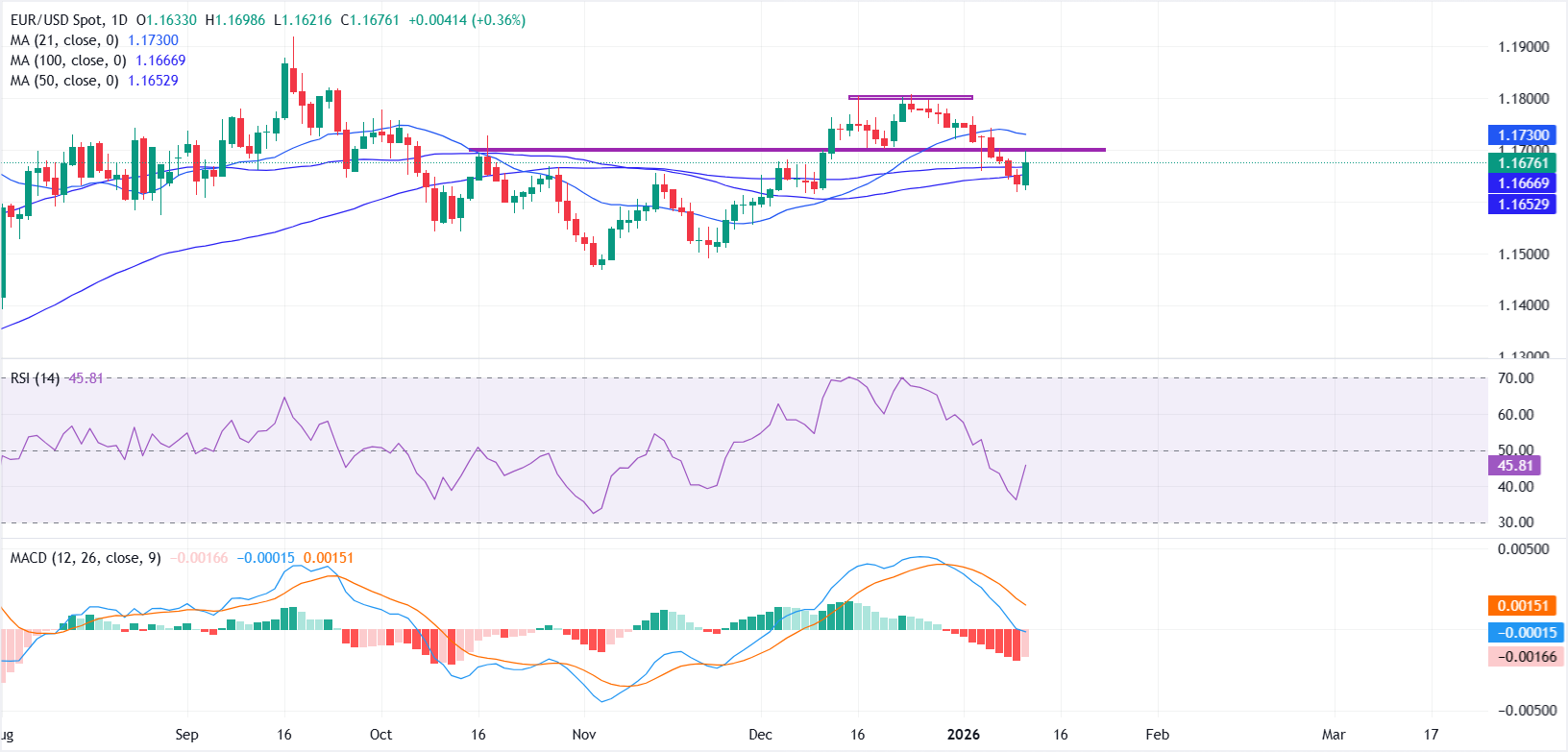
From a technical standpoint, EUR/USD is showing early signs of stabilization after last week’s slide to one-month lows, although the near-term picture remains mixed.
On the daily chart, the pair is holding above the 50-day and 100-day Simple Moving Averages (SMAs), which are both flattening near the 1.1670-1.1650 zone, while the 1.1700 psychological mark is capping immediate upside attempts.
A decisive break above 1.1700 would shift the near-term technical structure to the upside and open the door for a move toward the 21-day SMA near 1.1730, with scope for a further advance toward the 1.1800 region, where sellers previously emerged.
On the downside, a failure to hold above the 1.1650 region would keep the near-term bias tilted to the downside, exposing the 1.1600 psychological support. A deeper pullback could then bring the 1.1550 area back into focus.
Momentum indicators echo the lack of a clear directional bias. The Moving Average Convergence Divergence (MACD) remains below its signal line and under the zero mark, although the contracting negative histogram suggests that bearish momentum is fading.
Meanwhile, the Relative Strength Index (RSI) hovers near 47, in neutral territory, indicating limited directional conviction unless the indicator reclaims the 50 threshold.
Euro FAQs
The Euro is the currency for the 20 European Union countries that belong to the Eurozone. It is the second most heavily traded currency in the world behind the US Dollar. In 2022, it accounted for 31% of all foreign exchange transactions, with an average daily turnover of over $2.2 trillion a day. EUR/USD is the most heavily traded currency pair in the world, accounting for an estimated 30% off all transactions, followed by EUR/JPY (4%), EUR/GBP (3%) and EUR/AUD (2%).
The European Central Bank (ECB) in Frankfurt, Germany, is the reserve bank for the Eurozone. The ECB sets interest rates and manages monetary policy. The ECB’s primary mandate is to maintain price stability, which means either controlling inflation or stimulating growth. Its primary tool is the raising or lowering of interest rates. Relatively high interest rates – or the expectation of higher rates – will usually benefit the Euro and vice versa. The ECB Governing Council makes monetary policy decisions at meetings held eight times a year. Decisions are made by heads of the Eurozone national banks and six permanent members, including the President of the ECB, Christine Lagarde.
Eurozone inflation data, measured by the Harmonized Index of Consumer Prices (HICP), is an important econometric for the Euro. If inflation rises more than expected, especially if above the ECB’s 2% target, it obliges the ECB to raise interest rates to bring it back under control. Relatively high interest rates compared to its counterparts will usually benefit the Euro, as it makes the region more attractive as a place for global investors to park their money.
Data releases gauge the health of the economy and can impact on the Euro. Indicators such as GDP, Manufacturing and Services PMIs, employment, and consumer sentiment surveys can all influence the direction of the single currency. A strong economy is good for the Euro. Not only does it attract more foreign investment but it may encourage the ECB to put up interest rates, which will directly strengthen the Euro. Otherwise, if economic data is weak, the Euro is likely to fall. Economic data for the four largest economies in the euro area (Germany, France, Italy and Spain) are especially significant, as they account for 75% of the Eurozone’s economy.
Another significant data release for the Euro is the Trade Balance. This indicator measures the difference between what a country earns from its exports and what it spends on imports over a given period. If a country produces highly sought after exports then its currency will gain in value purely from the extra demand created from foreign buyers seeking to purchase these goods. Therefore, a positive net Trade Balance strengthens a currency and vice versa for a negative balance.

FXStreet
超過一百萬用戶依賴 FXStreet 獲取即時市場數據、圖表工具、專家洞見與外匯新聞。其全面的經濟日曆與教育網路研討會協助交易者保持資訊領先、做出審慎決策。FXStreet 擁有約 60 人的團隊,分布於巴塞隆納總部及全球各地。
Read More








