 Purpose and Mechanism
Controlling Inflation
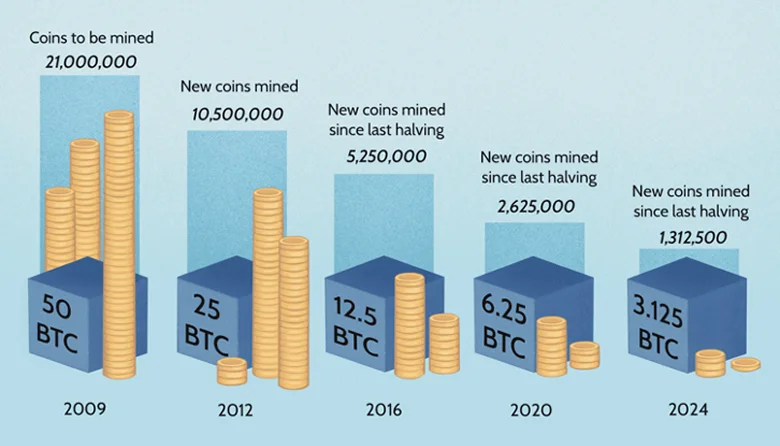
Unlike traditional fiat currencies, which can be printed in unlimited quantities by central banks, Bitcoin's design incorporates a deflationary model. Halving events systematically reduces the rate at which new bitcoins are introduced into circulation, aiming to curb potential inflation. This controlled supply growth ensures that, over time, the creation of new bitcoins slows down, contrasting sharply with the often unpredictable expansion of fiat money supplies.
Simulating Scarcity
Bitcoin's maximum supply is capped at 21 million coins. The halving mechanism reinforces this scarcity by decreasing the influx of new bitcoins, making existing coins more valuable as demand increases. This scarcity is akin to precious metals like gold, where limited availability contributes to their value.
Gradual Supply Distribution
In Bitcoin's early stages, miners received substantial rewards, incentivizing participation and securing the network. As halvings occur, these rewards diminish, extending the period over which the total supply is distributed.
This gradual reduction ensures that most bitcoins are mined over a prolonged timeframe, with the final bitcoin expected to be mined around the year 2140.
Enhancing Value Proposition
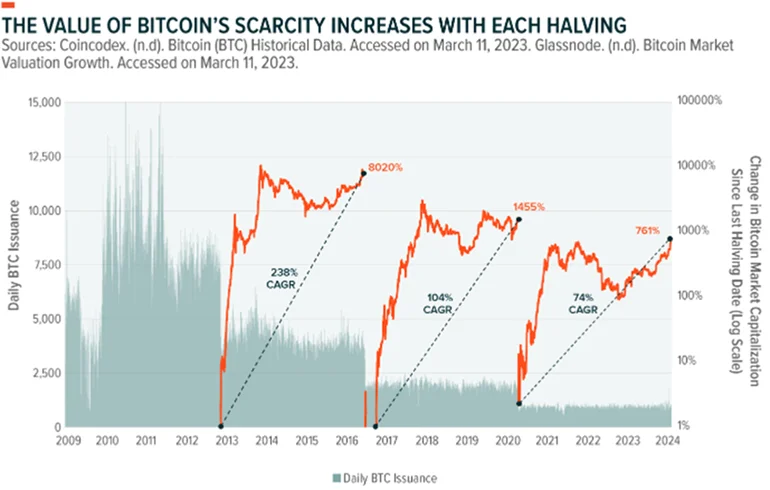
The interplay of reduced supply growth and sustained or increasing demand theoretically supports the appreciation of Bitcoin's value over time. As new issuance decreases, if demand remains constant or rises, economic principles suggest an upward price pressure, enhancing Bitcoin's appeal as a store of value.
Historical Context of Previous Halvings
Since its inception, Bitcoin has undergone four halving events, each leaving a significant imprint on its market dynamics and valuation.
The 2024 Halving: Key Details
Key Bitcoin Halving Events
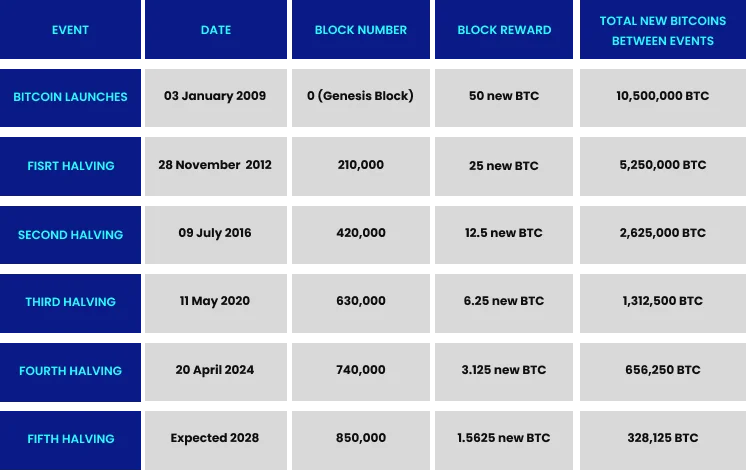
First Bitcoin Halving (November 28, 2012)
Block Reward Reduction: From 50 BTC to 25 BTC
Pre-Halving Price: Approximately $12
Price One Year Later: Around $1,000
Percentage Increase: Approximately 8,000%
The inaugural halving marked Bitcoin's transition from a niche digital asset to gaining broader attention. The substantial price surge post-halving highlighted the impact of reduced supply on market valuation.
Second Bitcoin Halving (July 9, 2016)
Block Reward Reduction: From 25 BTC to 12.5 BTC
Pre-Halving Price: Approximately $650
Price One Year Later: Around $2,500
Percentage Increase: Approximately 280%
The second halving occurred as Bitcoin was gaining mainstream recognition. While the percentage increase was less dramatic than the first, it reinforced the pattern of post-halving appreciation, albeit with diminishing returns as the market matured.
Third Bitcoin Halving (May 11, 2020)
Block Reward Reduction: From 12.5 BTC to 6.25 BTC
Pre-Halving Price: Approximately $8,800
Price One Year Later: Around $49,500
Percentage Increase: Approximately 460%
The third halving took place amidst growing institutional interest and global economic uncertainty. The significant price increase post-halving underscored Bitcoin's emerging role as a hedge against traditional financial market volatility.
Fourth Bitcoin Bitcoin Halving (April 20, 2024)
The fourth Bitcoin halving occurred on April 20, 2024, at a block height of 840,000, reducing the block reward from 6.25 BTC to 3.125 BTC. This event carried several critical implications for the Bitcoin ecosystem.
Technical Specifications
Current Block Reward: 6.25 BTC
Post-Halving Block Reward: 3.125 BTC
New Bitcoins Created Between Third and Fourth Halvings: 1,312,500 BTC
New Bitcoins to Be Created Between Fourth and Fifth Halvings: 656,250 BTC
This reduction signifies a continued deceleration in the rate of new Bitcoin issuance, reinforcing its deflationary nature.
Market Implications
Increased Market Maturity
Since the last halving in 2020, Bitcoin's market has evolved significantly. Institutional adoption has surged, with major financial entities integrating Bitcoin into their portfolios. Additionally, the development of regulated futures markets and exchange-traded funds (ETFs) has provided investors with more avenues to gain exposure to Bitcoin, potentially reducing volatility compared to previous cycles.

Miner Economics
The Bitcoin halving will directly impact miners by slashing their rewards by half. This reduction necessitates reevaluating operational costs, particularly for miners with higher electricity expenses or less efficient hardware. Potential outcomes include:
Consolidation Among Mining Entities: Smaller or less efficient operations may merge or exit the market.
Increased Reliance on Transaction Fees: As block rewards diminish, miners may depend more on transaction fees for revenue.
Geographical Shifts in Mining Operations: Miners might relocate to regions with more favorable energy costs to maintain profitability.
Supply Shock
The daily issuance of new bitcoins will decrease from approximately 900 BTC to 450 BTC. Assuming steady or rising demand, this reduction in new supply could exert upward pressure on Bitcoin's price as the market adjusts to the decreased availability of new coins.
Anticipatory Market Behavior
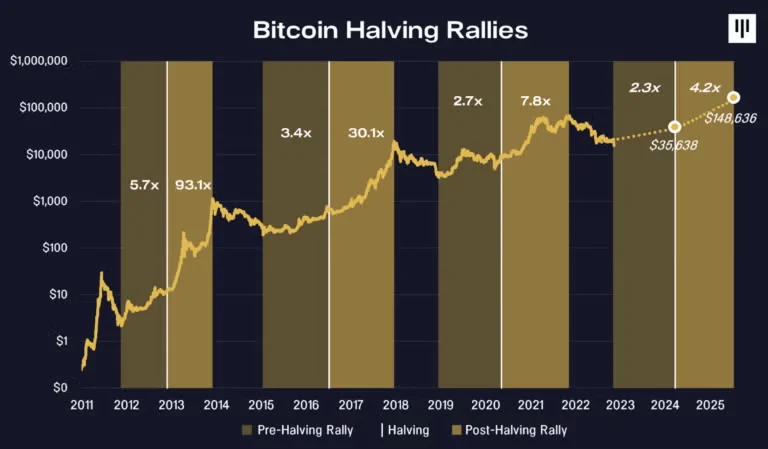
Historically, Bitcoin's price has often begun to rise months before a halving event as market participants anticipate the reduced supply. This pre-halving speculation can increase volatility and trading volumes as investors position themselves ahead of the event.
Market Predictions and Analysis
The Bitcoin halving presented a complex landscape for analysts and investors, with various factors influencing potential outcomes.
Supply-Demand Dynamics
From a fundamental perspective, the halving reduces the rate at which new bitcoins enter circulation. If demand remains constant or increases, this supply reduction could lead to price appreciation. However, market dynamics are influenced by myriad factors, including macroeconomic conditions, regulatory developments, and technological advancements.
Stock-to-Flow Model Implications
The Stock-to-Flow (S2F) model, which assesses an asset's scarcity by comparing its existing supply to the new production rate, has been applied to Bitcoin to forecast price movements. Bitcoin's S2F ratio will increase post-halving, suggesting potential for price appreciation. However, critics argue that the model oversimplifies complex market dynamics and may not account for external factors affecting price.
Market Efficiency Considerations
Efficient Market Hypothesis (EMH) proponents argue that because halvings are predictable events, their effects should already be priced into the market. However, the tangible reduction in supply and the psychological impact on investors often lead to market reactions that deviate from purely efficient models.
Maturity and Adoption Factors
The maturation of the Bitcoin market introduces new variables:
Institutional Adoption: Increased participation by institutional investors can lead to greater liquidity and potentially reduced volatility.
Regulatory Developments: Evolving regulations can either bolster confidence and adoption or introduce uncertainties that impact market sentiment.
Technological Innovations: Scalability, security, and usability advances can enhance Bitcoin's value proposition and attract a broader user base.
Trading Strategies for the Halving Period
Long-Term Accumulation
A common strategy around Bitcoin halvings is long-term accumulation. Historical patterns suggest that purchasing Bitcoin several months before a halving and holding through the subsequent cycle has yielded significant returns. This approach hinges on the expectation that the reduced supply issuance will drive prices higher over time.
Volatility Trading
Bitcoin halvings typically introduce heightened volatility, presenting opportunities for traders who engage in short-term speculation. Strategies include:
Swing Trading: Buying Bitcoin at perceived low points and selling during price spikes.
Leverage Trading: Utilizing margins or derivatives like futures contracts and options to amplify potential gains (though these carry high risk).
Scalping: Capitalizing on minor price movements throughout the trading day.
Mining Company Investments
For those who prefer indirect exposure to Bitcoin, investing in publicly traded Bitcoin mining companies is another option. Mining firms' stock prices often correlate with Bitcoin's price movements, offering alternative risk-reward profiles. Post-halving, profitable mining firms may consolidate market share, potentially leading to stock price appreciation.
Risk Management Considerations
Regardless of strategy, managing risk is crucial. Best practices include:
Using Stop-Loss Orders: Protecting capital by setting predetermined exit points.
Diversification: Avoid over-concentration in Bitcoin by allocating capital across various assets.
Portfolio Sizing: Ensuring Bitcoin exposure aligns with individual risk tolerance.
Hedging with Options: Utilizing put options to mitigate downside risks.
Bitcoin Mining Industry Impact
Profitability Challenges
The halving will reduce block rewards from 6.25 BTC to 3.125 BTC, significantly impacting miners' revenue streams. Profitability will depend on:
Electricity Costs: Lower costs will give some miners a competitive advantage.
Mining Equipment Efficiency: Firms with the latest ASIC miners will likely remain profitable.
Bitcoin Price Movements: A rising Bitcoin price post-halving could offset revenue reductions.
Network Difficulty Adjustments: If many miners exit, the network may adjust mining difficulty downward, reducing competition for remaining participants.
Industry Consolidation
With profitability under pressure, smaller mining operations may shut down or merge with larger firms. This consolidation could shift Bitcoin mining dominance to well-capitalized entities with access to cheap electricity and efficient hardware.
Technological Innovations
The necessity for improved profitability may drive miners to adopt innovative solutions, including:
More Energy-Efficient Mining Hardware: Reducing power consumption while maintaining high computational power.
Renewable Energy Mining: Expanding mining operations in regions with abundant hydro, solar, or wind energy.
Strategic Relocations: Moving operations to jurisdictions with favorable electricity pricing.
Increased Dependence on Transaction Fees
As block rewards decline, transaction fees will become a larger component of miner revenue. This shift raises questions about long-term network security and miner incentives, particularly as Bitcoin moves closer to its maximum supply limit.
Long-Term Implications of the 2024 Halving
Decreasing the Bitcoin Inflation Rate
Bitcoin’s annual inflation rate will drop to approximately 0.8% post-halving, making it one of the lowest inflationary assets globally. This reinforces Bitcoin’s potential role as "digital gold," offering a hedge against inflationary fiat currencies.
Security and Network Incentives
Bitcoin’s security relies on mining incentives. As block rewards diminish, network security must increasingly be maintained through transaction fees. Several factors could help sustain security:
Higher BTC Prices: Higher valuation compensates for lower block rewards.
Increased Transaction Volumes: More transactions leading to higher total fees.
Efficiency Improvements in Mining Technology: Enhancing cost-effectiveness of mining operations.
Bitcoin’s Path to Monetary Hardness
With each halving, Bitcoin approaches its final state as a hard-capped digital asset. By 2024, approximately 94% of all bitcoins have been mined. The remaining supply will be issued at an increasingly slower pace, extending over the next 115+ years. This characteristic strengthens Bitcoin’s appeal as a scarce asset with predictable issuance.
Bitcoin halvings occur approximately every four years, or after 210,000 blocks have been mined. This systematic reduction in mining rewards is built into Bitcoin’s protocol to regulate supply issuance and maintain scarcity.
When is the Next Bitcoin Halving?

How is the Next Bitcoin Halving Date Calculated?
The exact date of the next Bitcoin halving depends on the block time, which is the average time required to mine a new block. Bitcoin’s block time typically averages around 10 minutes, but variations due to mining difficulty adjustments can cause slight deviations in the estimated halving date.
Impact of the Next Bitcoin Halving on the Market
The next Bitcoin halving could have profound effects on:
Bitcoin’s Price: Historical trends suggest that Bitcoin prices tend to appreciate following a halving due to reduced supply issuance.
Mining Profitability: Lower block rewards will challenge mining operations, especially those with high operational costs.
Investor Sentiment: Increased media coverage and market speculation could drive heightened interest and volatility in the months leading up to and after the halving.
When is the Bitcoin Halving After 2024?
Given the current block production rate, the subsequent Bitcoin halving is expected to occur in 2028 at block 950,000, reducing block rewards further to 1.5625 BTC. This process will continue approximately every four years until around 2140 when the final Bitcoin is expected to be mined.
The Bitcoin halving is a critical milestone in Bitcoin’s monetary policy, influencing supply dynamics, miner economics, and overall market behavior. While historical trends indicate a post-halving price increase, Bitcoin’s maturing market introduces new complexities, including institutional participation, regulatory developments, and evolving miner incentives.
Understanding the nuances of Bitcoin halving is essential for investors and traders. Whether employing long-term accumulation strategies, leveraging market volatility, or considering mining-related investments, a well-researched approach will be crucial in navigating the 2024 halving cycle. As Bitcoin continues evolving, its halvings will remain central to its economic model and broader financial narrative.
Free Crypto Trading Courses and Resources
Becoming a successful crypto trader requires knowledge, strategy, and practice. TMGM provides everything you need to succeed, offering free trading courses and webinars tailored for crypto traders.
Get hands-on experience with a free demo account loaded with US$100,000 in virtual funds. This allows you to build confidence in a risk-free environment before trading real capital.