

GBP/USD extends mean reversion as investors brace for Fed
作者 Joshua Gibson
發布日期: 10 Dec 2025 | 修改日期: 10 Dec 2025


熱門文章

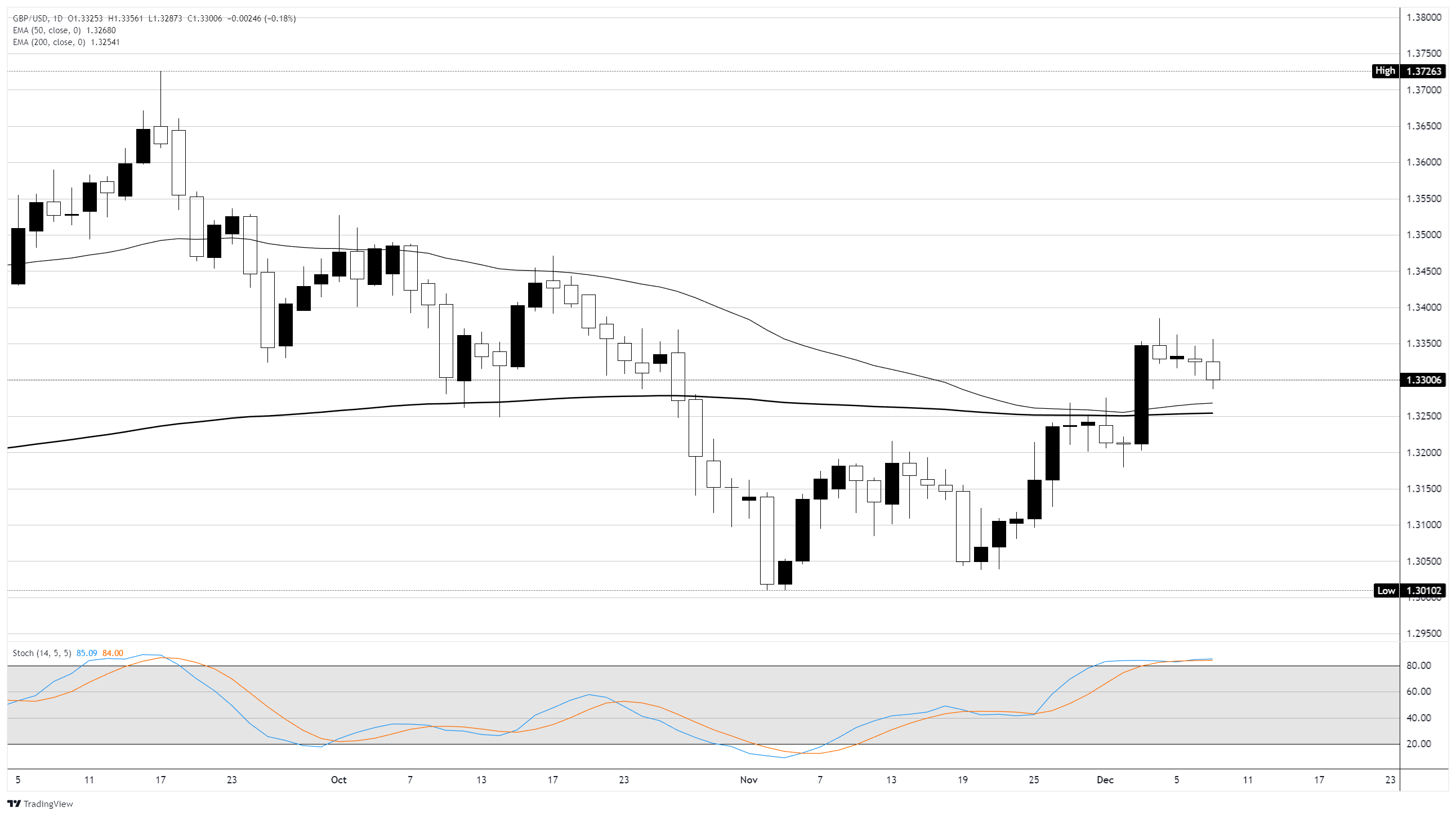
GBP/USD eased back toward the midrange on Tuesday, shedding around one-fifth of one percent after facing an intraday technical rejection from the 1.3350 level.
- GBP/USD sank back into the 1.3300 region on Tuesday.
- Cable traders are buckling down for the latest interest rate decision from the Fed.
- A December rate cut is fully priced in, but investors are on the lookout for tonal shifts on policy.
GBP/USD eased back toward the midrange on Tuesday, shedding around one-fifth of one percent after facing an intraday technical rejection from the 1.3350 level. Price action has slumped back into the 1.3300 handle and is holding just north of the long-term 200-day Exponential Moving Average (EMA) near 1.3250 as markets hunker down for the last Federal Reserve (Fed) interest rate decision of 2025.
Fed on deck, rate cut expected but tone matters
Investors are mainly focused on the Fed's interest rate decision scheduled for December 10, which is widely anticipated to result in a third consecutive quarter-point reduction. Fed funds futures currently suggest about an 87% probability of a cut, a significant increase from a month earlier. Market participants believe that the outcome of this rate decision, along with Fed Chair Jerome Powell’s messaging in one of his final press conferences before the rate decision, could influence market sentiment for the rest of December. This is especially true as markets grapple with persistent inflation, delayed economic data, and the ongoing transition toward new Fed leadership in 2026.
Beyond this immediate decision, analysts note that markets are already eyeing the next phase of Fed leadership and potential shifts in communication strategies amidst a year marked by unpredictable expectations. With the Fed’s dual mandate still under pressure from uneven inflation and slowing labor markets, investors are keenly observing whether policymakers can keep an accommodative approach in 2026 or if economic conditions will necessitate a more cautious stance.
BoE lurks around the corner
This week, UK economic data releases are quite subdued, but the Pound Sterling will prepare for a busy schedule next week, leading up to a possible interest rate cut by the Bank of England (BoE). The BoE's policy positions are generally more diverse than the often cautious statements from the US Federal Reserve. However, BoE officials have been increasingly open to the idea of further rate cuts, especially since the latest Monetary Policy Committee (MPC) meeting, where a narrow majority decided to keep rates unchanged.
GBP/USD daily chart
Pound Sterling FAQs
The Pound Sterling (GBP) is the oldest currency in the world (886 AD) and the official currency of the United Kingdom. It is the fourth most traded unit for foreign exchange (FX) in the world, accounting for 12% of all transactions, averaging $630 billion a day, according to 2022 data. Its key trading pairs are GBP/USD, also known as ‘Cable’, which accounts for 11% of FX, GBP/JPY, or the ‘Dragon’ as it is known by traders (3%), and EUR/GBP (2%). The Pound Sterling is issued by the Bank of England (BoE).
The single most important factor influencing the value of the Pound Sterling is monetary policy decided by the Bank of England. The BoE bases its decisions on whether it has achieved its primary goal of “price stability” – a steady inflation rate of around 2%. Its primary tool for achieving this is the adjustment of interest rates. When inflation is too high, the BoE will try to rein it in by raising interest rates, making it more expensive for people and businesses to access credit. This is generally positive for GBP, as higher interest rates make the UK a more attractive place for global investors to park their money. When inflation falls too low it is a sign economic growth is slowing. In this scenario, the BoE will consider lowering interest rates to cheapen credit so businesses will borrow more to invest in growth-generating projects.
Data releases gauge the health of the economy and can impact the value of the Pound Sterling. Indicators such as GDP, Manufacturing and Services PMIs, and employment can all influence the direction of the GBP. A strong economy is good for Sterling. Not only does it attract more foreign investment but it may encourage the BoE to put up interest rates, which will directly strengthen GBP. Otherwise, if economic data is weak, the Pound Sterling is likely to fall.
Another significant data release for the Pound Sterling is the Trade Balance. This indicator measures the difference between what a country earns from its exports and what it spends on imports over a given period. If a country produces highly sought-after exports, its currency will benefit purely from the extra demand created from foreign buyers seeking to purchase these goods. Therefore, a positive net Trade Balance strengthens a currency and vice versa for a negative balance.

超過一百萬用戶依賴 FXStreet 獲取即時市場數據、圖表工具、專家洞見與外匯新聞。其全面的經濟日曆與教育網路研討會協助交易者保持資訊領先、做出審慎決策。FXStreet 擁有約 60 人的團隊,分布於巴塞隆納總部及全球各地。
閱讀更多








