

Trade The World
BoJ's Ueda: Japan's economy recovering moderately albeit with some weakness
作者 Dhwani Mehta
發布日期: 31 Jul 2025 | 修改日期: 31 Jul 2025


POPULAR ARTICLES
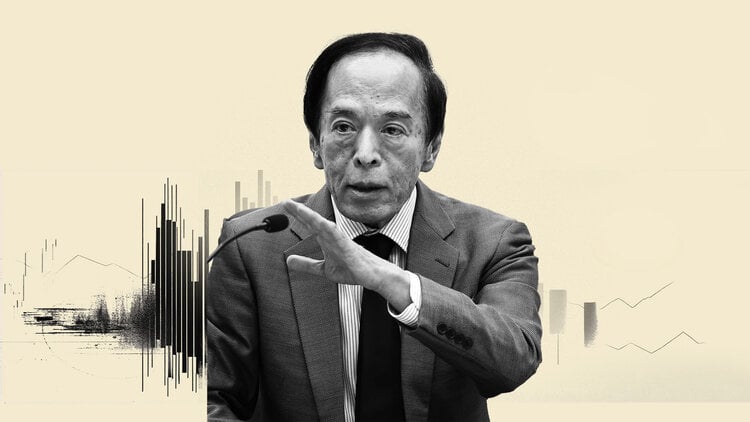
Bank of Japan (BoJ) Governor Kazuo Ueda is addressing a press conference on Thursday, explaining the central bank’s decision to maintain the interest rate at 0.5% for the fourth consecutive meeting.
Bank of Japan (BoJ) Governor Kazuo Ueda is addressing a press conference on Thursday, explaining the central bank’s decision to maintain the interest rate at 0.5% for the fourth consecutive meeting.
Additional quotes
Japan-US trade deal is a great progress.
Japan's economy recovering moderately albeit with some weakness.
Easy monetary conditions will support the economy.
Japan's economic growth likely to moderate as trade policies lead to slowdown in overseas economy, decline in corporate profits.
Underlying inflation likely to stall but gradually accelerate.
Developments on trade policies and how overseas economy, price react to them are highly uncertain.
Must pay attention to trade policies' impact on financial, FX markets, Japan's economy and prices.
Will continue to raise policy rate if the economy, prices move in line with forecast, in accordance with improvements in economy, prices.
Important to judge whether outlook will be achieved without any preconception.
Latest outlook report made based on assumption that major disruptions in global supply chains will be avoided.
Underlying inflation remains below 2% but gradually rising.
Moves to pass on rising costs to prices continue.
Underlying inflation could slow down in line with slowdown in economic growth.
Japan-US trade deal reduces uncertainty over Japan's economic outlook.
No big change to central outlook that growth pace slows down, underlying inflation stalls.
We will scrutinize how trade policies impact firm's price-setting behavior.
Will make appropriate decision at each mpm while confirming risks, likelihood of our view on underlying inflation.
Seeing waves of rushing demand and countereffects regarding US tariff policy impact.
We are in a phase where impact from tariffs would become apparent though not sure about when.
Will look at data that will come out without any preconception.
Policy decision would not depend solely on new CPI forecasts.
Won't comment directly on fiscal policy.
Will carefully assess impact of fiscal policy on the economy, prices.
Will continue to closely coordinate with government.
Food inflation rate likely to dissipate.
But will scrutinize potential impact on consumer sentiment, inflation expectation.
Underlying inflation gradually rising.
Point is whether underlying inflation more likely to hit 2%.
Underlying inflation not in phase of stalling due to tariffs.
Want to scrutinize if tariffs impact Japan's manufacturers, their wages.
Rising wages at Japanese companies are becoming the norm in recent years.
Uncertainties on rate of tariff decreased but impact from tariffs still yet to emerge.
It takes time until the fog clears for firms' capex.
Market reaction
USD/JPY remains heavy following these comments. The pair was last seen trading 0.50% lower on the day near 148.70.
Bank of Japan FAQs
The Bank of Japan (BoJ) is the Japanese central bank, which sets monetary policy in the country. Its mandate is to issue banknotes and carry out currency and monetary control to ensure price stability, which means an inflation target of around 2%.
The Bank of Japan embarked in an ultra-loose monetary policy in 2013 in order to stimulate the economy and fuel inflation amid a low-inflationary environment. The bank’s policy is based on Quantitative and Qualitative Easing (QQE), or printing notes to buy assets such as government or corporate bonds to provide liquidity. In 2016, the bank doubled down on its strategy and further loosened policy by first introducing negative interest rates and then directly controlling the yield of its 10-year government bonds. In March 2024, the BoJ lifted interest rates, effectively retreating from the ultra-loose monetary policy stance.
The Bank’s massive stimulus caused the Yen to depreciate against its main currency peers. This process exacerbated in 2022 and 2023 due to an increasing policy divergence between the Bank of Japan and other main central banks, which opted to increase interest rates sharply to fight decades-high levels of inflation. The BoJ’s policy led to a widening differential with other currencies, dragging down the value of the Yen. This trend partly reversed in 2024, when the BoJ decided to abandon its ultra-loose policy stance.
A weaker Yen and the spike in global energy prices led to an increase in Japanese inflation, which exceeded the BoJ’s 2% target. The prospect of rising salaries in the country – a key element fuelling inflation – also contributed to the move.

FXStreet
超過一百萬用戶依賴 FXStreet 獲取即時市場數據、圖表工具、專家洞見與外匯新聞。其全面的經濟日曆與教育網路研討會協助交易者保持資訊領先、做出審慎決策。FXStreet 擁有約 60 人的團隊,分布於巴塞隆納總部及全球各地。
Read More








